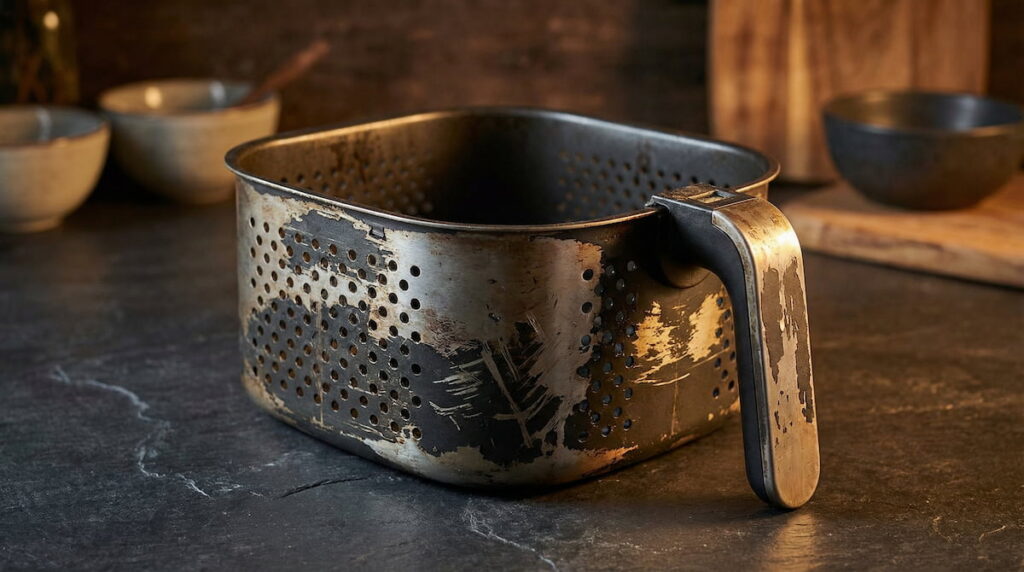
What temperature does PTFE break down? I spent a long time trying to get a straight answer to this. The number that kept coming up was 500°F — but the more I dug into it, the more I realized that number alone doesn’t tell you much without understanding what “break down” actually means, and how that compares to what’s happening inside a real air fryer during a typical cooking session.
Here’s what I found, and why it changed how I cook.
What PTFE Actually Is
PTFE stands for polytetrafluoroethylene. It’s the base material behind most nonstick coatings — including Teflon, which is DuPont’s brand name for it. If your air fryer basket has a smooth, slippery nonstick surface and isn’t labeled ceramic or stainless, there’s a good chance it has a PTFE-based coating.
At room temperature and normal cooking temperatures, PTFE is considered chemically inert. It doesn’t react with food, it doesn’t dissolve in water, and it’s been used in cookware for decades. The safety question isn’t about whether PTFE is inherently toxic — it’s about what happens when it gets hot enough to start breaking down.
That breakdown is what I wanted to understand. Because “safe at normal cooking temperatures” only means something if you know what the threshold is, and whether your air fryer stays below it.
The Breakdown Temperature — and What It Actually Means
PTFE begins to degrade at around 500°F (260°C). Below that temperature, the coating is stable. Above it, the polymer starts to break down and release byproducts — including ultrafine particles and gases that can be harmful when inhaled in sufficient quantities.
The degradation isn’t an on/off switch. It’s a progression:
| Temperature | What Happens to PTFE | Risk Level |
|---|---|---|
| Below 500°F (260°C) | Coating is stable, no meaningful degradation | Low |
| 500°F–570°F (260°C–299°C) | Early degradation begins, minor fume release possible | Moderate |
| 570°F–660°F (299°C–349°C) | Accelerated breakdown, more significant fume release | High |
| Above 660°F (349°C) | Rapid decomposition, toxic fumes — polymer fume fever risk | Serious |
Most air fryer recipes top out at 400°F–425°F on the display. That’s well below the 500°F threshold — so on paper, you should be fine.
The problem is that air fryers don’t always run at the temperature they display.
The Gap Between the Display and the Actual Temperature
This is the part that changed my thinking. The temperature shown on an air fryer’s display is the target air temperature in the cooking chamber — it’s not a measurement of the surface temperature of the basket or the heating element directly above it.
In testing done by independent reviewers and consumer labs, air fryer heating elements regularly reach significantly higher temperatures than the chamber air temperature. The basket surface — especially near the top where it’s closest to the element — can run 50°F to 100°F hotter than what the display shows.
Set your air fryer to 400°F, and the basket near the heating element might be hitting 470°F–500°F. That’s the edge of the degradation zone for PTFE — not a comfortable margin.
This isn’t a flaw unique to cheap brands. It’s a physics issue with how air fryers work. The heating element has to run hot to rapidly heat the circulating air, and the basket is physically close to it.
What “Polymer Fume Fever” Actually Is
When PTFE degrades at high temperatures, it can release ultrafine particles and gases. Inhaling these in significant quantities causes a condition called polymer fume fever — flu-like symptoms including chills, fever, headache, and chest tightness that typically appear hours after exposure and resolve within a day or two.
In humans, this has mostly been documented in occupational settings — factory workers dealing with PTFE in industrial processes, not home cooks. The concentrations involved in home cooking scenarios are generally much lower.
However, birds are significantly more sensitive to these fumes than humans. There’s a well-documented pattern of pet birds dying after being in kitchens where nonstick cookware was overheated. If you have birds at home, this isn’t a theoretical concern.
For humans, the practical risk from normal home cooking is low — but “low” assumes the coating is intact, the kitchen is ventilated, and you’re not regularly running your air fryer at maximum heat with the basket near the element.
I wrote more about the lung safety question in my post on whether air fryers are bad for your lungs — it goes deeper on the ventilation piece specifically.
Scratched Coatings Change the Math
An intact PTFE coating behaves differently from a damaged one. A scratched or flaking coating has compromised surface coverage — thinner spots reach degradation temperatures faster, and damaged areas can release particles into food directly, separate from the fume question.
If your basket has visible scratches, flaking, or discoloration that wasn’t there originally, the 500°F threshold effectively becomes less relevant. The coating is already compromised, and even moderate cooking temperatures may cause further breakdown at those weak points.
I went through exactly how to check for this in my post on how to tell if your air fryer coating is damaged — including what the specific warning signs look like and when replacement makes sense.
PTFE vs. Ceramic: How the Numbers Compare
Ceramic coatings — the ones marketed as PFAS-free or nonstick-free — don’t have the same thermal breakdown issue. They’re made from inorganic materials (primarily silicon and oxygen compounds) that are stable at temperatures well above what any home air fryer can produce.
The trade-off is durability. Ceramic coatings tend to lose their nonstick properties faster than PTFE, especially with metal utensils or abrasive cleaning. But from a pure heat-stability standpoint, ceramic gives you a wider safety margin.
Stainless steel interiors have no coating at all — nothing to degrade regardless of temperature. The trade-off there is food sticking, which requires more oil or a liner.
For a deeper comparison of these materials, my post on whether ceramic air fryers are actually safer covers the trade-offs in detail.
What I Actually Changed at Home
After going through all of this, I made a few practical changes — nothing dramatic, but things I stick to now.
I stopped using our old PTFE-coated basket and switched to a ceramic-coated one. Not because I think the old one was poisoning us, but because the margin of comfort is better and the coating transparency is clearer. The basket I use now is the Ninja AF150AMZ — ceramic-coated, explicitly PFAS-free, and the nonstick performance after two years of regular use has held up better than I expected.
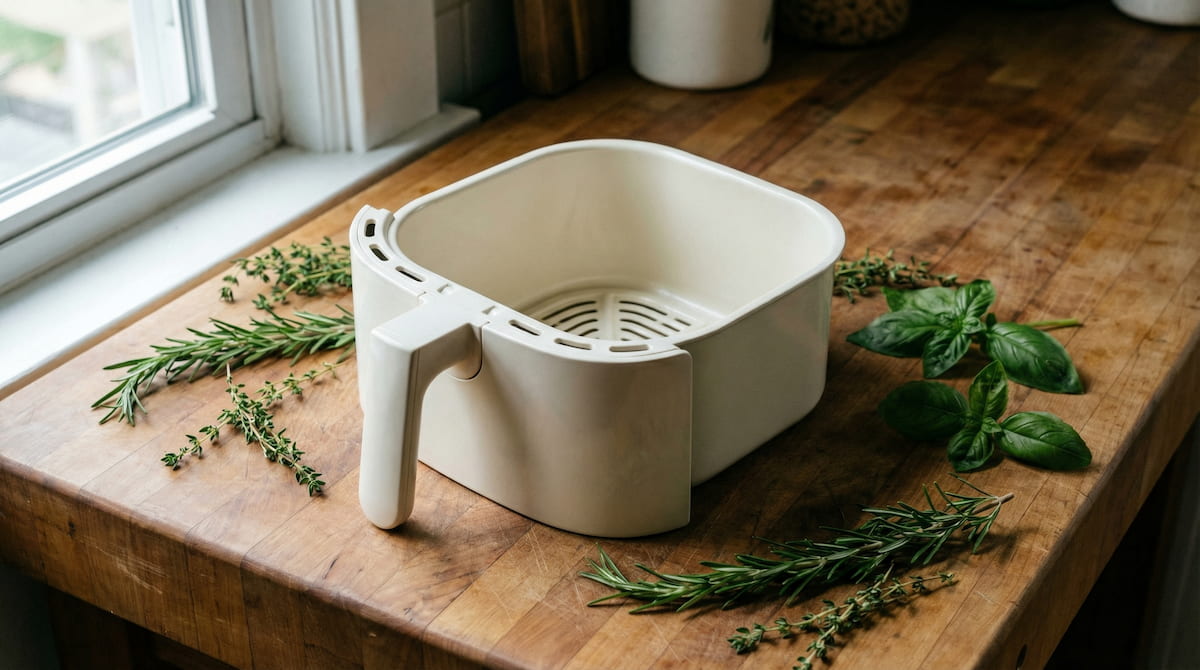
Ninja AF150AMZ — See Today’s Price on Amazon →
I also cook with the kitchen window open. Not because I’m worried about acute exposure, but because better ventilation is a low-effort habit that applies to gas cooking, oil smoke, and a dozen other kitchen scenarios — not just air fryer fumes.
And I run the air fryer at 375°F–390°F for most recipes instead of pushing to 400°F or higher. Most food doesn’t cook noticeably differently at that range, and it keeps the basket surface temperature further below the PTFE threshold.
The Short Version
PTFE starts to break down at around 500°F. Most air fryer displays read lower than the actual basket surface temperature — sometimes by 50°F–100°F. That gap matters when you’re cooking at 400°F and the basket near the element is closer to 470°F–500°F.
For most people cooking normally with an intact, undamaged coating in a ventilated kitchen, the practical risk is low. But “low risk” isn’t the same as “no consideration” — and if your coating is already scratched, or you have birds at home, or you’re regularly cooking at maximum heat, the calculus changes.
The simplest fix is switching to a ceramic or stainless basket. The next simplest is ventilation. Neither requires spending much or changing how you cook in any meaningful way.
Affiliate Disclosure: This post contains Amazon affiliate links. If you purchase through these links, I earn a small commission at no extra cost to you. I only recommend products I’ve personally researched or used.