Affiliate Disclosure: This post contains Amazon affiliate links. If you purchase through my links, I may earn a small commission at no extra cost to you. I only recommend products I’ve personally tested or thoroughly researched.
If you’re weighing a small vs large air fryer, the size you pick will affect every meal you make — so getting this right matters more than most people think.
I’ve been using both sizes in my kitchen for the past year and a half. My family of four usually needs volume, but there are plenty of days when I’m cooking for myself or my wife while the boys are out. That real-world testing taught me a lot about when each size actually earns its counter space.
Here’s what I found.
The Core Difference: It’s Not Just Capacity
Most people assume the only difference between a small and large air fryer is how much food fits inside. That’s true — but it’s only part of the story. The size of the unit affects preheating time, how evenly food cooks, energy usage, and how much counter space you’re giving up permanently.
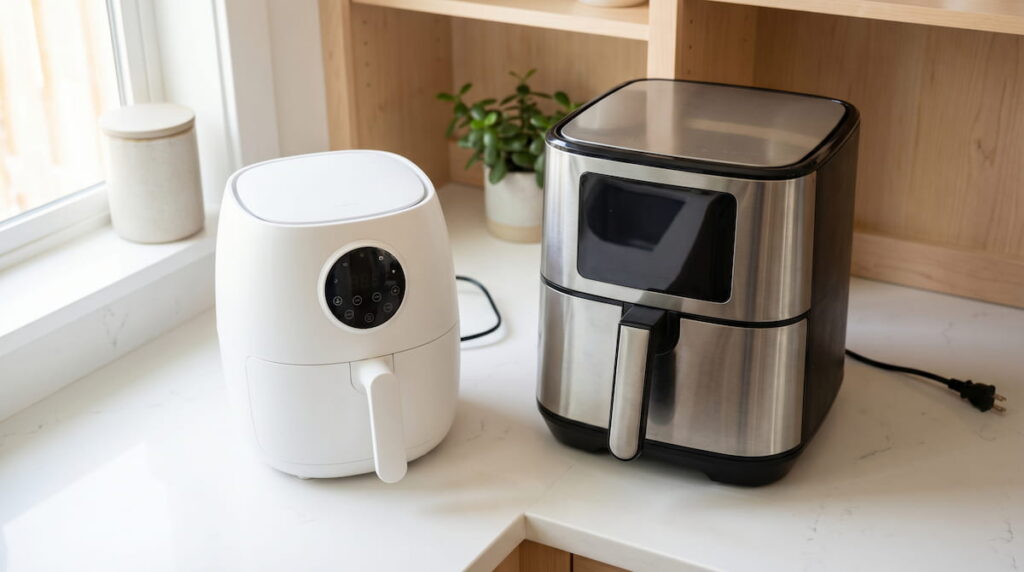
Small air fryers (1.5 to 3 quarts) heat up faster and use less electricity. Large air fryers (5 to 8+ quarts) give you room to cook a whole meal in one go without batching.
Small Air Fryer: Who It’s Actually For
A small air fryer makes the most sense if you’re cooking for one or two people regularly. It preheats in under three minutes, takes up minimal counter space, and is easier to clean because there’s simply less surface area to deal with.
The trade-off is batching. If you want fries and chicken tenders at the same time, you’ll either cook them separately or end up with a crowded basket where things steam instead of crisp. Crowding is the number one reason food comes out soggy — and small baskets hit that limit fast.
For apartments, dorm rooms, or households where one person does most of the eating, a compact model like the Ninja AF150AMZ is a strong fit. It uses a ceramic-coated basket that’s PFAS-free, which matters if you’re trying to avoid synthetic coatings at high heat.
Large Air Fryer: Who It’s Actually For
If you’re feeding three or more people, a large air fryer stops being a luxury and starts being a practical necessity. You can cook a full batch of wings, a whole salmon fillet, or enough vegetables for the whole table in one run — no standing at the counter doing multiple rounds.
The downside is bulk. A 6-quart or larger unit takes up significant counter space, and if your kitchen is small, that’s a real cost. Preheating also takes a bit longer, and energy use is higher per session — though if you’re cooking larger quantities, the per-serving efficiency often works out in the large model’s favor.
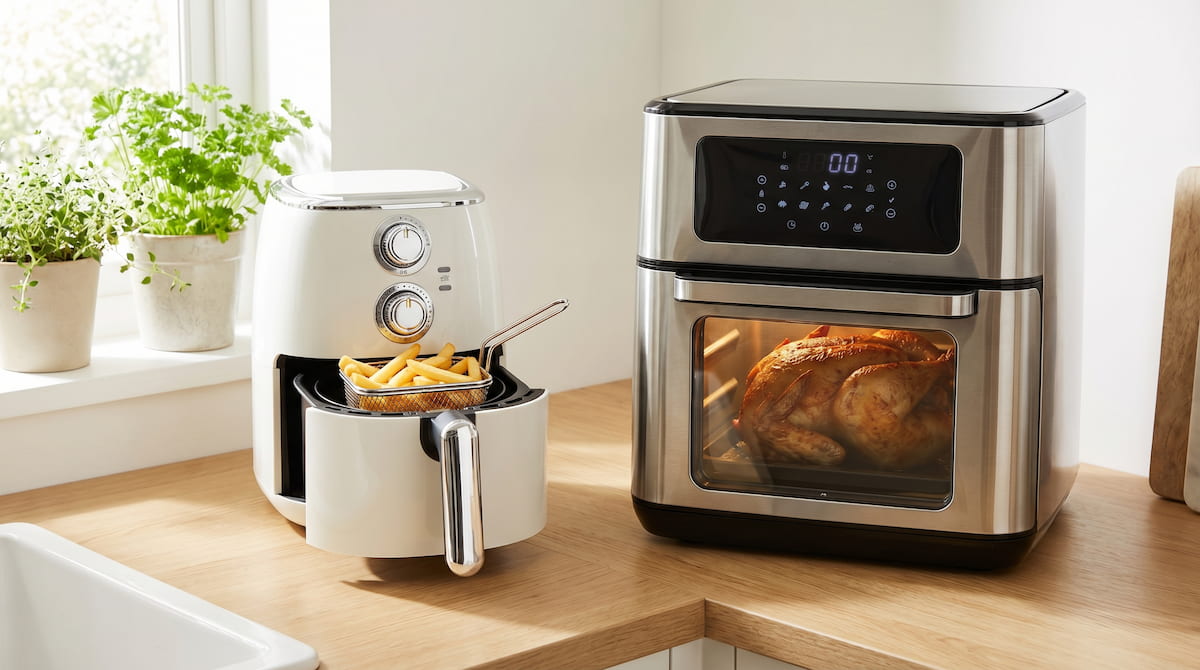
Small baskets work great for one or two portions — large units handle the whole family in one go.
Small vs Large Air Fryer: Side-by-Side
| Factor | Small (1.5–3 Qt) | Large (5–8 Qt) |
|---|---|---|
| Best for | 1–2 people | 3–6 people |
| Preheat time | ~2–3 min | ~4–6 min |
| Counter space | Minimal | Significant |
| Energy use | Lower per session | Higher per session |
| Batching needed? | Often yes | Rarely |
| Price range | $40–$80 | $80–$200+ |
| Easier to clean? | Yes | Takes more effort |
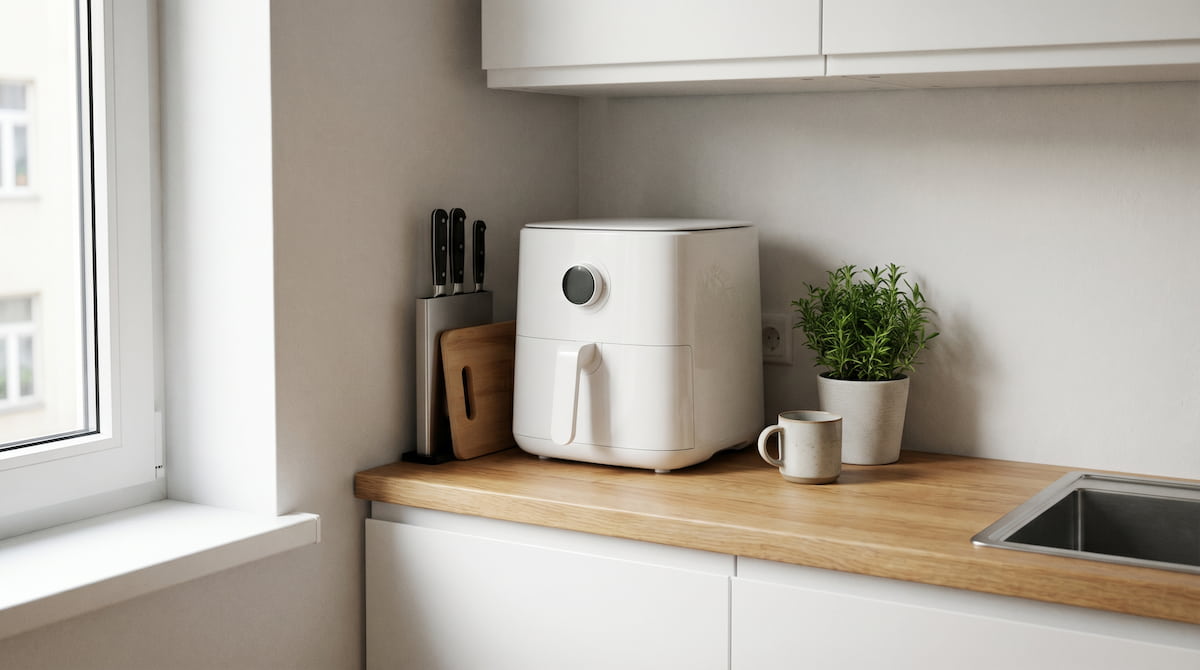
A compact air fryer fits easily on a tight counter — no sacrifice in performance for 1–2 people.
What About the Coating? Size Doesn’t Change the Risk
One thing that doesn’t change based on size is the coating question. Whether you buy a compact or large air fryer, you want to check whether the basket uses PTFE (Teflon) or PFAS-based coatings. These synthetic coatings can degrade at high temperatures, and the EPA has flagged PFAS as a class of chemicals associated with long-term health risks.
Ceramic-coated and stainless steel baskets avoid this issue entirely. That applies whether you’re going small or going large — the safer material choices are available in both sizes.
My Recommendation by Household Size
1–2 people: Go small. You’ll use it more often, clean it faster, and not waste energy heating a massive chamber for two portions. The Ninja AF150AMZ is a solid PFAS-free pick at this size.
3–4 people: You’re at the crossover point. If you batch-cook on weekends or do meal prep, go large. If you mostly make quick weeknight dinners, a mid-size (4 qt) unit may be the sweet spot.
5+ people: Large is the only practical choice. The Instant Pot Omni Plus 18L handles full family meals with room to spare and uses stainless steel interior walls instead of synthetic coatings.
For more on choosing a non-toxic air fryer at any size, see my full breakdown: PFAS-Free Air Fryer Guide →