
Affiliate Disclosure: This post contains Amazon affiliate links. If you click and buy, I earn a small commission at no extra cost to you. I only recommend products I’ve personally researched or tested.
Is air fryer safe in rv camper? That’s a question I kept asking myself after my buddy invited me on a weekend camping trip and I wanted to bring our Ninja along. Turns out, the answer isn’t just yes or no — it depends on ventilation, wattage, and what your basket is actually made of.
Why RV Cooking Raises Different Safety Questions
An RV kitchen is nothing like your home kitchen. The space is smaller, airflow is limited, and your power source is either a generator or shore power with a strict wattage ceiling. That changes how you think about air fryer safety entirely.
At home, if your air fryer releases fumes — from a worn PTFE coating or a first-use burn-off — your kitchen ventilates relatively fast. In a camper, those same fumes concentrate quickly. That’s not a reason to avoid air fryers in an RV, but it is a reason to be picky about which one you bring.
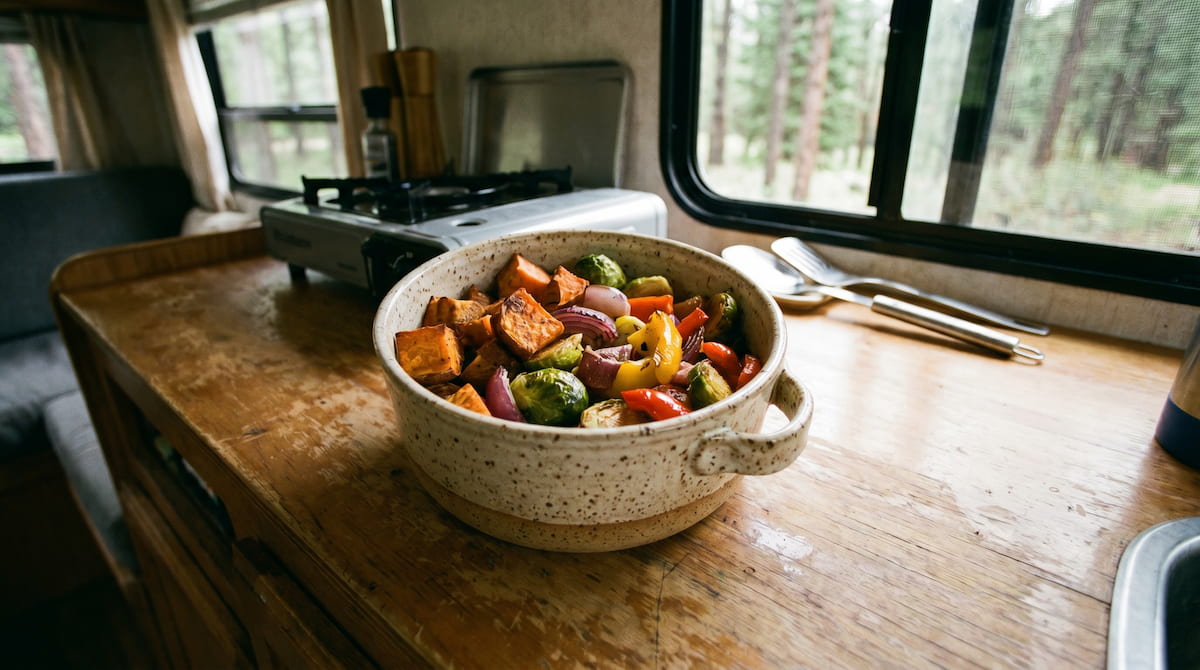
A ceramic basket air fryer is a safer choice for compact RV kitchens where ventilation is limited.
The Coating Problem: Why It Matters More in Small Spaces
Most budget air fryers use PTFE-based nonstick coatings — the same family of chemicals as Teflon. Under normal conditions, PTFE is considered stable. But when the coating gets scratched or overheated above 500°F, it can release fumes that are unpleasant at best and potentially harmful with repeated exposure.
In a well-ventilated home kitchen, this is a manageable concern. In a 100-square-foot RV with the windows cracked, it’s a bigger deal. The EPA has flagged PFAS chemicals — which include some compounds used in nonstick coatings — as an area of ongoing health concern.
That’s why I always recommend a ceramic-coated air fryer for RV use. Ceramic baskets contain no PTFE and no PFAS, which means no fume risk even in tight quarters. The best PFAS-free air fryers are exactly what you want when cooking in a small enclosed space.
Is Air Fryer Safe in RV Camper — Power and Wattage
Most RV shore power connections run on 15-amp or 30-amp service. A standard air fryer draws between 1,200 and 1,800 watts. That math matters.
| RV Power Setup | Max Wattage | Air Fryer Compatible? |
|---|---|---|
| 15-amp shore power | ~1,800W | ✅ Tight but workable |
| 30-amp shore power | ~3,600W | ✅ Comfortable |
| 50-amp shore power | ~12,000W | ✅ No issue |
| Generator (1,000–2,000W) | 1,000–2,000W | ⚠️ Check your model’s draw |
The Ninja AF150AMZ draws around 1,550 watts — well within 15-amp shore power limits as long as you’re not running the microwave at the same time. It’s compact, ceramic-coated, and one of the easiest to fit on a narrow RV counter.
Ventilation Rules for Air Frying in an RV
Even with a PFAS-free ceramic air fryer, ventilation is still important — especially when cooking fatty foods that produce smoke or steam.
Here’s what I’d do every time before air frying in a camper: open at least one window on each side of the RV to create cross-ventilation, run the range hood fan if you have one, and keep cook times short when possible. If you smell anything unusual during the first few uses of a new air fryer, that’s normal burn-off — but step outside for a few minutes and let it air out before continuing.
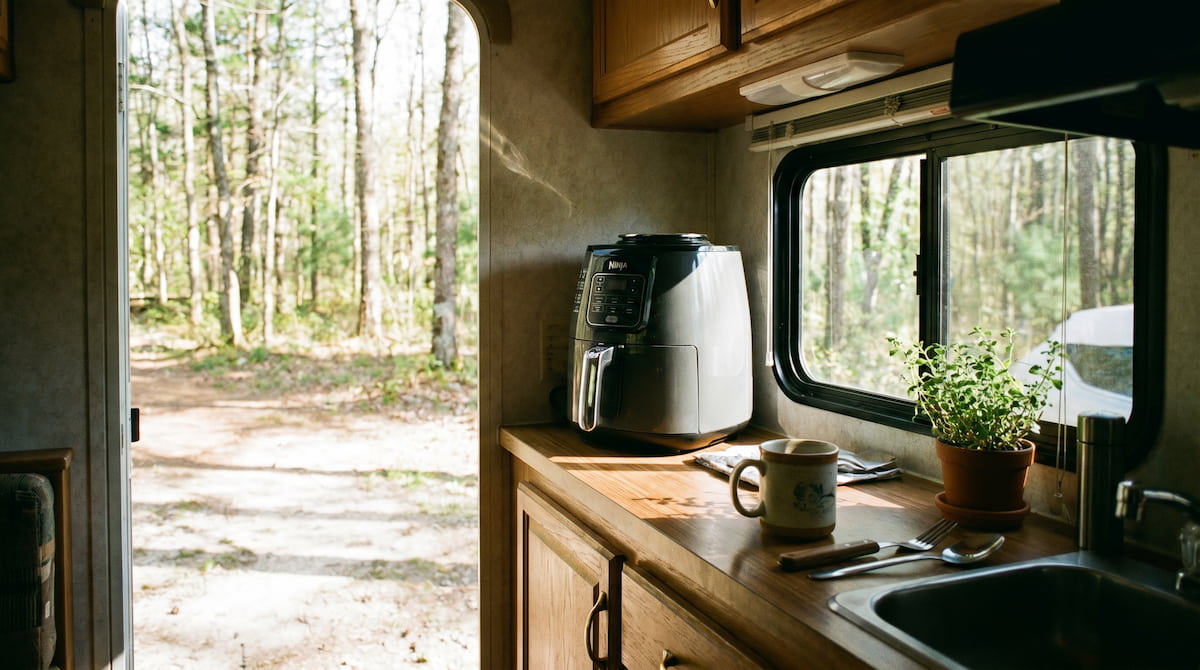
A compact non-toxic air fryer fits easily on an RV counter — just keep a window open when cooking.
What Air Fryer I’d Bring on a Camping Trip
For RV use specifically, I’d look for three things: compact footprint, low wattage draw, and a ceramic or stainless interior. The Ninja AF150AMZ checks all three. It’s a 4-quart basket-style unit with a ceramic-coated basket, no PTFE, and a wattage that plays nice with most RV setups.
If you’re cooking for more than two people, the Instant Pot Omni Plus is worth a look — it’s larger but gives you oven-style versatility. Just confirm your RV’s power capacity before plugging in anything that draws over 1,500 watts.
For a full breakdown of safe materials and what to avoid, check out our guide on PFAS-free air fryers.
Is Air Fryer Safe in RV Camper — Quick Checklist
| Checklist Item | What to Do |
|---|---|
| Coating | Choose ceramic or stainless — avoid PTFE in small spaces |
| Wattage | Check your RV’s amp service before plugging in |
| Ventilation | Open windows on both sides for cross-airflow |
| Size | 4-quart basket style fits most RV counters |
| First use | Run empty for 10 min outside or with windows fully open |
Is It Worth Bringing an Air Fryer on Your Next Trip?
Honestly, yes — as long as you pick the right one. A ceramic-coated, compact air fryer is one of the safest and most efficient ways to cook in an RV. It uses less energy than a full oven, produces less heat in the cabin, and gives you crispy results without the grease splatter of stovetop cooking.
Just avoid cheap units with unknown coatings, check your wattage, and keep a window open. Do those three things and you’re in good shape.