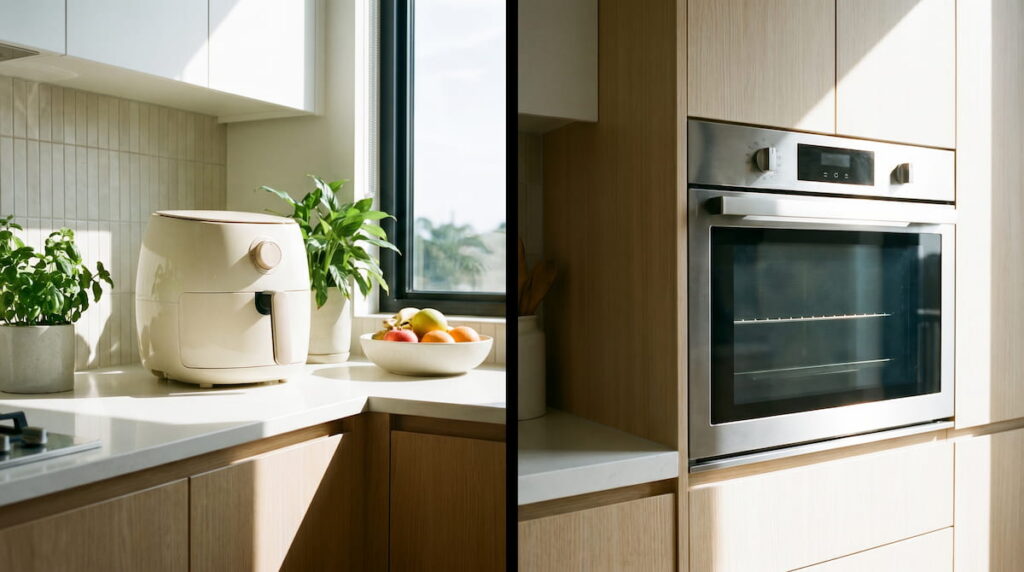
Does air fryer produce more toxic fumes than oven? That question came up in our house after I noticed a stronger smell from our old air fryer than from our conventional oven cooking the same food. The answer depends almost entirely on what the air fryer basket is made of — and once you understand that, the comparison becomes a lot clearer.
How Air Fryers and Ovens Produce Fumes Differently
Both air fryers and conventional ovens produce fumes during cooking. The sources are different, the concentrations are different, and the risk profiles are different. Understanding where each appliance’s fumes actually come from is the starting point for an honest comparison.
A conventional oven produces fumes primarily from two sources: the food itself — fat rendering, sugars caramelizing, proteins browning — and any grease or food residue on the oven walls or heating elements from previous cooks. The oven interior is typically enameled steel or bare metal with no synthetic coating to contribute additional chemistry. The fumes it produces are largely combustion byproducts from food, not from the appliance itself.
An air fryer produces fumes from the same food-based sources, plus one additional variable: the basket coating. A PTFE-coated air fryer basket runs at temperatures between 350°F and 400°F — right in the range where PTFE begins to off-gas detectable compounds, especially when the coating is scratched or worn. That’s a fume source a conventional oven simply doesn’t have.
Does Air Fryer Produce More Toxic Fumes Than Oven — The Direct Comparison

Ventilation matters for both appliances — but a ceramic air fryer with no PTFE coating removes the biggest chemical fume variable entirely.
| Fume Source | Conventional Oven | PTFE Air Fryer | Ceramic Air Fryer |
|---|---|---|---|
| Food combustion byproducts | ✅ Yes | ✅ Yes | ✅ Yes |
| Grease residue smoke | ✅ Yes (if not cleaned) | ✅ Yes (if not cleaned) | ✅ Yes (if not cleaned) |
| PTFE coating off-gassing | ❌ No | ⚠️ Yes — especially if scratched | ❌ No |
| PFAS-related compounds | ❌ No | ⚠️ Possible with degraded coating | ❌ No |
| Acrylamide from starchy foods | ✅ Yes | ✅ Yes (lower than deep fry) | ✅ Yes (lower than deep fry) |
The PTFE Factor: When Air Fryers Are Worse Than Ovens
A PTFE-coated air fryer basket is the one scenario where an air fryer genuinely produces more concerning fumes than a conventional oven. PTFE — the nonstick compound used in the majority of budget air fryer baskets — begins to off-gas detectable fluorinated compounds at temperatures above 500°F, and shows early degradation signs at temperatures as low as 392°F under sustained exposure.
Air fryers run at 350°F to 400°F as a matter of routine. A basket that’s been scratched by metal utensils or degraded through repeated washing with abrasive materials reaches its off-gassing threshold at lower temperatures than an intact coating. The EPA has flagged PFAS-related compounds — the chemical family that includes PTFE decomposition products — as an area of ongoing health concern.
A conventional oven has no PTFE coating on its cooking surfaces. In that specific respect, a standard oven is safer than a PTFE-coated air fryer. This is why basket material is the most important factor in the air fryer vs oven fume comparison.
When a Ceramic Air Fryer Is Safer Than an Oven
A ceramic-coated air fryer changes the comparison entirely. Ceramic contains no PTFE and no PFAS. The only fumes it produces come from the food itself — the same source as a conventional oven, and at similar concentrations. In this scenario, the air fryer is not worse than an oven from a fume perspective, and in some ways it’s better: shorter cook times mean less total fume exposure per meal, and the sealed basket format means less ambient smoke drifting through the kitchen during cooking.
The Ninja AF150AMZ uses a ceramic-coated basket with no PTFE anywhere on the cooking surface. Running it daily for over six months, I’ve noticed no chemical smell beyond the initial factory burn-off — and nothing that approaches what I get from our oven when cooking fatty proteins at high heat.
Ventilation Needs: Air Fryer vs Oven
A ceramic air fryer produces steam and food-based cooking vapor — the same as a conventional oven, with no additional chemical fume risk from the cooking surface.
Both appliances benefit from kitchen ventilation during use. The difference is that a conventional oven typically vents heat and cooking vapor upward through or around the oven door, where it dissipates into a larger kitchen space. An air fryer vents hot air from the back or sides of the unit into the immediate surrounding area — which means fume concentration near the appliance can be higher than near an oven during cooking, even if the total fume volume is lower.
For either appliance, opening a window or running a range hood fan during cooking is the most effective ventilation step. For a PTFE-coated air fryer specifically, ventilation is more important than for an oven because the coating adds a chemical fume source the oven doesn’t have. For a ceramic air fryer, ventilation is simply good kitchen practice — not a safety requirement driven by coating chemistry.
Does Air Fryer Produce More Toxic Fumes Than Oven — Verdict
| Scenario | Which Is Safer? |
|---|---|
| PTFE air fryer vs conventional oven | Oven — no coating fume risk |
| Ceramic air fryer vs conventional oven | Roughly equal — same food-based fume sources |
| Ceramic air fryer vs oven for cook time | Air fryer — shorter cook time, less total exposure |
| PTFE air fryer with scratched basket vs oven | Oven — significantly safer |
The bottom line: a PTFE-coated air fryer produces more concerning fumes than a conventional oven when the basket is scratched or degraded. A ceramic air fryer produces fumes that are comparable to a conventional oven — food-based, manageable with normal ventilation, and free of the coating chemistry that makes PTFE a concern.
For more on what air fryers actually release during cooking, our guide on air fryer fumes covers the full picture. And if you’re ready to move to a ceramic model, our PFAS-free air fryer guide is the place to start.