
Disclosure: This post contains affiliate links. If you purchase through them, I earn a small commission at no extra cost to you. I only recommend products I personally trust for my family.
Can you use extension cord with air fryer is a practical question that comes up whenever the nearest outlet isn’t close enough to the ideal counter position. I’m Wook, a bus driver and dad who cooks for my family almost every night. When we rearranged our kitchen and the closest outlet ended up on the wrong side of the counter, my first instinct was to grab an extension cord. What I found out before doing that changed my mind completely.
Can You Use an Extension Cord With an Air Fryer?
The short answer is no — and most air fryer manufacturers explicitly state this in their user manuals. Air fryers are high-wattage appliances that draw 1,400–1,800 watts during operation. Most standard household extension cords are not rated for this sustained power draw, which creates real fire and electrical hazard risks that aren’t immediately obvious.
Why Extension Cords Are Dangerous With Air Fryers
1. Wattage Mismatch
Standard household extension cords are typically rated for 1,000–1,500 watts maximum. An air fryer drawing 1,500–1,800 watts pushes most extension cords at or beyond their rated capacity. Running any electrical device at or near an extension cord’s maximum rating causes the cord to heat up — and sustained heat in an overloaded extension cord is a direct fire risk.
2. Voltage Drop Over Length
The longer an extension cord, the more resistance it adds to the circuit. This resistance causes voltage to drop between the outlet and the appliance. For an air fryer, voltage drop means the unit has to draw more current to maintain the same wattage — further stressing both the cord and the appliance’s internal components. Longer extension cords create worse voltage drop than shorter ones.
3. Cord Gauge Too Thin
Extension cord gauge determines how much current the cord can safely carry. Most light-duty household extension cords use 16-gauge or 14-gauge wire. For a high-draw appliance like an air fryer, a minimum of 12-gauge wire is needed to handle the current safely. Using an undersized gauge cord with an air fryer causes the cord to overheat even if the total wattage appears within spec.
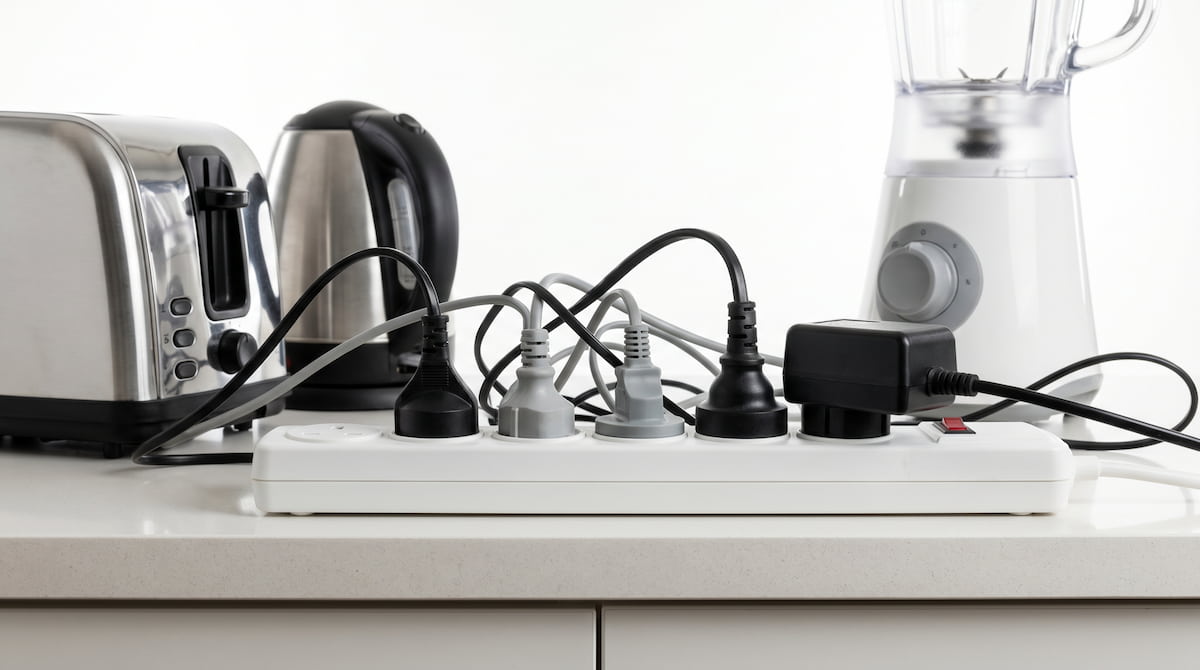
An overloaded extension cord with multiple appliances is one of the most common kitchen fire setups — air fryers should never share a cord.
4. Power Strip and Surge Protector Risk
Power strips — even those marketed as surge protectors — are not designed for sustained high-wattage appliance use. They’re built for electronics like computers and TVs that draw a fraction of what an air fryer uses. Plugging an air fryer into a power strip creates the same overheating risk as an undersized extension cord, and in some cases worse because multiple devices may be sharing the same circuit through the strip.
5. Connection Point Heating
Every connection point in an electrical circuit — including the plug-to-extension-cord junction and the extension-cord-to-outlet junction — adds resistance. Resistance generates heat. With the sustained high current draw of an air fryer, these connection points can get hot enough to melt plastic housing and ignite nearby materials. According to the U.S. Consumer Product Safety Commission, connection point overheating is a leading cause of extension cord fires in American homes.
Extension Cord Risk Summary
| Extension Cord Type | Safe for Air Fryer? | Risk |
|---|---|---|
| Standard light-duty cord | No | Overheating, fire risk |
| Power strip / surge protector | No | Overload, connection heating |
| Long extension cord (10+ ft) | No | Voltage drop, increased current draw |
| Heavy-duty 12-gauge, short, rated 2000W+ | Last resort only | Still not recommended by manufacturers |
| Direct wall outlet | Yes — always preferred | No extension cord risk |
What to Do Instead of Using an Extension Cord
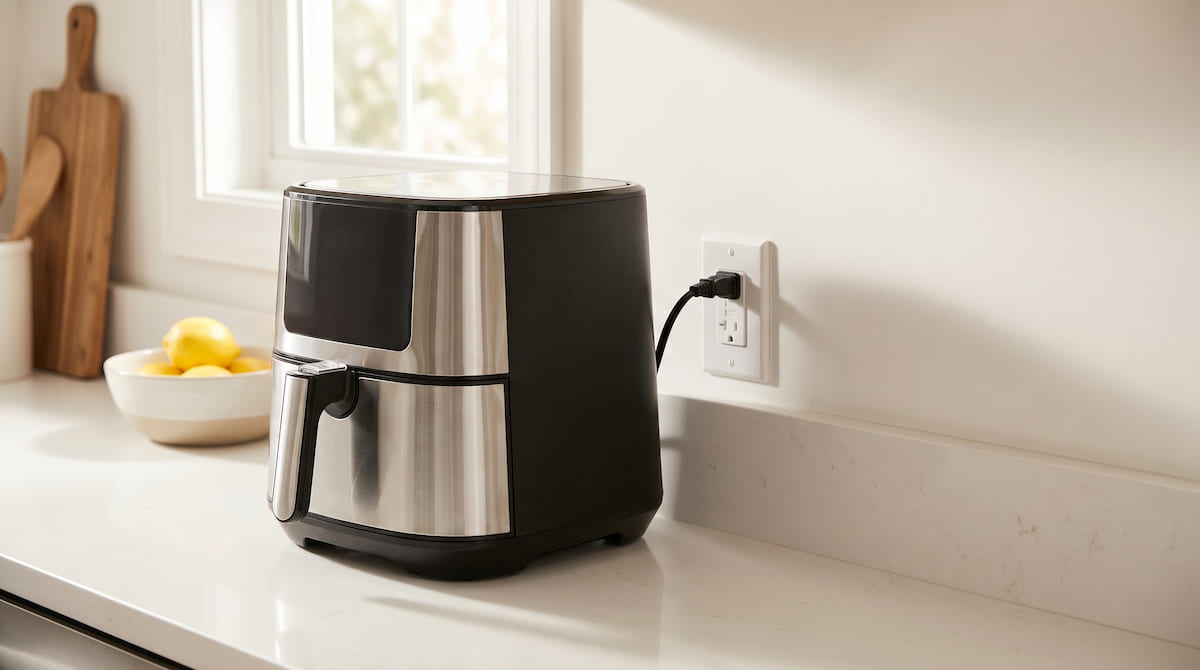
A dedicated wall outlet is always the safest connection for an air fryer — no extension cord, no shared circuit.
The safest solution is always a direct wall outlet connection. If your current kitchen layout doesn’t allow this, here are practical alternatives:
- Rearrange the counter layout — move the air fryer to a position closer to an existing outlet even if it’s less convenient
- Have an electrician add an outlet — for a permanent kitchen setup, a dedicated outlet near the cooking area is the right long-term solution
- Use the air fryer on a different counter surface temporarily if needed, rather than stretching a cord across the kitchen
- If an extension cord is truly unavoidable — use only a heavy-duty appliance-rated cord (12-gauge minimum, rated for 2,000+ watts, as short as possible), never share it with another appliance, and never leave the unit unattended while in use
Extension Cords and Air Fryer Fire Risk
Extension cord misuse is one of the contributing factors in air fryer fire incidents. Combined with poor placement and grease buildup, an overloaded extension cord creates multiple simultaneous fire risk factors. For the complete picture on air fryer fire prevention: Can an Air Fryer Catch Fire? Real Risk Explained
And for all the electrical safety considerations around air fryer use: Why Does My Air Fryer Smell Electrical? (Warning Signs You Shouldn’t Ignore)
Bottom Line
Can you use extension cord with air fryer? Technically possible in a narrow set of circumstances — but not recommended by any air fryer manufacturer, and genuinely risky with the standard extension cords found in most homes. The wattage demand of an air fryer exceeds what most cords handle safely, and the connection point heating risk exists regardless of cord rating. The right answer is always a direct wall outlet. If that requires rearranging your kitchen or adding an outlet, it’s worth doing — the alternative is introducing a fire risk every time you cook.