
Air fryer fumes asthma connection is something most appliance guides completely skip over — but for the roughly 25 million Americans living with asthma, it’s a practical daily concern. The fumes an air fryer releases during cooking aren’t equally risky for everyone, and people with asthma sit at the higher end of the sensitivity spectrum.
My younger son has mild asthma, which is exactly why I started paying close attention to what our air fryer was releasing into the kitchen air. What I found shaped every appliance decision we’ve made since. This guide covers which air fryer fumes matter most for asthma sufferers, which basket materials to avoid, and what our family does to keep cooking safe every day.
Why Are Air Fryer Fumes a Bigger Problem for People With Asthma?
Asthma involves chronic airway inflammation that makes the respiratory tract significantly more reactive to airborne irritants. What a healthy adult might barely notice — a faint chemical smell, a brief puff of smoke — can trigger bronchospasm, coughing, wheezing, or a full asthma attack in someone whose airways are already sensitized.
The specific compounds that air fryers release under heat hit several of the known asthma trigger categories:
- VOCs (volatile organic compounds) — known respiratory irritants at elevated concentrations, especially formaldehyde and acrolein
- Ultrafine particles — penetrate deep into lung tissue and are particularly problematic for inflamed airways
- PTFE decomposition byproducts — fluorinated compounds released from degrading nonstick coatings that can cause acute respiratory irritation even in otherwise healthy people
For a full breakdown of what these compounds are and where they come from, our guide on what chemicals air fryers release covers each material type in detail.
Which Air Fryer Fumes Are Most Dangerous for Asthma?
| Fume Type | Source | Asthma Risk |
|---|---|---|
| PTFE decomposition byproducts | Overheated or damaged Teflon coating | ❌ High — acute airway irritant |
| Acrolein | Overheated cooking oil | ❌ High — known asthma trigger |
| Ultrafine particles | High-heat cooking, grease combustion | ⚠️ Moderate–High — deep lung penetration |
| General VOCs | Heated coatings, oil residue | ⚠️ Moderate — airway sensitizer |
| Steam and water vapor | Normal food moisture | ✅ Low — generally not an asthma trigger |
According to the EPA’s indoor air quality guidelines, VOC concentrations indoors can reach 2–5 times outdoor levels during cooking — and for people with asthma, that concentration window matters significantly more than it does for the general population.
Air Fryer Fumes Asthma Safety Checklist
✅ Lower risk setup for asthma sufferers:
- Air fryer basket is ceramic-coated, stainless steel, or glass — no PTFE
- Basket surface is clean, intact, and showing no scratches or peeling
- Window open and range hood running during every cooking session
- Cooking temperatures kept at or below 380°F
- Parchment or silicone liner used to reduce direct oil contact with basket
- Person with asthma stays out of the kitchen during the first 5–10 minutes of cooking
⚠️ Moderate concern — make adjustments:
- Standard nonstick basket that appears intact but is aging
- Cooking in a kitchen without consistent ventilation
- Asthma symptoms seem worse on days when air fryer is used heavily
- Occasional chemical smell during cooking
❌ High risk — stop and replace:
- Basket coating is scratched, peeling, or visibly degrading
- Persistent chemical smell every cooking session
- Asthma symptoms consistently triggered during or after air fryer use
- Cannot confirm basket material is PTFE-free
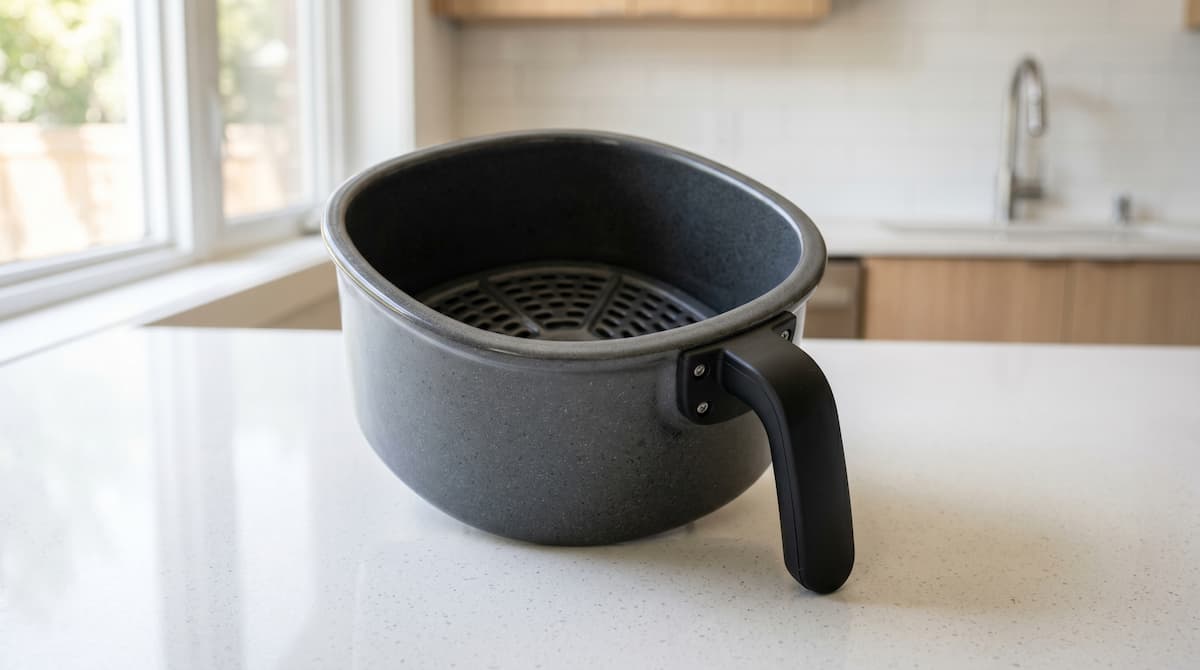
A ceramic-coated basket contains no PTFE or PFAS — eliminating the fume compounds most likely to irritate asthmatic airways.
How to Reduce Air Fryer Fume Exposure for Asthma Sufferers
These steps make a measurable difference for households where someone has asthma:
- Switch to a ceramic or glass-interior model — this removes PTFE from the equation entirely, eliminating the most acutely irritating fume source for sensitive airways
- Keep the person with asthma out of the kitchen during initial cooking — the first 5–10 minutes generate the most particles and fumes; entering after that point significantly reduces exposure
- Always ventilate — open a window, run the range hood, or use a fan pointed toward an open vent every single time. Our full kitchen ventilation guide for air fryer use covers layout-specific tips
- Use a HEPA air purifier in or near the kitchen — captures ultrafine particles that ventilation alone doesn’t fully address
- Cook at moderate temperatures — 350–380°F handles most recipes while keeping coating stress and particle generation lower than max-heat cooking
- Use parchment liners — reduces grease contact with the basket, which cuts down on acrolein and VOC output from oil combustion
- Clean the basket after every use — grease residue burning during the next cook adds to the airborne compound load unnecessarily
For a broader look at what air fryer fumes do to indoor air quality beyond just asthma, see our guide on air fryer breathing safety for families.

Running the range hood and opening a window during air fryer use is especially important in households where someone has asthma or other respiratory conditions.
Which Air Fryer Is Safest for Someone With Asthma?
The safest air fryer for asthma sufferers is one with no PTFE coating — because PTFE decomposition byproducts are the most acutely irritating fume source for sensitive airways, and they’re entirely avoidable by choosing the right material.
Our family uses the Ninja AF150AMZ, which has a ceramic-coated basket that is verified PTFE-free and PFAS-free. Since switching, our son’s cooking-related symptoms have been a non-issue — and we’ve maintained that result through consistent ventilation habits alongside the material upgrade.
For households where asthma is a significant concern, the Big Boss 16Qt glass air fryer is worth serious consideration. A borosilicate glass cooking chamber produces no coating off-gassing whatsoever — the most inert cooking surface available in any air fryer design. For a full comparison of both options, see our PFAS-free air fryer guide.
See Ninja AF150AMZ on Amazon → See Big Boss Glass Air Fryer on Amazon →Frequently Asked Questions
Can air fryer fumes trigger an asthma attack?
Yes, in certain conditions. Fumes from a degrading PTFE coating, overheated cooking oil, or a poorly ventilated kitchen can reach concentrations that irritate already-inflamed airways and trigger bronchospasm in asthma sufferers. The risk is significantly lower with a ceramic or glass-interior model and good ventilation.
Is cooking with an air fryer safer than a regular oven for asthma?
It can be, especially for high-fat foods — air fryers produce less smoke overall than open-element cooking. But the basket material matters more than the appliance type. A PTFE-coated air fryer can be worse for asthma than a clean oven, while a ceramic-coated model is generally safer than most conventional cooking methods.
Should someone with asthma avoid using an air fryer entirely?
Not necessarily. With a non-toxic basket material, consistent ventilation, and moderate cooking temperatures, air fryer use can be very low risk even for asthma sufferers. The key is removing the PTFE coating variable and maintaining good kitchen airflow.
Does cooking oil type affect asthma risk from air fryers?
Yes. Oils with lower smoke points — like butter or unrefined oils — produce more acrolein and VOCs when heated. Using a small amount of high smoke-point oil such as avocado or refined coconut oil reduces the cooking-related fume contribution beyond just the basket material.
How long do air fryer fumes stay in the kitchen after cooking?
In a well-ventilated kitchen, most cooking-related particles and VOCs clear within 15–30 minutes after cooking ends. In a closed kitchen, they can persist for an hour or more — which is why ventilation during cooking, not just after, matters for asthma management.
The Bottom Line on Air Fryer Fumes and Asthma
Air fryer fumes asthma risk is real but manageable with the right material choice and consistent ventilation habits. The most important single change for any household where someone has asthma is switching away from PTFE-based nonstick coatings — ceramic and glass interiors eliminate the most acutely irritating fume compounds at the source.
Combined with ventilation, moderate temperatures, and clean cooking habits, a non-toxic air fryer can be a genuinely safe daily appliance even for sensitive households. Our PFAS-free air fryer guide compares the safest ceramic, stainless, and glass models available in 2026 if you’re ready to make the switch.