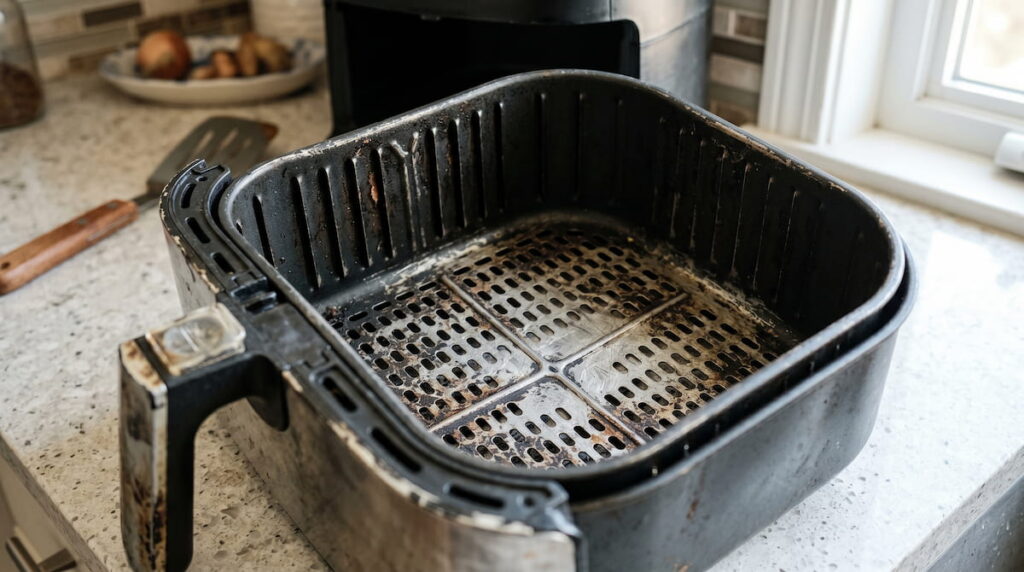
Air fryer basket unsafe signs are something most families miss until the damage is already significant — and by that point, coating particles have often been entering food for weeks. Knowing what to look for, and understanding which signs require immediate action versus which allow a short window to plan replacement, is what this guide covers.
I’ve inspected a lot of air fryer baskets since I started researching coating safety for our family. The pattern I see most often: families wait until the basket looks dramatically bad before acting, when the actual warning signs appeared months earlier. Here’s how to read those early signals correctly.
Why Air Fryer Basket Safety Matters More Than Most People Realize
The basket is the surface your food contacts directly during every cook. For most air fryers, that surface is a PTFE-based nonstick coating — and when that coating degrades, it releases fluorinated compounds into food and air. According to the EPA’s PFAS resource page, these fluoropolymer breakdown products have raised ongoing health concerns with repeated exposure.
A ceramic-coated basket carries significantly less risk when it wears — no fluorinated chemistry means the failure mode is reduced nonstick performance, not chemical release. But any basket showing significant damage warrants attention. For a full breakdown of what each coating type releases as it ages, see our guide on what chemicals air fryers release by material type.
Air Fryer Basket Unsafe Signs: The Complete List
🔴 Replace Immediately — No Exceptions
These signs mean the basket is already past the point of safe use. Stop cooking with it and replace before your next meal:
- Visible flaking or peeling coating — pieces of the coating are separating from the basket surface. These particles are going directly into your food. This is the clearest and most urgent replacement signal
- Bare metal visible beneath the coating — you can see the aluminum or steel substrate through gaps in the coating. The protective layer is gone in those areas entirely
- Persistent chemical or plastic smell at normal temperatures — a smell that returns every cooking session at 350–380°F indicates active coating degradation, not residue from food
- Dark bubbling or blistering on the surface — the coating has separated from the substrate beneath it. Structural integrity of the coating is gone
- Family members reporting headaches or eye irritation after cooking — this level of symptom with a degrading PTFE basket warrants immediate replacement and improved ventilation
⚠️ Plan Replacement Within Weeks
These signs don’t require stopping immediately, but they indicate the basket is in decline and should be replaced soon:
- Visible scratches that don’t expose bare metal yet — the coating is compromised at those points and will degrade faster from here. Use parchment liners and plan replacement
- Dull patches or color inconsistency across the basket interior — the coating has worn thinner in spots. Even cooking performance will deteriorate and chemical release risk increases
- Food sticking consistently where it didn’t before — when a nonstick basket loses its release, it means the coating is wearing through. The nonstick property is gone before the coating is visibly damaged
- Occasional faint chemical smell at high heat only — intermittent smell at 400°F+ that clears quickly suggests early degradation. Lower cooking temperatures and plan replacement
- Coating feels rough or textured where it was previously smooth — surface roughness without visible scratching indicates micro-degradation that’s progressing
✅ Monitor Closely — Not Yet Urgent
These observations suggest the basket is aging normally and should be watched, but don’t require immediate action:
- Very light surface marks with coating fully intact — cosmetic scuffs that don’t break through the coating surface are low concern. Use silicone utensils going forward
- Slightly reduced nonstick performance with no visible damage — normal aging. A light brush of oil before cooking restores performance. Watch for progression
- Minor discoloration from heat cycling — some darkening from repeated heating is normal. The concern is if it’s accompanied by roughness or scratch marks
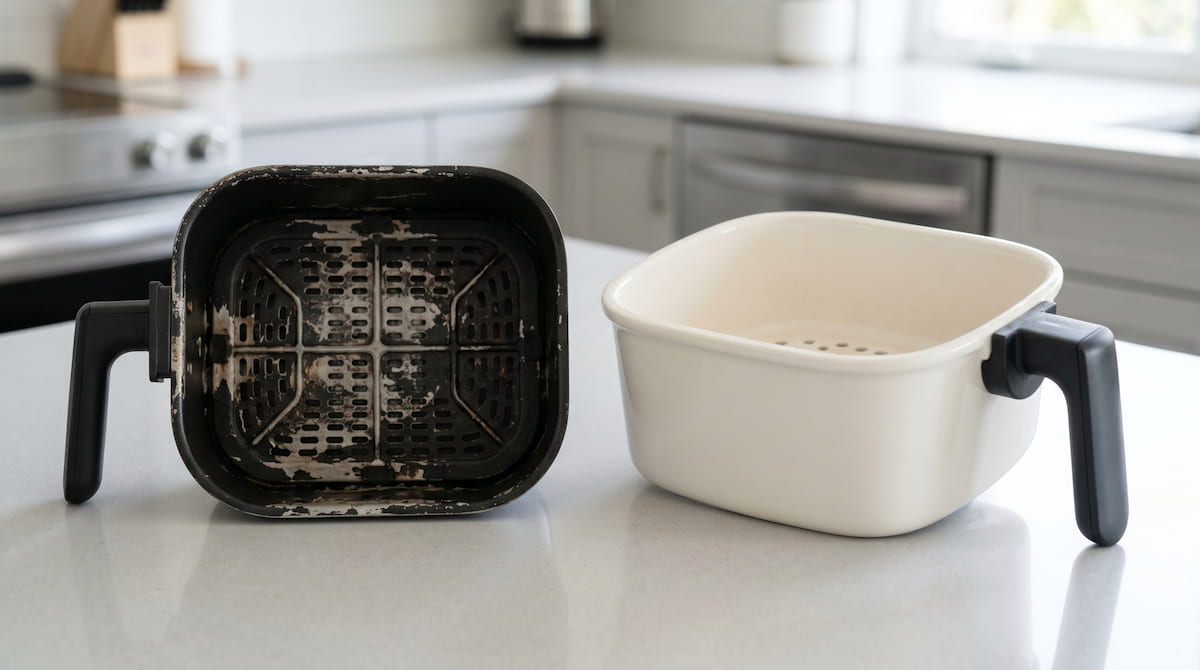
The difference between a basket that needs immediate replacement (left) and an intact ceramic surface still in good condition (right) — catching the warning signs early is what prevents reaching the left-side state.
Quick Reference: Air Fryer Basket Safety Checklist
| Sign | Coating Type | Urgency | Action |
|---|---|---|---|
| Flaking or peeling | Any | ❌ Immediate | Stop using now |
| Bare metal visible | Any | ❌ Immediate | Stop using now |
| Chemical smell every session | PTFE especially | ❌ Immediate | Stop using now |
| Visible scratches | PTFE — urgent / Ceramic — less urgent | ⚠️ Soon | Use liners, replace within weeks |
| Food sticking consistently | Any nonstick | ⚠️ Soon | Coating wearing out — plan replacement |
| Dull patches or discoloration | Any | ⚠️ Monitor | Inspect monthly, plan replacement |
| Light surface scuffs only | Any | ✅ Low | Switch to silicone utensils, monitor |
Does Coating Type Change How Urgently You Should Replace?
Yes — significantly. The urgency of replacement depends heavily on what the coating is made of:
PTFE-coated baskets: Replace at the first sign of visible scratching, not when flaking begins. A scratched PTFE coating is already releasing more compounds under heat than an intact one — the degradation is happening before visible flaking appears. For PTFE, the safe use window after scratching is short. Our guide on what happens when air fryer coating gets scratched covers this timeline in detail.
Ceramic-coated baskets: A scratched ceramic basket loses nonstick performance but doesn’t release fluorinated compounds. The urgency is lower — you can continue with parchment liners while planning replacement, rather than stopping immediately. Replace when performance drops noticeably or when bare substrate becomes visible.
Stainless steel and glass: No coating means no coating-related replacement urgency. These surfaces can develop stains and discoloration from food residue, but that’s a cleaning issue, not a safety one.
How to Inspect Your Air Fryer Basket
A proper monthly inspection takes under two minutes and catches problems before they become serious:
- Clean the basket thoroughly first — residue can mask scratches and discoloration
- Inspect under bright light — hold the basket under a direct light source and tilt it at different angles. Scratches and thin spots catch the light differently than intact coating
- Run your finger lightly across the surface — feel for roughness, texture changes, or areas that feel different from the surrounding surface
- Check the edges and corners — these areas experience the most utensil contact and show wear first
- Smell the basket after cooking — a chemical smell that wasn’t present before is often the earliest warning sign
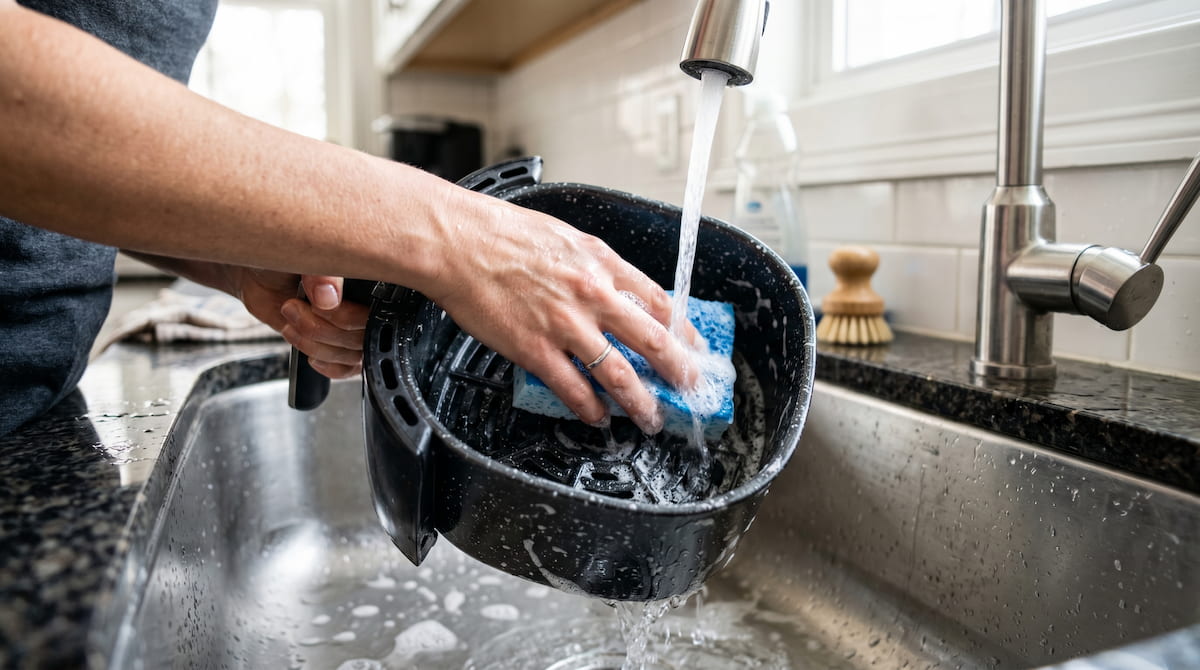
Cleaning with a soft sponge after every use is the single most effective habit for extending basket life and catching early damage during the process.
What to Do When You Spot Unsafe Signs
If you’ve identified signs that your basket needs replacing:
- For immediate replacement signs — stop using the basket now. Use the oven or stovetop until a replacement arrives
- For “replace soon” signs — start using parchment liners for every cook, lower your cooking temperature to 350–375°F, and order a replacement within the week
- Decide: replace the basket or upgrade the unit — if your model sells replacement baskets and this is your first replacement, a new basket is cost-effective. If it’s your second PTFE replacement, consider upgrading to ceramic or stainless
- Ventilate until you’ve replaced — keep a window open and the range hood running for every cook session while you’re waiting for replacement
For a full comparison of the safest replacement options, see our PFAS-free air fryer guide and our guide on how long air fryer coatings last by material type.
The Safest Long-Term Solution
The most reliable way to stop worrying about basket unsafe signs is to switch to a coating that doesn’t carry the same chemical risk when it wears. Our family uses the Ninja AF150AMZ — its ceramic-coated basket is PTFE-free and PFAS-free, meaning even as it ages and eventually shows wear, the failure mode is reduced nonstick performance, not fluorinated particle release.
For families who want to eliminate the coating inspection question entirely, the Big Boss 16Qt glass air fryer has a borosilicate glass cooking chamber — no coating means no coating to inspect, no coating to replace, and no coating-related safety concern at any age.
See Ninja AF150AMZ on Amazon → See Big Boss Glass Air Fryer on Amazon →Frequently Asked Questions
How do I know if my air fryer basket is unsafe?
The clearest signs are visible flaking or peeling, bare metal showing through coating damage, and a persistent chemical smell during normal cooking. Earlier warning signs include visible scratches, food sticking where it didn’t before, and dull patches or discoloration on the coating surface.
Is a scratched air fryer basket dangerous?
For PTFE-coated baskets — yes, meaningfully so. A scratched PTFE surface releases more fluorinated compounds under heat than an intact one, even before visible flaking begins. For ceramic baskets, a scratch reduces nonstick performance without the same chemical release concern. Coating type determines urgency more than the depth of the scratch.
Can I still use my air fryer if the coating is peeling?
No — peeling coating means particles are entering your food directly. Stop using it immediately regardless of basket material. This is the clearest and most urgent replacement signal for any air fryer basket.
How often should I check my air fryer basket for damage?
Once a month under bright light is appropriate for most households. If you use metal utensils or put the basket in the dishwasher regularly, check more frequently — those habits accelerate coating wear significantly.
What is the safest air fryer basket material?
Glass and stainless steel interiors have no coating to degrade — the safest from a long-term perspective. Among coated baskets, verified PTFE-free ceramic is significantly safer than PTFE-based nonstick when the coating eventually wears, because the failure mode doesn’t involve fluorinated chemical release.
Should I replace my whole air fryer or just the basket?
If your model sells replacement baskets separately and this is your first replacement, a basket swap is cost-effective. If you’re on your second PTFE replacement or the replacement basket is also PTFE-coated, use it as an opportunity to upgrade to a ceramic or stainless model and get off the replacement cycle entirely.
The Bottom Line on Air Fryer Basket Unsafe Signs
Air fryer basket unsafe signs range from immediate stop-using signals — flaking, bare metal, persistent chemical smell — to early warnings that allow a short window to plan replacement. Knowing which category a sign falls into, and understanding that PTFE coatings warrant faster action than ceramic, is what makes the difference between catching a problem early and cooking on a degraded surface for months without realizing it.
Monthly inspection, silicone utensils, and hand washing are the three habits that catch problems earliest and extend basket life the most. And when replacement time comes, switching to a PTFE-free ceramic or coating-free stainless or glass model means this inspection cycle becomes significantly less urgent going forward.