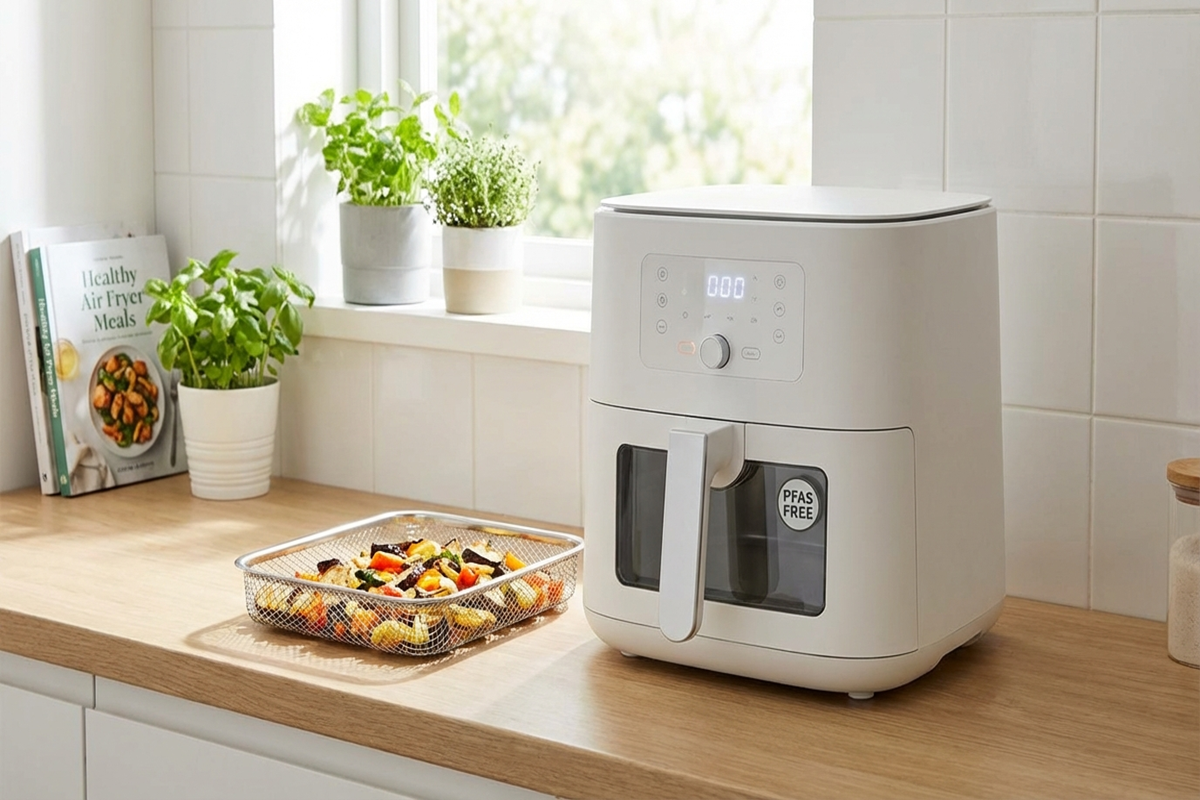
Air fryers have quickly become one of the most popular kitchen appliances in modern kitchens. However, as more people become concerned about non-toxic cookware and PFAS chemicals, a common question appears:
Is Teflon dangerous in air fryers?
Many air fryers use nonstick baskets coated with PTFE, often associated with the Teflon brand. While nonstick coatings make cooking and cleaning easier, some consumers worry about the long-term safety of these materials.
In this guide, we’ll explain how Teflon works, whether it is safe in air fryers, and what alternatives exist for people looking for PFAS-free cooking appliances.
What Is Teflon?
Teflon is a brand name commonly used to describe PTFE (Polytetrafluoroethylene).
PTFE is a synthetic material widely used in nonstick cookware because it offers:
• excellent nonstick performance
• easy cleaning
• reduced oil usage
You will commonly find PTFE coatings in:
• frying pans
• baking trays
• air fryer baskets
However, PTFE belongs to a larger group of chemicals known as PFAS (Per- and Polyfluoroalkyl Substances).
These chemicals are often called “forever chemicals” because they can remain in the environment for a very long time.
Are Teflon Air Fryers Safe?
Under normal cooking conditions, most modern air fryers with PTFE coatings are considered safe.
PTFE remains stable at temperatures below approximately 500°F (260°C).
Most air fryers typically operate between:
• 300°F
• 350°F
• 400°F
Because of this temperature range, PTFE coatings generally stay within their safe operating limits during normal cooking.
However, problems may occur if the coating becomes:
• scratched
• damaged
• overheated
When PTFE reaches extremely high temperatures, it may begin to break down and release fumes.
Concerns About PFAS and Nonstick Coatings
The main concern people have with Teflon cookware relates to PFAS chemicals.
In the past, some nonstick products were manufactured using PFOA, a chemical that belongs to the PFAS family.
Today, PFOA has largely been removed from cookware manufacturing.
However, many consumers still prefer avoiding PFAS materials entirely and instead look for PFAS-free kitchen appliances.
Signs Your Air Fryer Coating May Be Damaged
If your air fryer uses a nonstick basket, it’s important to check the coating occasionally.
Signs that the surface may be deteriorating include:
• visible scratches
• peeling coating
• rough texture
• food sticking more than usual
When the coating becomes damaged, it may be safer to replace the basket or the appliance.
PFAS-Free Air Fryer Alternatives
For people who prefer avoiding Teflon completely, several air fryer models use safer materials such as ceramic, stainless steel, or glass.
These materials are often recommended for consumers who want PFAS-free kitchen appliances.
Ceramic Air Fryers
Ceramic-coated air fryers are often marketed as PFAS-free alternatives to traditional nonstick baskets.
One of the most popular ceramic models is:
⭐ Best Overall Ceramic
Ninja AF150AMZ
Benefits include:
• PFAS-free ceramic coating
• excellent heat resistance
• durable nonstick surface
• easy cleaning
Stainless Steel Interior Air Fryers
Some oven-style air fryers avoid coated baskets entirely and instead use stainless steel interiors.
A popular model in this category is:
⭐ Best Stainless Steel Interior
Instant Pot Omni Plus
Advantages include:
• no synthetic nonstick coating
• extremely durable cooking surface
• large cooking capacity
• long appliance lifespan
Glass Bowl Air Fryers
Glass air fryers are another PFAS-free option because they use a glass cooking bowl instead of coated baskets.
One well-known example is:
⭐ Best Fully Glass Air Fryer
Big Boss 16Qt
Benefits include:
• completely PFAS-free cooking surface
• transparent glass bowl for visibility
• simple construction
• easy cleaning
Best PFAS-Free Air Fryers
If you’re looking for safer materials like ceramic, stainless steel, or glass, you can see our full guide comparing the best options.
Should You Avoid Teflon Air Fryers?
For most households, modern Teflon air fryers are safe when used correctly.
They are designed to operate within temperature ranges that keep PTFE stable during cooking.
However, many consumers still prefer PFAS-free alternatives because they want to reduce long-term exposure to synthetic chemicals.
Fortunately, ceramic, stainless steel, and glass air fryers provide several options for people seeking safer materials.
Final Thoughts
Teflon itself is not inherently dangerous when used within normal cooking temperatures. However, concerns about PFAS chemicals have encouraged many consumers to explore alternative materials.
If material safety is important to you, choosing an air fryer made from ceramic, stainless steel, or glass may provide extra peace of mind.
FAQ
Do air fryers contain Teflon?
Many basket-style air fryers use PTFE nonstick coatings, but some models use ceramic, stainless steel, or glass materials instead.
Is PTFE the same as PFAS?
PTFE is part of the PFAS chemical family. While PTFE itself is stable under normal cooking temperatures, some consumers prefer avoiding PFAS materials entirely.
What is the safest air fryer material?
Glass, stainless steel, and ceramic coatings are commonly considered safer alternatives for people concerned about PFAS chemicals.
Leave a Reply