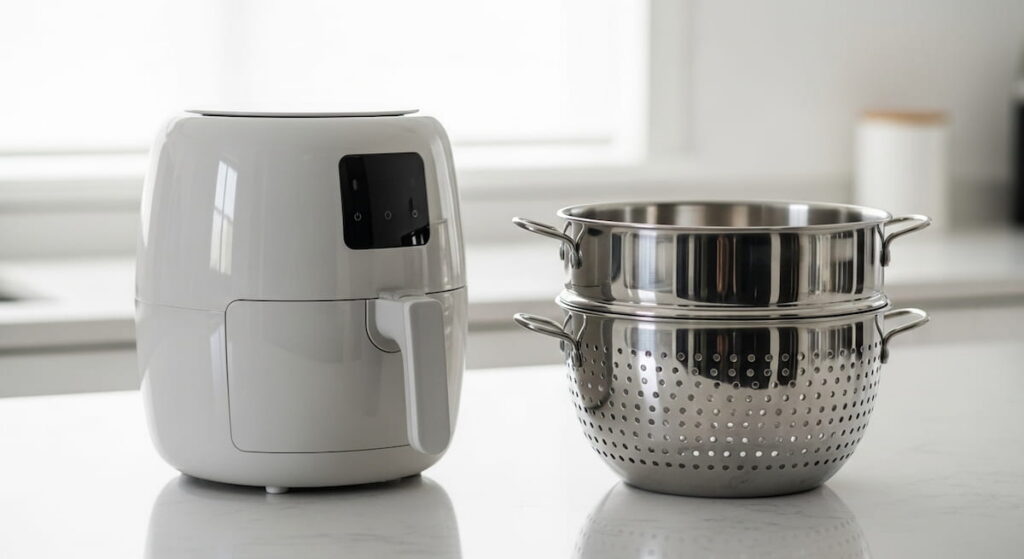
Air fryer vs steamer for baby food is a comparison more new parents are making as both appliances become standard in family kitchens. Both produce soft textures appropriate for early solids. Both avoid the oil and high-heat risks of pan frying. But they work differently, produce different results, and carry different safety profiles — and for baby food specifically, those differences matter. Here’s the honest comparison.
How Each Appliance Cooks Baby Food
A steamer cooks food using hot water vapor at approximately 212°F — the boiling point of water. Food sits in a basket above simmering water and cooks through steam contact. The temperature never exceeds 212°F regardless of how long the food cooks, which means there’s a natural ceiling on heat exposure. Nutrients that are heat-sensitive — particularly water-soluble vitamins like vitamin C and folate — are partially retained because the lower temperature limits degradation, though some leach into the steam water.
An air fryer cooks food using circulated hot air at temperatures between 300°F and 400°F. For baby food, lower settings of 325°F to 375°F produce the soft textures appropriate for early solids. The higher temperature range produces a lightly textured exterior that steaming doesn’t — which is useful for baby led weaning where food needs enough structure to be picked up and held.
Air Fryer vs Steamer for Baby Food — Safety Comparison
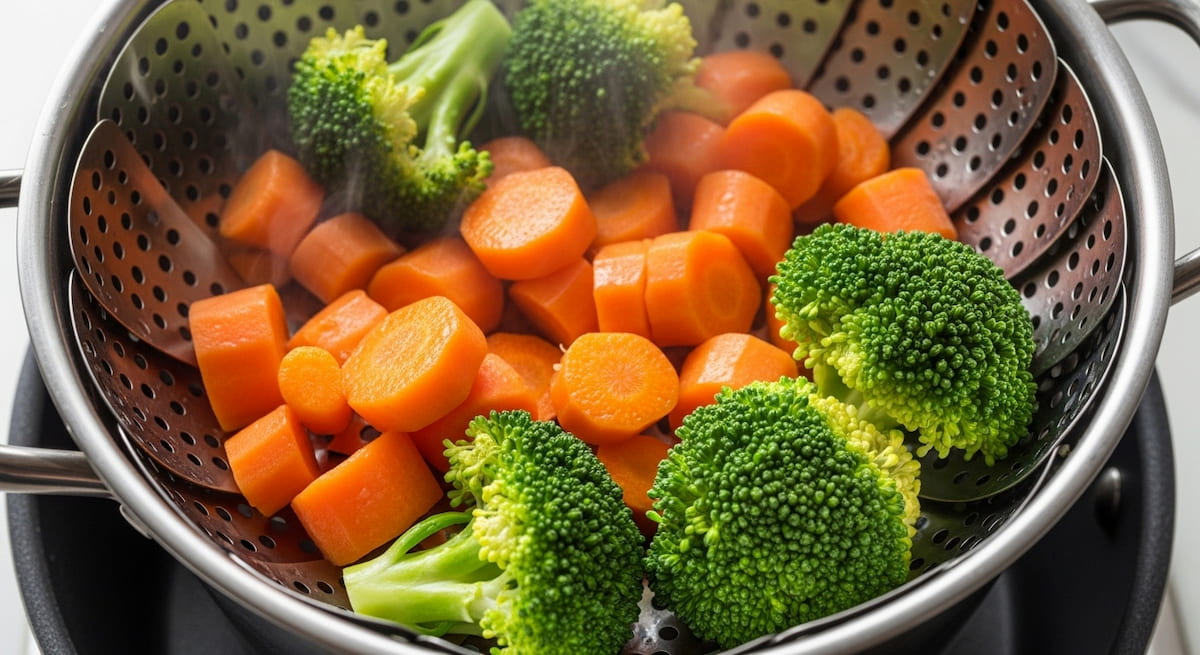
A stainless steel steamer basket produces soft, safe baby food with no coating concern — the lowest-risk cooking surface available for early solids.
| Factor | Steamer | Air Fryer (Ceramic) | Air Fryer (PTFE) |
|---|---|---|---|
| Coating risk | ✅ None (stainless basket) | ✅ None (ceramic) | ⚠️ PTFE degradation risk |
| Max cooking temp | 212°F (steam) | 325–375°F (baby food) | 325–375°F (baby food) |
| Acrylamide risk | ✅ None | 🟡 Low at baby food temps | 🟡 Low at baby food temps |
| Nutrient retention | Good (some leaches to water) | Good (no water contact) | Good (no water contact) |
| Texture for BLW | Very soft, no exterior structure | Soft with light exterior | Soft with light exterior |
| Texture for purees | ✅ Ideal | Good with extra water | Good with extra water |
| Cook time | 10–20 minutes | 10–16 minutes | 10–16 minutes |
Where the Steamer Wins
For pure safety simplicity, a stainless steel steamer basket is the lowest-risk cooking surface available for baby food. The temperature ceiling at 212°F means no acrylamide formation, no coating chemistry at high heat, and no risk of overcooking to a texture unsafe for early solids. A stainless steel steamer basket has no coating at all — nothing to degrade, nothing to monitor, nothing to replace.
For purees specifically, steaming is the better method. Steamed vegetables have higher water content than air-fried ones, which makes them easier to blend to a smooth consistency without adding significant amounts of liquid. A steamed sweet potato blends to a silky puree in seconds. An air-fried sweet potato needs more added liquid to reach the same consistency.
The steamer also wins on simplicity. There’s no temperature setting to think about, no timer to calibrate for texture, and no coating to inspect. For a sleep-deprived new parent in the early months, that simplicity has real value.
Where the Air Fryer Wins
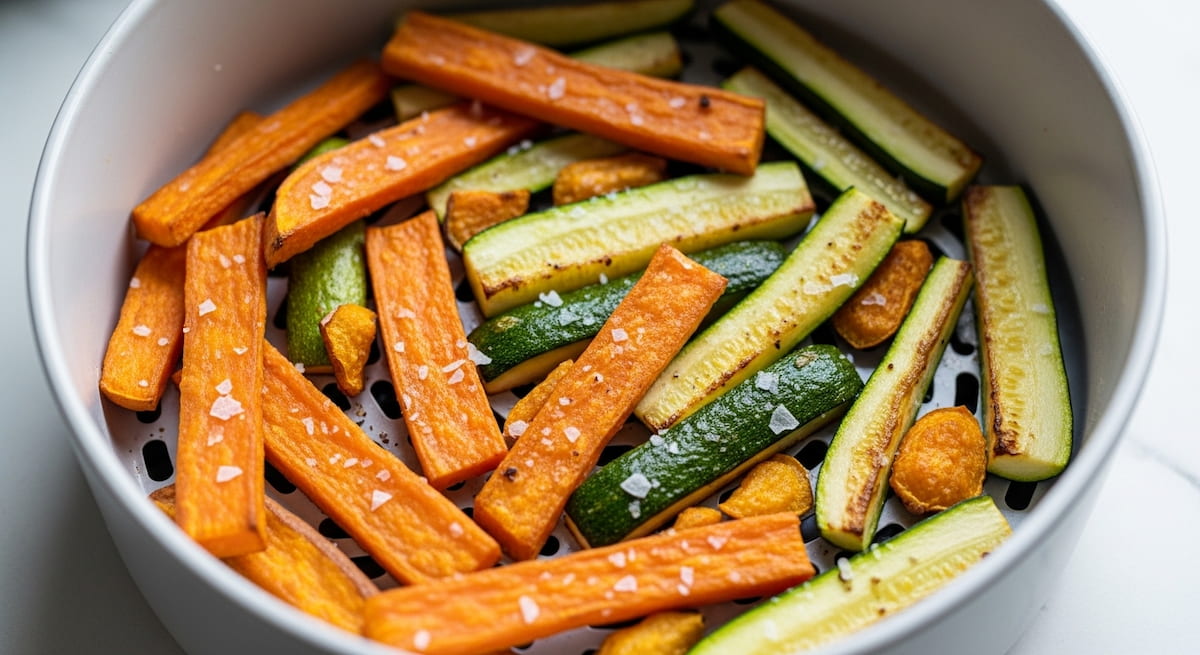
Air-fried sweet potato strips in a ceramic basket reach BLW-appropriate softness with enough exterior structure for a baby to grip and self-feed.
For baby led weaning, the air fryer produces better results than a steamer. BLW finger foods need enough exterior structure to be picked up — a steamed carrot stick is often too slippery and soft to grip reliably. An air-fried carrot stick at 350°F has a slightly firmer exterior that gives a baby something to hold while remaining soft enough to mash with gum pressure.
The air fryer also wins on versatility. As babies grow into toddlers and start eating family foods, the air fryer cooks the full range of what a family eats — proteins, vegetables, reheated leftovers, frozen foods — while a steamer is limited to steaming. One appliance that serves the baby stage and grows with the family is more practical than a dedicated baby food tool that gets retired in 12 months.
For a ceramic air fryer used specifically for baby food, the Ninja AF150AMZ runs low enough temperatures for early solids cooking and is compact enough that it doesn’t take over a kitchen that’s already full of baby gear. Our full PFAS-free air fryer guide covers the safe material options in detail.
Which Should You Get as a New Parent
The honest answer is that both have a place in a new parent’s kitchen — and they’re not expensive enough individually to make choosing between them a difficult financial decision.
A stainless steel steamer basket costs very little and is the right tool for puree-stage cooking in the first six to eight months. A ceramic air fryer is the right tool from baby led weaning onward — and it keeps serving the family well past the baby stage. If budget allows only one, get the ceramic air fryer first. If you’re doing traditional spoon-feeding with purees before moving to finger foods, add a steamer basket as an inexpensive complement.
What neither approach needs is a PTFE-coated air fryer basket. The coating concern that matters least for adult cooking matters most when the primary user of the appliance is an infant eating food in direct contact with the basket surface multiple times per week. Ceramic only for baby food cooking — that’s the non-negotiable in this comparison.
For more on cooking specifically for the earliest stages, our guide on how to make baby food in an air fryer safely covers the full process from first foods through toddler meals.