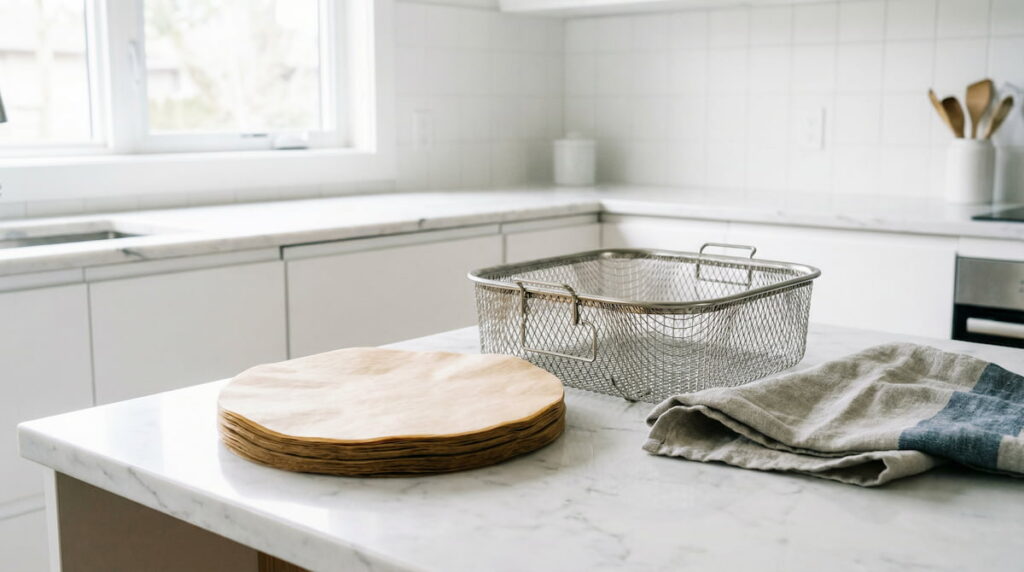
Can you use parchment paper in an air fryer? I started asking this after my aluminum foil incident — the one where loose foil lifted into the heating element and started smoking. I needed a safer liner option, and parchment kept coming up as the alternative. So I tested it properly and here’s what I found.
If you want the full story on why I stopped using foil, I covered it in my post on whether aluminum foil is safe in an air fryer. Short version: it can work, but the risks aren’t worth it for everyday cooking.
Yes, You Can Use Parchment Paper — With Conditions
Parchment paper works in an air fryer, but it’s not as simple as cutting a piece and dropping it in. The same physics that make foil dangerous apply here too — an air fryer runs on high-speed circulating air, and anything lightweight that isn’t held down can move around inside the chamber.
The good news: parchment is safer than foil in most scenarios. It won’t conduct heat the way metal does, it won’t create hot spots, and it’s non-reactive — no leaching concerns with acidic foods the way aluminum has. But it still needs to be used correctly.
The Temperature Question
Most parchment paper is rated to 420°F–450°F. Most air fryer recipes run between 350°F and 400°F. So the overlap is comfortable for everyday cooking — chicken thighs, vegetables, fish fillets, reheating leftovers.
Where it gets risky: some air fryer models run hotter than their display shows, especially near the heating element. If you’re cooking at 400°F and your machine runs 10–15 degrees hot, you’re pushing the limit of cheaper parchment paper. My rule is to stay under 400°F when using parchment, regardless of what the recipe says.
If you’ve ever wondered about the broader question of whether air fryers are bad for your lungs, using the wrong liner at the wrong temperature is exactly the kind of thing that makes that concern more relevant.
Perforated vs. Flat: Which One to Use
This is the detail most articles skip, and it matters more than people realize.
Flat parchment paper — the kind you’d use in a regular oven — blocks airflow when it covers the basket floor. The whole point of an air fryer is that hot air circulates around the food. A solid sheet underneath defeats that. Food ends up steaming instead of crisping, and you lose the main advantage of the appliance.
Perforated parchment liners — pre-cut rounds or squares with holes punched through — are designed specifically for air fryers. The holes let air circulate while still protecting the basket surface. These are worth the small extra cost. I buy them in bulk now and keep them next to the fryer.
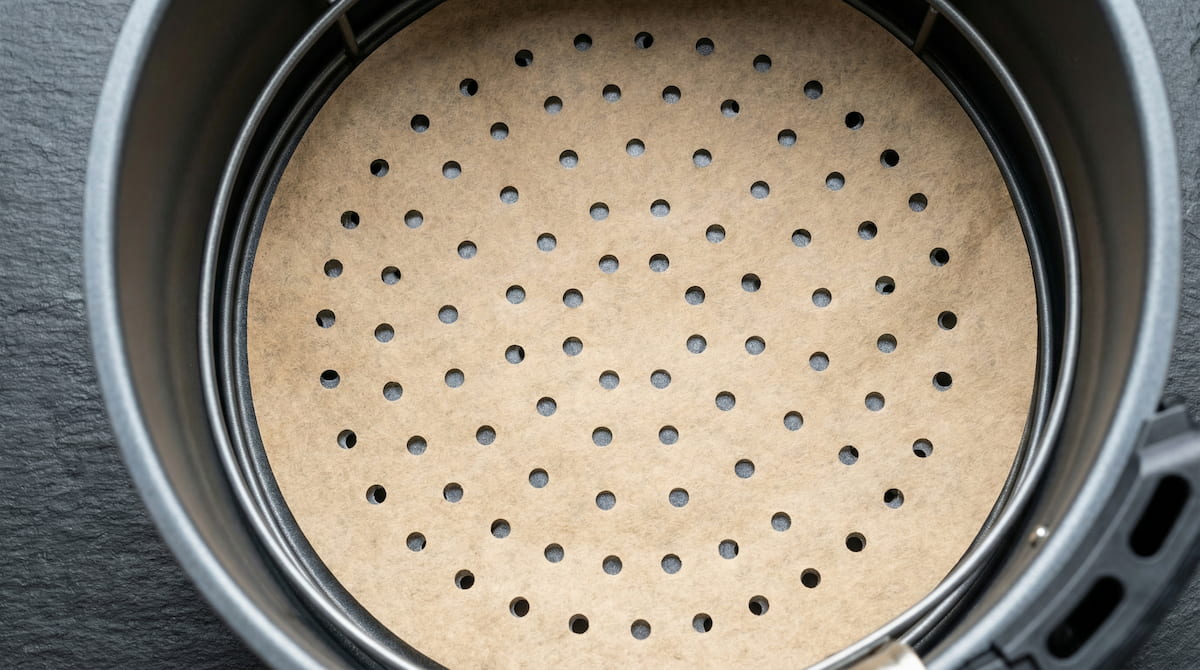
If you only have flat parchment on hand, cut it smaller than the basket floor and leave the edges completely open. It won’t be as effective as perforated, but it’s workable for the occasional messy recipe.
The One Rule That Matters Most
Never put parchment paper in an empty air fryer during preheat.
I know I said this about foil too, but it applies here just as much. Lightweight parchment in an empty, preheating fryer will lift, hit the heating element, and catch fire. This isn’t a hypothetical — there are enough videos of it happening that it’s clearly a common mistake.
The correct sequence: put the food in first, place the parchment under it so the food weighs it down, then start the machine. The food acts as an anchor. Without it, you’re taking an unnecessary risk.
Parchment vs. Silicone Liners vs. No Liner
| Option | Best For | Watch Out For |
|---|---|---|
| Perforated Parchment | Sticky glazes, messy proteins, fish | Don’t preheat empty, stay under 400°F |
| Silicone Liner | Reusable, eco-friendly option | Buy platinum cured only, off-gassing risk with cheap versions |
| No Liner | Crispiest results, everyday cooking | Clean after every use or residue builds up fast |
| Aluminum Foil | Small pieces for tiny food items | Fire risk if loose, leaching with acidic foods |
My honest take: for most everyday cooking, no liner gives you the best results. The basket crisps food better when air can circulate freely underneath. I reach for parchment when I’m cooking something genuinely messy — glazed salmon, heavily seasoned chicken, anything with a sauce that would bond to the basket.
For the full breakdown on silicone liners specifically, I wrote about the safety concerns with air fryer silicone liners — including the off-gassing issue that made me stop using them daily.
Does Parchment Paper Affect Cooking Performance?
Honestly, yes — but less than you’d expect with perforated liners.
With flat parchment covering the full basket floor, food takes noticeably longer and comes out less crispy. The steam from the food has nowhere to escape, so it sits underneath and softens the bottom surface.
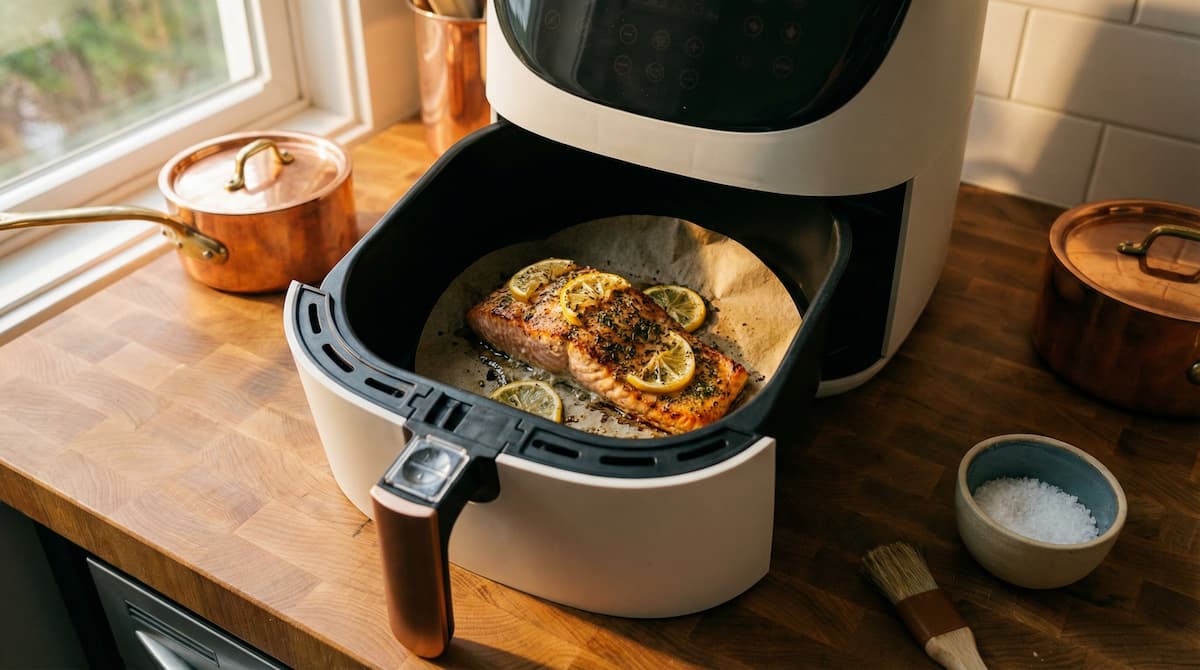
With perforated parchment, the performance difference is small enough that I don’t adjust cooking time. The holes do enough work that air still circulates reasonably well. For things like frozen fries or chicken wings where maximum crispiness matters, I still skip the liner. For fish or anything delicate that I don’t want sticking, perforated parchment is worth the slight tradeoff.
What About Parchment Paper and PFAS?
This came up in my research and it’s worth addressing directly. Some parchment paper is coated with silicone, which is fine. A smaller number of products — particularly some older or budget brands — have used PFAS-based coatings for non-stick properties.
If you’re reading this site, you’re probably already thinking carefully about PFAS in your cookware. The same logic applies to liners. Look for parchment paper that’s explicitly labeled unbleached and PFAS-free. It’s not hard to find — most major brands have moved away from PFAS coatings — but it’s worth checking rather than assuming.
The Basket You’re Using Matters Too
If you find yourself reaching for a liner every single time you cook, that’s often a sign the basket coating is worn or damaged rather than a liner problem. A well-maintained ceramic basket releases food cleanly without any liner for most recipes.
The Ninja AF150AMZ is what I use — ceramic-coated, PFAS-free, and after two years the surface still releases food well enough that I only use parchment for genuinely sticky recipes.
Ninja AF150AMZ — See Today’s Price on Amazon →
For the parchment liners themselves, I use these perforated rounds — unbleached, pre-cut for 4-8Qt baskets, and cheap enough that I don’t think twice about grabbing one for messy recipes.
SIUDANGKA Air Fryer Parchment Liners — See Today’s Price on Amazon →
For more on how to tell when a basket needs replacing, I covered the signs in detail here: How to Tell If Your Air Fryer Coating Is Damaged.
Parchment Paper in an Air Fryer: The Simple Version
Yes, it works. Use perforated liners when you can. Never preheat with an empty liner inside. Stay under 400°F. Put food in first, then the parchment.
For everyday cooking, skip the liner and let the basket do its job. Save the parchment for recipes that actually need it — your food will come out crispier, and your basket will last longer without the extra cleaning stress that comes from liner residue buildup.
Have you had good or bad experiences with parchment in your air fryer? Drop a comment below.
Affiliate Disclosure: This post contains Amazon affiliate links. If you purchase through these links, I earn a small commission at no extra cost to you. I only recommend products I’ve personally researched or used.