Affiliate Disclosure: This post contains Amazon affiliate links. If you purchase through my links, I may earn a small commission at no extra cost to you. I only recommend products I’ve personally tested or thoroughly researched.
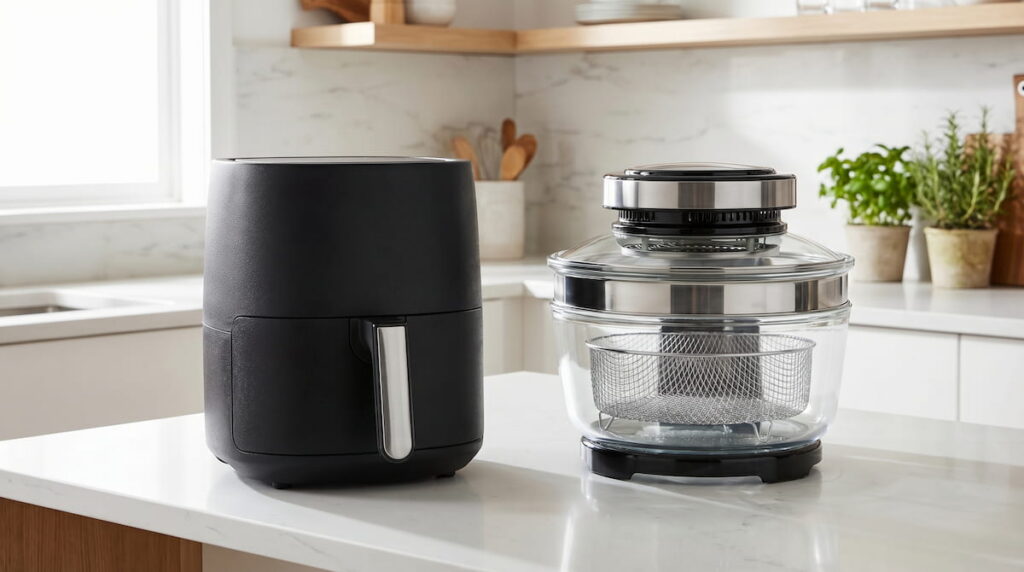
The ceramic vs glass air fryer debate comes down to one core question: which cooking surface is actually safer for daily family cooking — and which holds up better over time?
Both are marketed as PFAS-free alternatives to standard Teflon baskets. But they’re different materials with different properties, different durability profiles, and different tradeoffs. Here’s what I found after researching both specifically from a safety and longevity angle.
Ceramic vs Glass Air Fryer: Quick Comparison
| Feature | Ceramic Coating | Borosilicate Glass |
|---|---|---|
| PFAS-Free | ✅ Yes | ✅ Yes |
| Coating Present | Yes — applied over metal base | No — glass is the surface itself |
| Scratch Risk | Moderate — avoid metal utensils | Low — glass doesn’t scratch easily |
| Odor Absorption | Low | None — fully non-porous |
| Durability | Good with proper care | Excellent — no degradation over time |
| Cooking Visibility | ❌ No | ✅ Full view |
| Capacity Options | 2–6 qt (compact) | 16 qt (large) |
| Price Range | Budget to mid-range | Mid-range |
What “PFAS-Free” Actually Means for Each Material
Both ceramic and glass are free from PTFE and PFOA — the most commonly flagged PFAS compounds in cookware. The EPA’s PFAS research highlights these compounds as a significant health concern, which is why families are increasingly moving away from standard nonstick coatings.
But there’s an important distinction between the two:
- Ceramic coating is applied over a metal base. It’s PFAS-free when intact — but it is still a coating, which means it can scratch, chip, or wear down over time with heavy use or improper care.
- Borosilicate glass is the surface itself — not a coating applied over something else. There’s nothing to scratch away or degrade. The safety profile doesn’t change with use.
Ceramic Air Fryer: The Case For and Against
Ceramic-coated baskets are the most widely available PFAS-free option. They’re compact, affordable, heat up fast, and clean easily. For households cooking 1–3 portions at a time, a ceramic basket like the Ninja AF150AMZ is genuinely practical and safe — as long as you treat the coating with care.
The tradeoff: ceramic coatings are only as safe as their condition. Metal utensils, dishwasher cycles, and aggressive scrubbing all shorten the coating’s lifespan. Once the coating shows visible wear, it’s time to replace the basket or the unit.
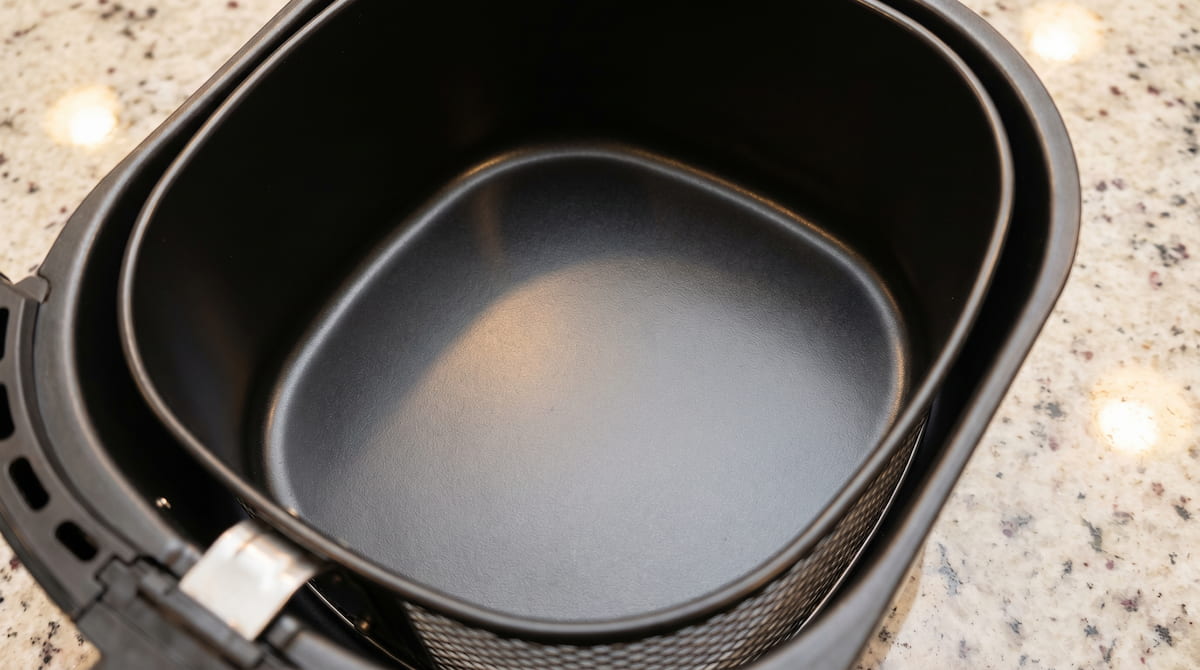
A ceramic basket is PFAS-free when intact — treat it with care and it lasts significantly longer.
Glass Air Fryer: The Case For and Against
Borosilicate glass is inert — it doesn’t react with food, doesn’t absorb odors, and doesn’t change its safety profile with age or heavy use. For families who cook daily and want a surface they never have to think about, glass removes every coating concern permanently.
The Big Boss 16Qt glass bowl is the clearest example of this in practice. At 16 quarts, it handles family-sized portions, the transparent bowl lets you monitor cooking without opening the unit, and cleanup is straightforward after every use.
The tradeoffs: glass units are larger and bulkier, the bowl requires careful handling, and availability can be inconsistent. It’s also not the right pick for a small apartment kitchen with limited counter space.
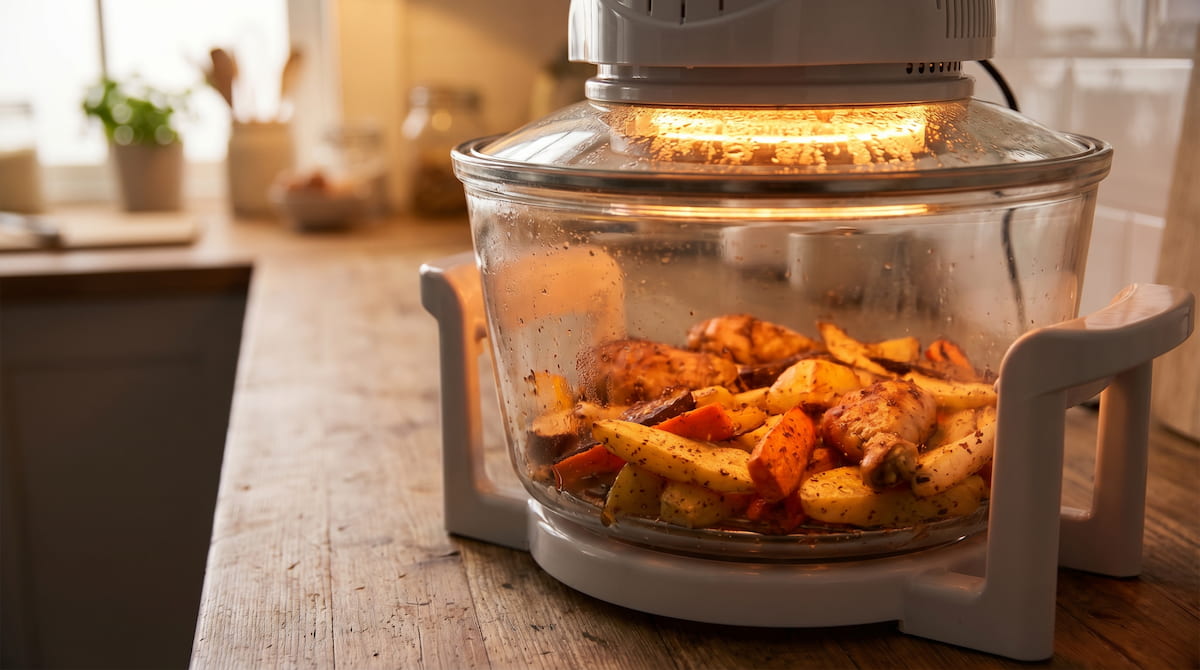
Glass is fully non-porous — no odor absorption, no coating to degrade, ever.
Which Is Actually Safer?
On pure material safety, glass has the edge — it’s a fully inert surface with no coating to degrade. But the practical safety difference between a well-maintained ceramic basket and a glass bowl is small for most households.
The more useful question is fit:
- Choose ceramic if you cook for 1–3 people, have limited counter space, and want a compact PFAS-free option at a lower price. Use soft utensils, hand wash only, and replace when the coating shows wear.
- Choose glass if you cook for a family, want a surface you never have to monitor for wear, and prioritize the purest possible cooking surface for daily use.
My Take
For a family cooking every night, I’d lean toward glass — not because ceramic is unsafe, but because glass removes the maintenance variable entirely. You never have to wonder if the coating is still intact. For a solo cook or small household, ceramic is a practical, safe, and affordable choice.
For a broader comparison of all PFAS-free air fryer materials — ceramic, glass, and stainless steel — see my full guide: Best PFAS-Free Air Fryers: Ceramic, Glass & Stainless Compared.
Affiliate Disclosure: As an Amazon Associate, I earn from qualifying purchases. This means if you click a link and buy something, I receive a small commission — at no extra cost to you. I only recommend products I’ve personally tested or researched thoroughly. My opinions are always my own.