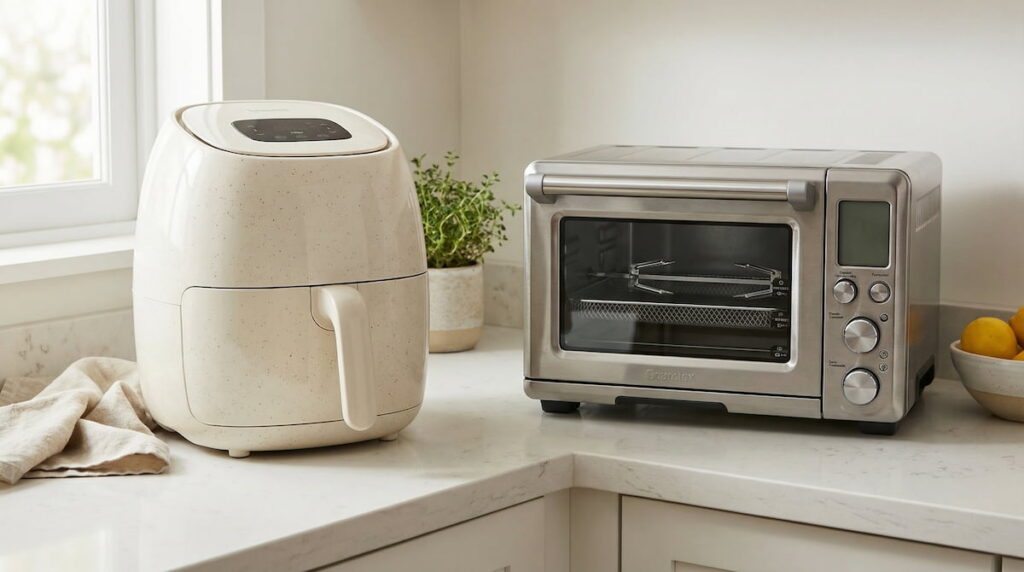
When I started comparing ceramic and stainless steel air fryers, I assumed ceramic would win on safety and stainless would win on durability. The reality is more nuanced — both are genuinely safe choices, and the decision between them comes down to cooking style, household size, and how much maintenance you want to think about.
Here’s the honest breakdown of what each actually delivers for daily family cooking.
What Is a Ceramic Air Fryer?
A ceramic air fryer uses a ceramic-based coating on the basket instead of PTFE. The coating is made from silica minerals — no fluorine-based chemistry, no PFAS compounds. It feels and performs almost identically to a standard nonstick basket, which is why it’s the easiest transition for most households moving away from PTFE.
The trade-off: it’s still a coating. With heavy use, aerosol sprays, or metal utensils, it will thin over time. Hand washing only, and you’ll eventually need to replace the basket. For a detailed breakdown of what ceramic coatings contain and how they behave under heat, see our guide on Ninja ceramic basket safety.
What Is a Stainless Steel Air Fryer?
A stainless steel air fryer — usually an oven-style unit — uses metal racks and trays instead of a coated basket. There’s no synthetic surface layer at all. Stainless steel is an alloy, not a coating, which means nothing can peel, chip, or degrade over time.
The trade-off: food sticks more without a nonstick surface, so you need oil, and the units are larger. Most true stainless interior models are oven-style appliances with a bigger footprint than compact basket air fryers.
What Most People Get Wrong About This Comparison
The most common mistake is treating this as a safety decision when it’s really a practical one. Both ceramic and stainless steel are PTFE-free and PFAS-free — the chemical safety gap between them is essentially zero under normal use. The real differences are durability, cooking convenience, and form factor. Choosing stainless over ceramic for safety reasons alone is solving a problem that doesn’t exist between these two options.
The second mistake is assuming stainless steel means nonstick. It doesn’t — stainless steel requires oil and more active cleaning than ceramic. Families who switch from PTFE nonstick to stainless without adjusting their cooking habits often find food sticking and cleanup frustrating. Ceramic makes the transition from nonstick much smoother.
The third mistake is not checking whether a stainless steel model’s interior is genuinely stainless throughout. Some models have stainless exterior panels but PTFE-coated interior trays — defeating the whole purpose. Always confirm that the cooking trays and racks specifically are stainless steel with no coating. Our guide on what chemicals air fryers release by material type explains why interior surface material is the relevant variable.
Ceramic vs Stainless Steel: Full Safety and Practical Comparison
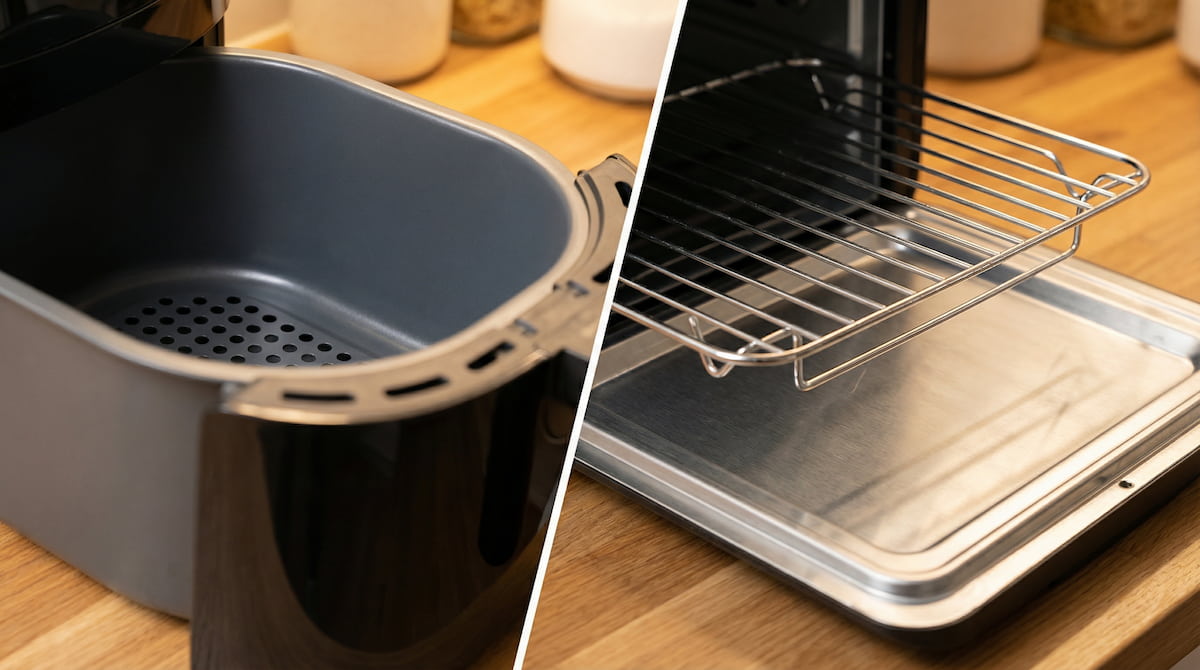
Ceramic coating (left) and stainless steel tray (right) — both PTFE-free, but with fundamentally different surface chemistry and cooking experiences.
| Feature | Ceramic | Stainless Steel |
|---|---|---|
| PFAS risk | ✅ None (if certified) | ✅ None — no coating |
| PTFE risk | ✅ None (if verified) | ✅ None — no coating |
| Safe for birds/pets | ✅ Yes | ✅ Yes |
| Nonstick convenience | ✅ Excellent when new | ⚠️ Poor — needs oil |
| Durability | ⚠️ 2–4 years with care | ✅ 5+ years — no degradation |
| Cleaning ease | ✅ Very easy | ⚠️ More effort required |
| Size options | ✅ Compact available | ⚠️ Larger footprint |
| Coating wear risk | ⚠️ Gradual thinning over time | ✅ None — no coating |
| Replacement needed | ⚠️ Basket every 2–4 years | ✅ No coating replacement |
| Best for | 1–3 people, compact kitchen | Families, larger households |
Safety: Which Is Actually Safer?
Both are safe options — but they’re safe in different ways and for different reasons.
Ceramic eliminates PTFE and PFAS from the coating chemistry. For certified brands with explicit PTFE-free and PFAS-free documentation, the coating is genuinely non-toxic. The only safety consideration that emerges over time is coating wear — which is why maintaining the basket properly matters and monthly inspection is worth doing. Our guide on how long air fryer coatings last covers the ceramic safety timeline in detail.
Stainless steel removes the coating question entirely. There’s nothing to test, nothing to degrade, and nothing to verify on a regular basis. For buyers who want the most structurally conservative choice — or households with pet birds where eliminating every possible coating variable matters — stainless wins on that dimension.
For most families, the difference in daily safety is negligible. The decision should be made on practical grounds, not safety ones.
The Best Options in Each Category
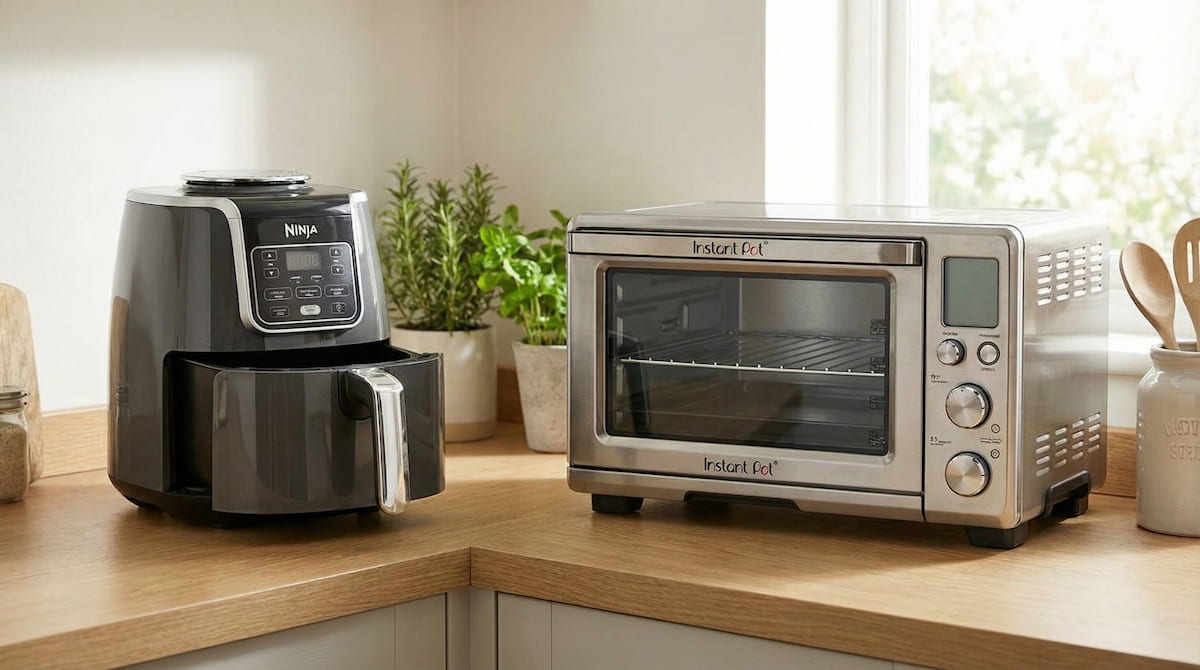
The Ninja AF150AMZ (ceramic) and Instant Pot Omni Plus (stainless) — the two most practical non-toxic options at opposite ends of the size and cooking style spectrum.
Best Ceramic: Ninja AF150AMZ
PTFE-free ceramic coating, compact 5.5Qt size, easy cleanup, digital temperature control. The most practical everyday option for households of 1–3 people who want nonstick convenience without PTFE. Hand wash only, no aerosol sprays, and it delivers well beyond the first year with proper care.
See Ninja AF150AMZ on Amazon →Best Stainless Steel: Instant Pot Omni Plus 18L
True stainless steel interior throughout, 18L capacity, multiple cooking functions. No coating anywhere in the cooking chamber — nothing to degrade, nothing to replace on a coating timeline. The most durable non-toxic option available for families who can accommodate the larger footprint.
See Instant Pot Omni Plus on Amazon →How to Choose Between Ceramic and Stainless Steel
Choose ceramic if:
- You want nonstick convenience without PTFE
- You cook for 1–3 people and prefer a compact appliance
- Counter space is limited
- You’re transitioning from a PTFE nonstick model and want the smoothest adjustment
Choose stainless steel if:
- You’re cooking for a family of 4+ and need larger capacity
- You want maximum long-term durability with no coating replacement cycle
- You don’t mind using a bit of oil and accepting more active cleaning
- You have pet birds or household members with chemical sensitivities who benefit from zero coating chemistry
If neither feels right for your situation, glass is a third option — completely inert, fully transparent, but the largest footprint and most fragile of the three. Our glass vs stainless steel air fryer comparison covers that side of the decision in full detail.
Frequently Asked Questions
Is ceramic or stainless steel safer for air frying?
Both are equally safe from a chemical standpoint — neither contains PTFE or PFAS. The safety difference between a verified ceramic-coated basket and a stainless steel interior is negligible for most families. The choice between them is a practical one, not a safety one.
Does ceramic coating wear out faster than stainless steel?
Yes — ceramic is a coating that thins over time, while stainless steel has no coating to degrade. A well-maintained ceramic basket lasts 2–4 years. Stainless steel trays last 5+ years with no coating-related replacement concern. For families who don’t want to think about basket replacement cycles, stainless has a clear durability advantage.
Is stainless steel air fryer better for families with birds?
Both are safe for bird households — neither contains PTFE. The stainless steel option has a slight theoretical advantage because there is no coating chemistry of any kind, eliminating even the question of coating certification. For most bird households, a verified PTFE-free ceramic model is equally safe in practice.
Can you use a stainless steel air fryer without oil?
For most foods — no, not practically. Stainless steel doesn’t have nonstick properties, so foods with lower fat content will stick without oil. Foods with naturally high fat content like chicken thighs cook well on stainless with minimal added oil. This is the main practical trade-off compared to ceramic.
Which is easier to clean — ceramic or stainless steel?
Ceramic is significantly easier to clean because food releases well from the nonstick surface. Stainless steel requires more active scrubbing to remove stuck-on food, though stainless trays are typically dishwasher safe — which somewhat offsets the extra effort for daily cleaning.
What if I want both nonstick convenience and maximum durability?
The most practical answer is ceramic now, stainless eventually. Start with a ceramic model for the nonstick transition experience, and when that basket eventually needs replacing, evaluate whether your cooking habits have shifted enough to make stainless practical. Many families find the transition to stainless easier after a year or two of adjusting to non-PTFE cooking generally.
The Bottom Line: Ceramic vs Stainless Steel Air Fryer
Ceramic is the more practical daily choice for most families — nonstick convenience, compact size, and easy cleanup make it the smoothest transition from PTFE nonstick. Stainless steel is the more conservative long-term choice for buyers who want to eliminate the coating variable entirely and don’t mind a larger unit and more active cleaning.
Neither is wrong — the right choice depends on how you cook and what you’re optimizing for. For a full comparison of all three non-toxic surface types including glass, our PFAS-free air fryer guide covers the complete 2026 landscape.