Affiliate Disclosure: This post contains affiliate links. If you purchase through my links, I may earn a small commission at no extra cost to you. I only recommend products I’ve personally researched and trust for my own family.
If you want to know how to cook frozen salmon in air fryer without ending up with dry, rubbery fish — or worse, without knowing what’s coming off your basket coating at high heat — this guide covers both.
Salmon was one of the first things I tried in our air fryer after I started paying attention to what we were actually cooking on. It’s a weekly protein in our house, and I wanted to make sure we were doing it right — both for taste and for safety.
Here’s the full breakdown.
Why Air Fryer Works Well for Frozen Salmon
Salmon is naturally high in fat, which makes it more forgiving than lean proteins like chicken breast when cooked from frozen. The fat content helps it stay moist even during the rapid high-heat cooking an air fryer delivers.
The circulating hot air also produces a lightly crisped exterior while keeping the interior tender — something that’s hard to replicate with a microwave or stovetop when starting from frozen.
That said, salmon cooks faster than chicken, which means the margin for error is smaller. A couple of extra minutes and you’ve gone from flaky to dry. Temperature control matters here more than with most proteins.
How to Cook Frozen Salmon in Air Fryer: Step-by-Step
Step 1 — Preheat to 390°F (199°C)
Preheat for 3–5 minutes before adding the fish. Salmon benefits from immediate high heat to develop a light crust on the outside while keeping the center from overcooking.
Step 2 — Place fillets skin-side down, single layer
Don’t stack or overlap. Skin-side down helps protect the flesh from direct contact with the basket and makes removal cleaner. If your fillets are thick, add a very light brush of avocado oil to the top surface.
Step 3 — Cook at 390°F for 12–15 minutes
No flipping needed for most fillets. The circulating air handles both sides evenly enough. Thin fillets (under 1 inch) are typically done at 12 minutes. Thicker cuts need closer to 15.
Step 4 — Check for doneness
The FDA recommends an internal temperature of 145°F (63°C) for fish. A thin instant-read thermometer inserted into the thickest part is the most reliable method. Visually, the flesh should be opaque throughout and flake easily with a fork.
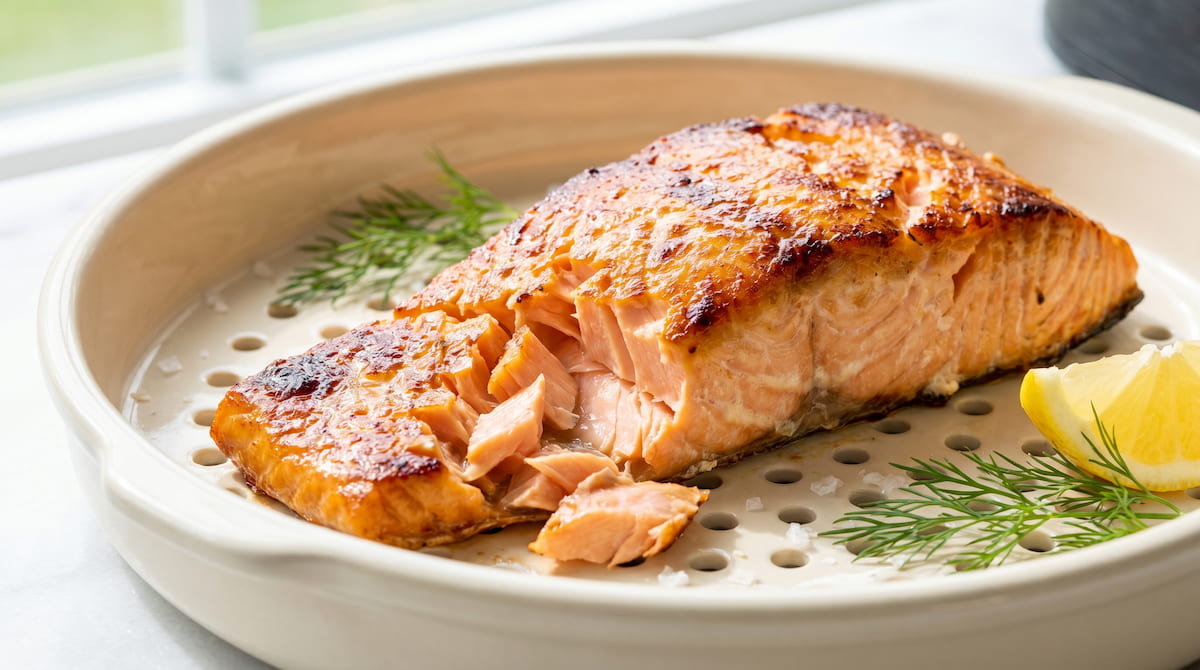
Properly cooked frozen salmon in a ceramic air fryer basket — flaky texture, no rubbery center.
Step 5 — Rest for 2 minutes before serving
Salmon continues to cook briefly after it’s pulled from the basket. A short rest prevents the center from being pushed past the ideal temperature by residual heat.
The Coating Issue That Most Salmon Guides Skip
Salmon cooks at 390°F — one of the higher temperatures commonly used in air fryer cooking. That’s the range where PTFE-based nonstick coatings, found in most standard air fryer baskets, begin to experience meaningful stress over repeated use.
If the coating is already scratched or degraded, that temperature becomes more of a concern. Salmon also has natural oils that interact with the basket surface differently than dry proteins do — meaning residue buildup on a compromised coating is more likely.
According to FDA guidance on PFAS and food safety, certain fluoropolymer compounds used in nonstick coatings remain an active area of research. The precautionary recommendation for families is to minimize exposure where practical — and high-heat cooking on worn coatings is one of the more avoidable exposure points.
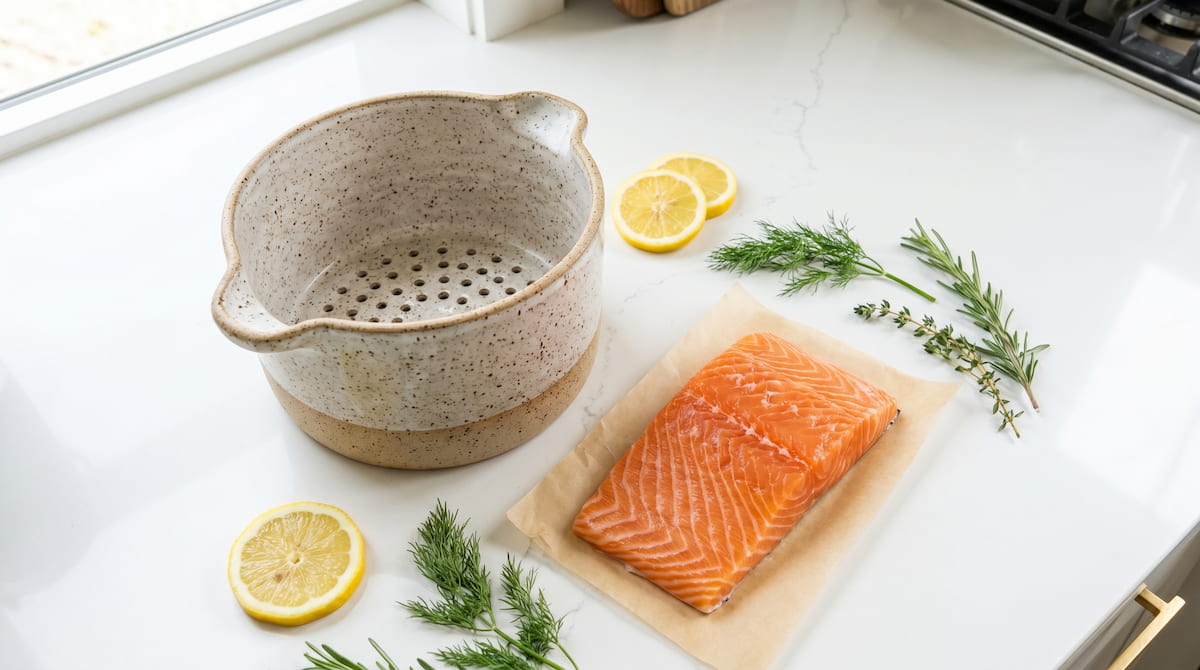
Starting with quality ingredients and a clean ceramic basket makes a difference — especially at the higher temps salmon requires.
I switched to a ceramic-coated basket for all our fish cooking after noticing a faint chemical smell during early high-heat cooks. The ceramic surface handles 390°F without any of those issues, and cleanup is significantly easier with salmon’s natural oils.
Frozen Salmon Cook Time Reference
| Fillet Type | Temp | Time | Flip? |
|---|---|---|---|
| Thin fillet (under 1″) | 390°F | 11–12 min | No |
| Standard fillet (1–1.5″) | 390°F | 13–15 min | No |
| Thick fillet (over 1.5″) | 390°F | 16–18 min | Optional at 10 min |
| Salmon burger (frozen) | 380°F | 12–14 min | Yes, at 7 min |
Always confirm with a thermometer. Fillet thickness varies significantly between brands and cuts, so times are a starting point — not a guarantee.
Which Air Fryer Basket Is Best for Fish?
Fish at high heat is one of the more demanding use cases for air fryer baskets. The combination of natural oils, high temperature, and moisture creates conditions that accelerate coating wear on PTFE surfaces.
| Basket Type | For Fish Cooking | Notes |
|---|---|---|
| Ceramic-coated | ✅ Recommended | PTFE-free, handles fish oils well, easy cleanup |
| Stainless steel | ✅ Best long-term | No coating to degrade, most durable option |
| PTFE nonstick (intact) | ⚠️ Use with caution | Fine if undamaged, but fish oils speed up wear |
| PTFE nonstick (scratched) | ❌ Avoid | High heat plus fish oils plus damaged coating — avoid |
The air fryer I use for fish in our house is the Ninja AF150AMZ. Ceramic basket, compact enough for weeknight fillets, and the cleanup after salmon is straightforward. It’s held up well over regular use.
If you’re regularly cooking salmon for a larger family and need more basket space, the Instant Pot Omni Plus 18L handles full fillets side by side without crowding.
Common Mistakes When Cooking Frozen Salmon in Air Fryer
Overcrowding the basket. Salmon releases moisture during cooking. If fillets are too close together, steam builds up between them and you lose the crisp exterior that makes air-fried salmon worth eating.
Cooking at too low a temperature. Some guides recommend 350°F for fish to play it safe. For frozen salmon specifically, that temperature often results in a rubbery texture and uneven cooking through the center. 390°F with a short cook time produces a better result.
Skipping the thermometer. Salmon can look done on the outside while the center is still below 145°F. This is especially true for thick wild-caught fillets, which are denser than farmed varieties.
Not checking the basket condition first. If your basket coating is visibly scratched or flaking, that’s the cook to skip — or the moment to replace it. For more on basket lifespan, see my guide on how long air fryer baskets last.
Frozen Salmon in Air Fryer: What You’re Actually Getting
Done right, frozen salmon in an air fryer produces a result that’s genuinely good — lightly crisped exterior, moist interior, and ready in under 15 minutes with no thawing. The key variables are temperature accuracy, basket condition, and not pushing the cook time past the point where the fish starts to dry out.
Use a ceramic or stainless basket, check internal temperature, and you have a reliable weeknight protein that requires almost no prep.
For a full guide on which air fryers use safe coatings for regular fish cooking, see my breakdown of PFAS-free air fryers. And if frozen chicken is also a regular in your rotation, the frozen chicken air fryer guide covers the same safety angle for poultry.