Disclosure: This post contains affiliate links. If you purchase through them, I earn a small commission at no extra cost to you. I only recommend products I personally trust for my family.
Why does my air fryer smell worse over time is something most regular users notice around the 3–6 month mark — the unit that smelled fine when new starts producing a stronger, more unpleasant odor with every cook. I’m Wook, a bus driver and dad who cooks for my family almost every night. I went through this exact progression with our first air fryer, and understanding what was actually causing the smell to intensify changed both how I clean and how long I keep a unit before replacing it.
Why Air Fryer Smells Get Worse Over Time: 5 Causes
1. Cumulative Grease Layering
Every cook cycle deposits a thin layer of grease on the basket, drawer, and interior walls. Each subsequent cook bakes that layer further — polymerizing it into a sticky, increasingly pungent residue that regular washing struggles to fully remove. After months of daily use without periodic deep cleaning, these layers compound into a thick, rancid-smelling coating that releases intensifying odors every time the unit heats up.
This is the most common and most fixable cause of worsening smell. A thorough deep clean — including the heating element, interior walls, and drawer — addresses this buildup directly. The challenge is that the smell often returns faster after each cleaning as the baked-on layers become more embedded over time.
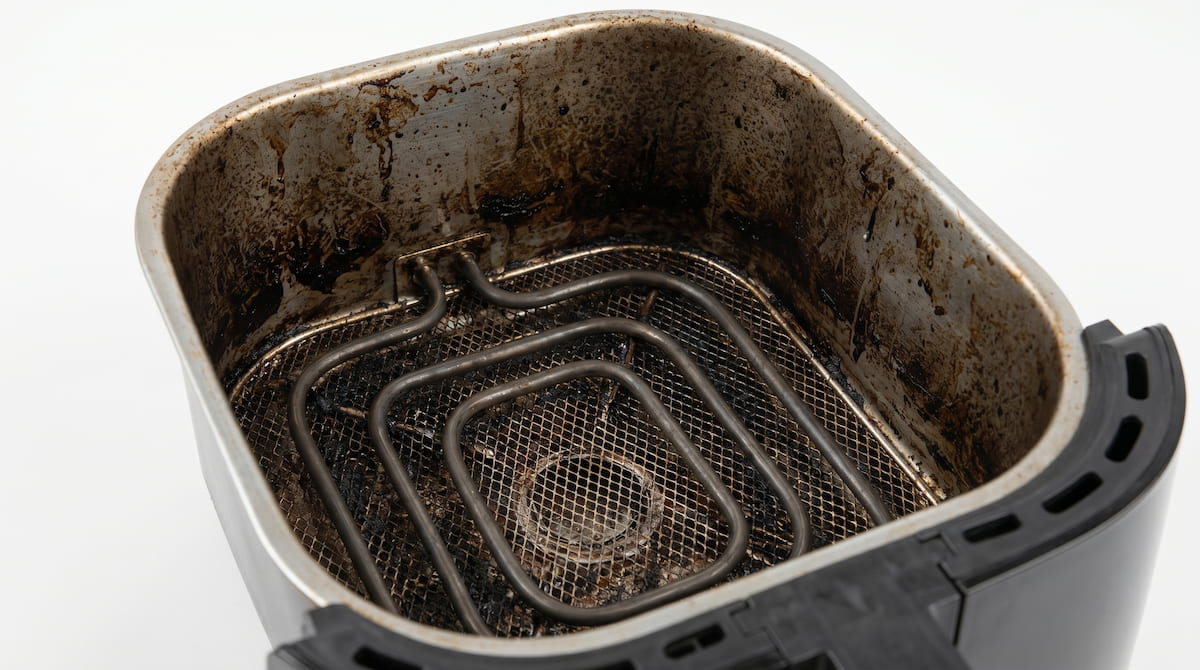
Accumulated baked-on grease layers are the primary driver of air fryer smells that worsen progressively over months of use.
2. Basket Coating Degradation
This is the cause that matters most from a safety standpoint. As nonstick or ceramic coatings age and degrade with heat cycles, they begin to off-gas during cooking — producing chemical or plastic-like smells that intensify as the coating breaks down further. Unlike grease smell — which is unpleasant but relatively inert — coating off-gassing introduces chemical compounds into your cooking environment.
According to the U.S. EPA, PFAS chemicals found in traditional nonstick coatings are persistent in the body and environment. A coating that’s progressively worsening in smell is a coating that’s progressively breaking down — and that breakdown is not reversible with cleaning.
3. Heating Element Grease Carbonization
Grease that reaches the heating element doesn’t just sit there — it carbonizes with repeated heat exposure, creating a layer of burnt carbon compounds that smell increasingly acrid with every cook. Unlike basket and drawer grease which can be washed away, carbonized grease on the heating element requires careful mechanical removal with a soft brush and is easy to miss during routine cleaning.
4. Aerosol Spray Residue Buildup
Aerosol cooking sprays leave a polymer film on basket surfaces that builds up with each use and burns progressively worse over time. What starts as a barely noticeable smell from a new aerosol residue layer intensifies into a sharp, chemical-adjacent odor after months of accumulation. This is a completely avoidable smell source — switching to a pump mister or skipping oil entirely eliminates it.
5. Moisture and Bacterial Growth in Gaps
The interior of an air fryer has gaps, seams, and recessed areas that trap moisture and food particles. Over time — particularly if the unit is stored while still slightly warm and humid — this trapped organic material can develop bacterial or mold growth that produces musty, increasingly foul odors. This smell is distinctly different from grease or chemical smells — it’s more musty and organic in character.
How to Identify Which Cause Is Yours
| Smell Character | Likely Cause | Fix |
|---|---|---|
| Rancid cooking oil smell | Grease layer buildup | Deep clean all surfaces |
| Chemical or plastic smell | Coating degradation | Replace basket or unit |
| Sharp acrid burnt smell | Heating element carbonization | Clean heating element thoroughly |
| Sharp chemical on every cook | Aerosol spray residue | Degrease, switch to pump mister |
| Musty, moldy character | Moisture and bacterial growth | Deep clean, dry completely before storage |
How to Fix a Worsening Air Fryer Smell
For Grease Buildup — Baking Soda Paste Treatment
Mix 3 tablespoons of baking soda with enough warm water to make a thick paste. Apply to all basket and drawer surfaces and let sit for 15–20 minutes. The alkaline baking soda breaks down the acidic grease compounds that standard dish soap struggles with. Scrub gently with a soft brush and rinse thoroughly.
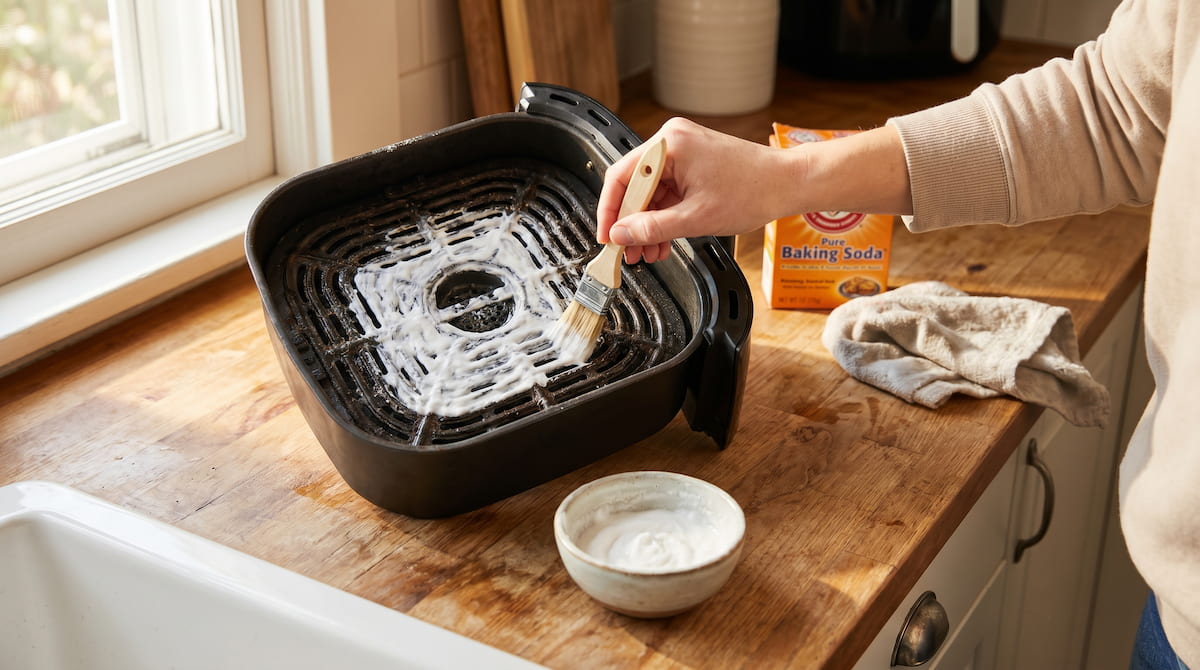
Baking soda paste is the most effective non-toxic treatment for baked-on grease that causes worsening air fryer smell.
For Heating Element Carbonization
Flip the unit upside down, use a dry soft-bristle brush to remove loose carbon from the element, then follow with a barely damp cloth wipe. Allow to dry completely — at least 30 minutes — before use.
For Coating Degradation
Cleaning will not reverse coating degradation smell. If the smell is chemical or plastic in character and has been worsening progressively, the coating is the source and replacement is the only resolution.
When Worsening Smell Means It’s Time to Replace
A grease smell that responds to deep cleaning and stays manageable between cleans is a maintenance issue. A chemical or plastic smell that worsens despite cleaning is a coating issue — and cleaning cannot fix it. For the full replacement decision guide: How to Tell When Your Air Fryer Needs to Be Replaced (Safety Signs)
And for the complete safe deep cleaning process that addresses most fixable smell causes: How to Deep Clean an Air Fryer Safely (Without Toxic Chemicals)
Bottom Line
An air fryer that smells worse over time is experiencing one of five progressive processes — and four of them are fixable with the right cleaning approach. Grease layering, heating element carbonization, aerosol residue, and moisture buildup all respond to deep cleaning. Coating degradation does not — and a unit producing a progressively worsening chemical or plastic smell needs to be replaced, not cleaned more aggressively. Identify which smell you’re dealing with first, then apply the right fix for that specific cause.