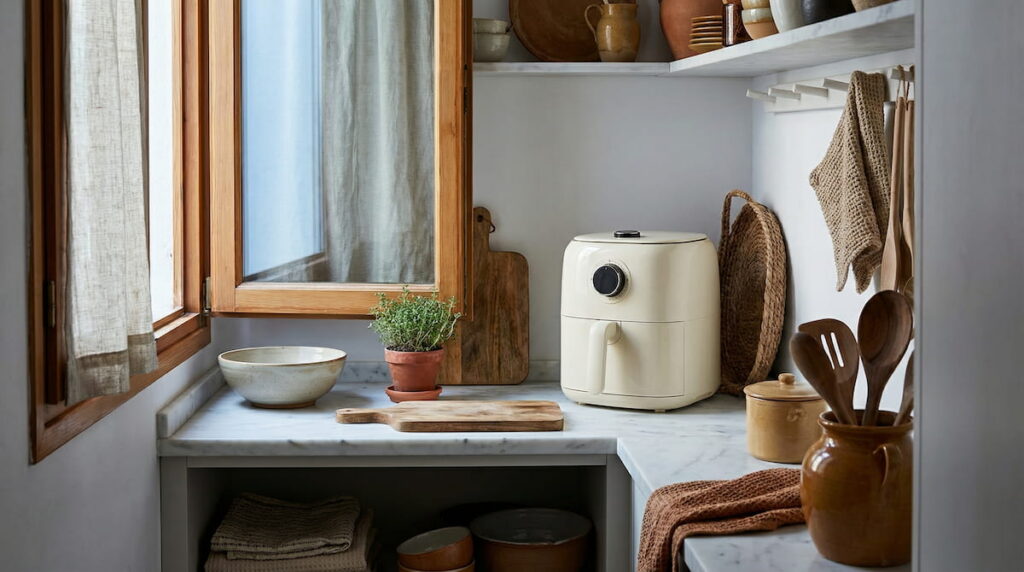
Air fryer small kitchen safety was something I didn’t think about until my wife pointed out that our kitchen window was fogging up every time I used the air fryer. Our kitchen isn’t tiny by any measure, but it’s not large either — a galley-style layout with one window and a range hood that’s more decorative than functional.
If you’re cooking in a studio apartment, a small condo kitchen, or any space where the air fryer sits closer to walls and cabinets than you’d like, there are a few things worth knowing. Most of them are simple. None of them should stop you from using your air fryer — but they’re worth getting right.
The Main Concerns in a Small Kitchen
Running an air fryer in a small kitchen raises three practical issues: ventilation, heat buildup, and clearance. They’re related but distinct, and each one has a straightforward solution.
Ventilation: The Most Important Factor
Air fryers circulate hot air at high speed inside a sealed cooking chamber. The exhaust — hot air, cooking vapors, and any compounds released during heating — vents out through the back or top of the unit, depending on the model.
In a large, open kitchen with good airflow, that exhaust disperses quickly. In a small kitchen with limited air exchange, it can accumulate — which means cooking odors linger longer, and any compounds released during cooking stay in the air longer too.
This matters more if you’re cooking fatty foods that produce smoke, if you’re using an air fryer with a PTFE-coated basket, or if anyone in your household has respiratory sensitivities.
The fix is straightforward: active ventilation every time you cook. Range hood on, window open, or both. You’re not trying to eliminate all cooking vapors — that’s not realistic in any kitchen. You’re just keeping the air moving so nothing accumulates.
If your kitchen has no window and a non-functional range hood, a small box fan placed near the cooking area and pointed toward a door or hallway does the job. It’s not elegant, but it works.
Heat Buildup Around the Unit
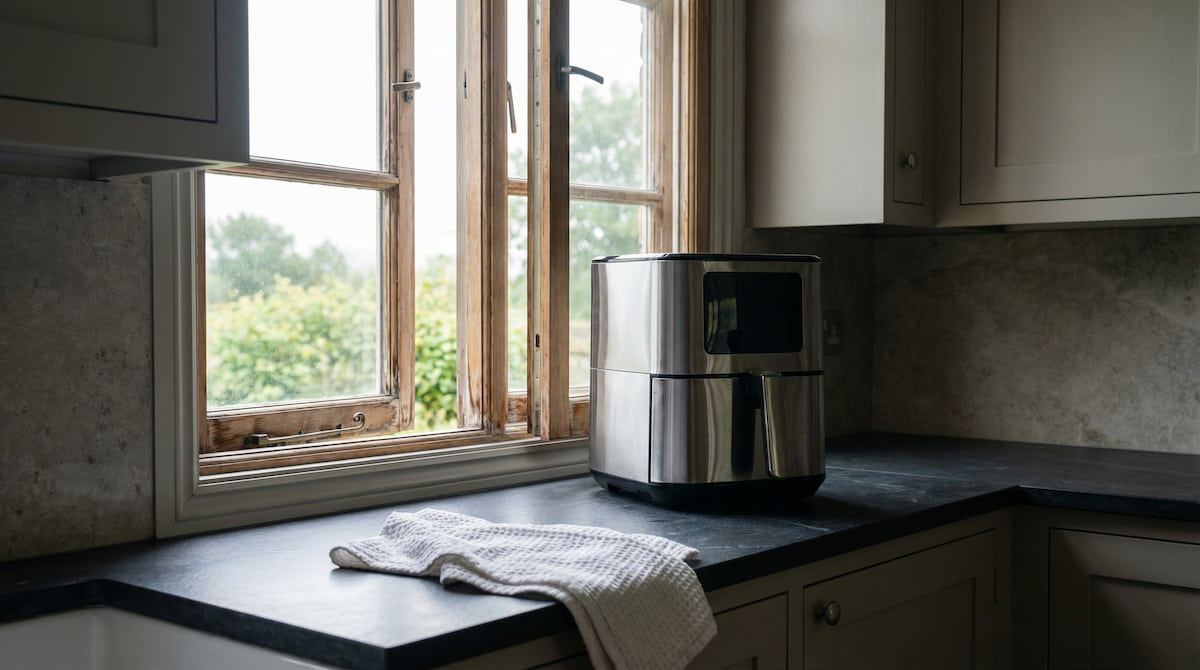
Air fryers generate significant heat — not just inside the cooking chamber, but from the exterior of the unit itself. The sides, back, and top can get hot during and after a cooking cycle. In a small kitchen where the air fryer sits close to walls, cabinets, or other appliances, this heat has nowhere to go.
Sustained heat exposure isn’t good for cabinet finishes, nearby plastic items, or anything heat-sensitive stored close to the unit. More practically, a cramped air fryer that can’t dissipate heat properly may run hotter than intended, which puts more stress on the unit itself over time.
Most manufacturers specify minimum clearance distances — typically 5 inches on the sides and back, and several inches above the unit. In a small kitchen, actually maintaining those clearances sometimes requires repositioning the air fryer away from its usual spot during cooking.
I started pulling my air fryer a few inches away from the backsplash before each use. It takes three seconds and I don’t think about it anymore.
Countertop Placement
Beyond clearance from walls, the surface the air fryer sits on matters. Air fryers have rubber feet that keep them off the counter, but the underside still gets warm during extended cooking cycles.
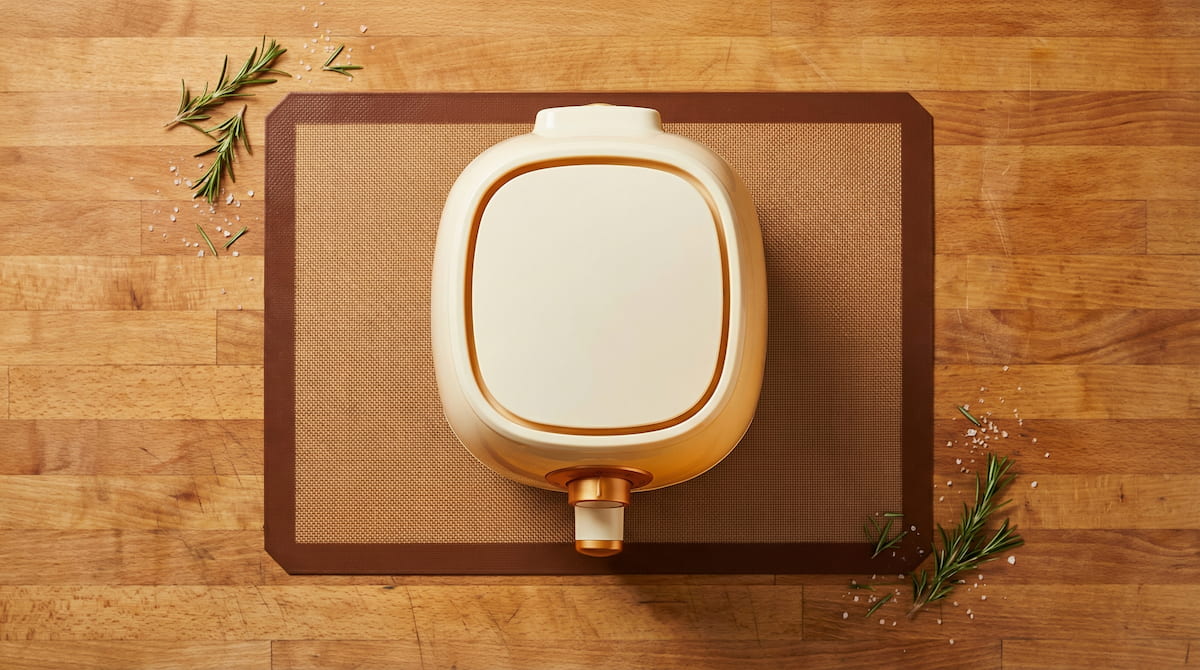
Placing the air fryer directly on a wooden countertop for long cooking sessions isn’t ideal. A silicone mat or a thin cutting board underneath provides a buffer and protects the surface. This is a small kitchen issue more than a large kitchen one — in a bigger space you might have a dedicated appliance area with a tile or stone surface. In a small kitchen, the air fryer often ends up on whatever counter space is available.
Fire Safety Basics
Keep flammables away from the exhaust. Paper towels, dish towels, and plastic bags near the exhaust vent are a hazard. In a small kitchen where counter space is limited, it’s easy for things to migrate close to the unit without noticing.
Don’t leave it unattended on the first use. Manufacturing residue burns off during initial heating and produces smoke. In a small kitchen that smoke has less room to go. Stay nearby, keep ventilation running, and you won’t have issues.
Clean it regularly. Grease buildup in the basket and drip tray is the most common source of smoke during cooking. In a small kitchen where smoke has less room to disperse, a dirty air fryer becomes a much bigger nuisance. A quick wipe-down after each use takes less than two minutes.
What About Carbon Monoxide?
Air fryers are electric appliances — they don’t produce carbon monoxide. CO is a byproduct of incomplete combustion, which requires burning fuel (gas, wood, charcoal). An electric air fryer produces heat through a resistive heating element, not combustion.
If you have a gas range in your small kitchen and use it alongside the air fryer, standard CO safety applies — but that’s a gas appliance concern, not an air fryer one.
Is a Small Kitchen Actually a Problem?
Honestly, not really — as long as you’re paying attention to the basics. Millions of people use air fryers in apartment kitchens, studio setups, and small condos without issues. The concerns above are real but manageable with simple habits.
The two things I’d prioritize if space is limited: ventilation and clearance. Get those right and the rest follows naturally.
If you’re also thinking about which air fryer works best in a tight space, compact models in the 2–4 quart range take up significantly less counter space and exhaust less heat than larger oven-style units. My guide to PFAS-free air fryers covers some of the better smaller options if you’re in the market.
Small Kitchen Air Fryer Safety Checklist
| Habit | Why It Matters | How Often |
|---|---|---|
| Run range hood / open window | Clears cooking vapors and heat | Every use |
| Maintain 5″ clearance on sides and back | Prevents heat buildup and cabinet damage | Every use |
| Place silicone mat underneath | Protects countertop from heat | Every use |
| Keep flammables away from exhaust | Basic fire safety | Every use |
| Wipe basket and drip tray | Prevents grease smoke buildup | After each use |
| Deep clean basket | Removes stubborn grease residue | Weekly |
The Bottom Line
Air fryer small kitchen safety comes down to airflow, clearance, and cleanliness. None of these require special equipment or major changes to how you cook. They’re small habits that make a real difference in a space where there’s less room for error.
I’ve been cooking in a tight kitchen for years now. The air fryer is still one of the most-used appliances in the house — I’ve just learned to give it a little more breathing room than I used to.
Affiliate Disclosure: This site participates in the Amazon Services LLC Associates Program. If you click a link and make a purchase, I may earn a small commission at no extra cost to you. I only recommend products I’ve personally researched and would use for my own family.