Affiliate Disclosure: This post contains affiliate links. If you purchase through my links, I may earn a small commission at no extra cost to you. I only recommend products I’ve personally researched and trust for my own family.
What is PTFE coating in air fryers — and should you actually be worried about it? After the chemical smell coming off my old air fryer sent me down a research rabbit hole, I spent weeks digging into what PTFE actually is, when it becomes a problem, and what I switched to as a result. Here’s everything I found.
What Is PTFE?
PTFE stands for polytetrafluoroethylene — a synthetic fluoropolymer that’s been used in nonstick cookware since the 1940s. You probably know it better by its brand name: Teflon. It’s the slippery coating that makes food slide off a pan without sticking, and it’s used in the vast majority of conventional air fryer baskets sold today.
PTFE itself is considered chemically inert at normal cooking temperatures — meaning it doesn’t react with food and doesn’t dissolve into what you’re eating. The problem isn’t the coating sitting there quietly. The problem is what happens when it gets too hot.
When Does PTFE Become Dangerous?
According to research reviewed by the U.S. Environmental Protection Agency (EPA), PTFE begins to break down at temperatures above 500°F (260°C). At that point it can release fluoropolymer fumes — a mix of gases that can cause flu-like symptoms in humans (sometimes called “Teflon flu” or polymer fume fever) and are potentially fatal to pet birds.
At normal air fryer cooking temperatures — typically 350°F to 400°F — an intact PTFE coating is generally considered low-risk for healthy adults. The danger increases when:
- The air fryer is preheated empty at maximum temperature
- The coating is scratched, flaking, or degraded
- The kitchen is small and poorly ventilated
- The appliance is a cheap model with a thin, low-quality coating
I covered the temperature breakdown in more detail in my post on what temperature PTFE starts to break down.
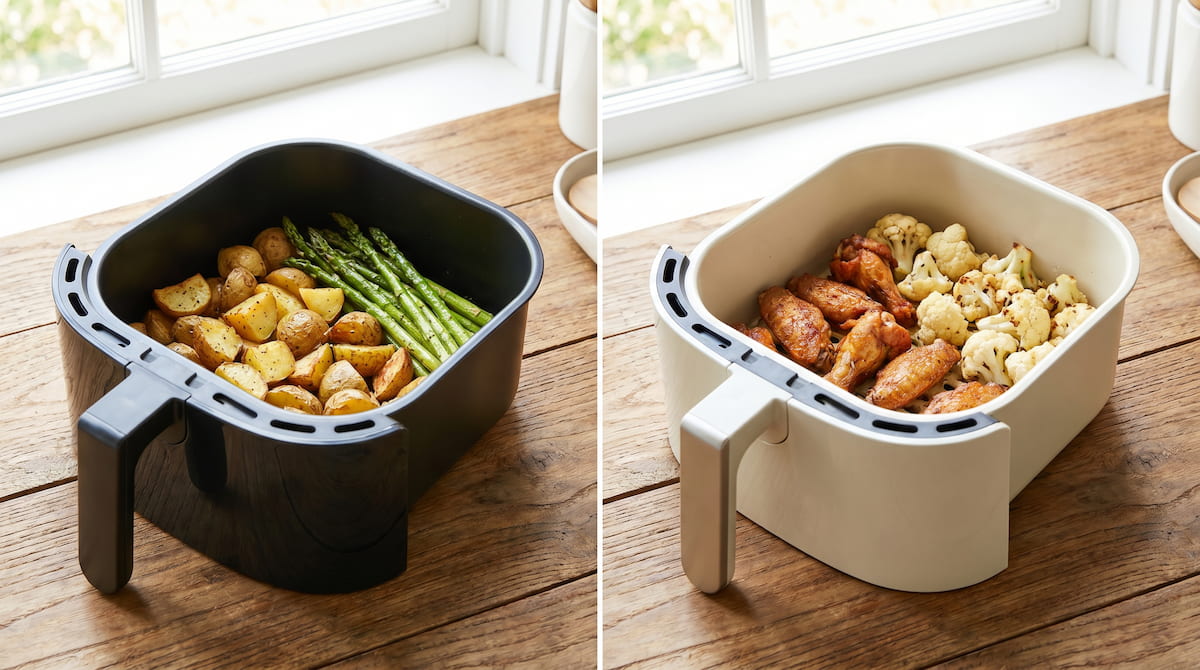
PTFE-coated baskets (dark) vs ceramic-coated baskets (light) — the coating material makes a significant difference in safety profile.
What Is PTFE Coating in Air Fryers vs Other Chemicals?
PTFE often gets confused with PFOA and PFAS — and for good reason, because they’re related but different things.
| Chemical | What It Is | Current Status |
|---|---|---|
| PTFE | The actual nonstick coating (Teflon) | Still widely used — considered safe at normal temps |
| PFOA | Chemical formerly used to manufacture PTFE | Phased out in the US by 2013 — linked to health concerns |
| PFAS | Broad class of thousands of fluorochemicals | Under increasing regulatory scrutiny — PTFE is technically a PFAS |
The key takeaway: most modern air fryers are PFOA-free, but that doesn’t mean they’re PTFE-free. Many brands advertise “PFOA-free” while still using PTFE coatings. If you want to avoid fluoropolymers entirely, you need to specifically look for PTFE-free models. For more on this distinction, see my full guide on PTFE vs PFAS.
Is PTFE Coating in Air Fryers Safe? My Honest Take
For a healthy adult using a quality air fryer at normal temperatures with good ventilation — probably fine. But “probably fine” wasn’t good enough for me when I thought about my kids eating food out of that basket every day. The uncertainty alone was enough to make me switch.
The bigger issue is that most people don’t cook perfectly. We forget to check if the coating is scratching. We preheat on max. We use the fryer in a small kitchen without opening a window. Every one of those scenarios nudges the risk upward — and with a ceramic alternative available at a similar price, there’s no good reason to accept that risk.
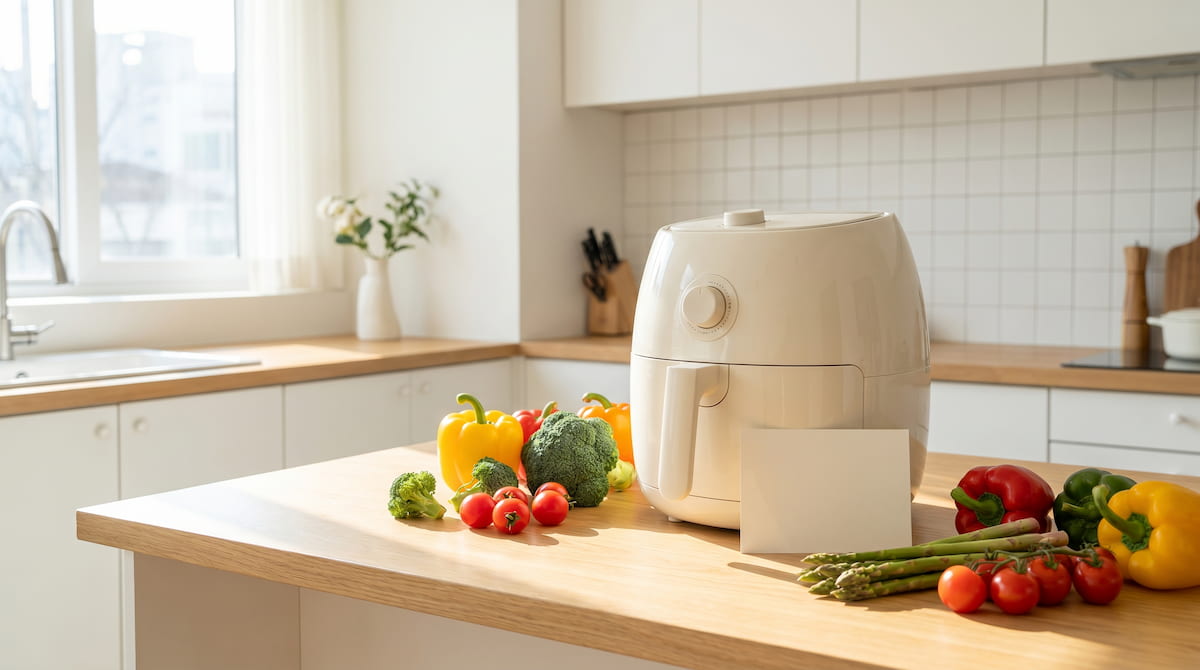
Switching to a PTFE-free ceramic air fryer eliminates the guesswork about coating safety entirely.
What to Use Instead of PTFE-Coated Air Fryers
There are three main PTFE-free options worth considering:
1. Ceramic-Coated Air Fryers
Ceramic coatings are made from inorganic minerals — no fluoropolymers, no PTFE, no PFOA. They’re naturally nonstick, easy to clean, and safe at normal cooking temperatures. The tradeoff is that ceramic coatings can wear faster than PTFE if you use metal utensils or abrasive cleaners — but with proper care they last well. The Ninja AF150AMZ is my top ceramic pick.
See Today’s Price on Amazon →2. Stainless Steel Air Fryers
Stainless steel interiors have no coating at all — nothing to flake, nothing to overheat, nothing to worry about. The Instant Pot Omni Plus 18L uses a stainless steel interior and is a solid choice for families who want zero coating concerns. I reviewed it in my Instant Pot Omni Plus full review.
See Today’s Price on Amazon →3. Glass Air Fryers
Glass cooking chambers eliminate coating concerns entirely. The Big Boss 16Qt uses a glass bowl design — you can see exactly what’s happening inside and there’s no coating to degrade. I covered it in my Big Boss Glass Air Fryer review.
See Today’s Price on Amazon →What Is PTFE Coating in Air Fryers — Bottom Line
PTFE is the nonstick fluoropolymer coating used in most conventional air fryer baskets. At normal cooking temperatures it’s generally considered low-risk, but it breaks down above 500°F and releases fumes that are concerning — especially for birds, children, and anyone in a small poorly ventilated space. If you want to eliminate the risk entirely, ceramic or stainless steel are the straightforward alternatives.
For a full comparison of safe air fryer materials, visit my main guide: Best PFAS-Free Air Fryers (2026).