Affiliate Disclosure: This post contains affiliate links. If you purchase through my links, I may earn a small commission at no extra cost to you. I only recommend products I’ve personally researched and trust for my own family.
What is PFAS in air fryer coatings — and why should you care? When I first started researching the chemical smell coming off my old air fryer, PFAS kept coming up. The more I read, the more I realized this wasn’t just environmental jargon. It was directly relevant to what my family was eating every day. Here’s what I found.
What Is PFAS?
PFAS stands for per- and polyfluoroalkyl substances — a large family of thousands of synthetic chemicals that have been manufactured and used in industrial and consumer products since the 1940s. They’re sometimes called “forever chemicals” because they don’t break down naturally in the environment or in the human body.
PFAS are used in a huge range of products: waterproof clothing, food packaging, firefighting foam, stain-resistant carpet — and nonstick cookware. According to the U.S. Environmental Protection Agency (EPA), certain PFAS compounds have been linked to a range of health concerns including immune system effects, thyroid disruption, and increased cancer risk with long-term exposure.
Where Do PFAS Show Up in Air Fryers?
The most common place PFAS appear in air fryers is in the nonstick coating on the basket. Most conventional air fryer baskets use PTFE — polytetrafluoroethylene — as their nonstick coating. PTFE is technically classified as a PFAS compound, though it’s considered more stable than many other PFAS chemicals.
The bigger historical concern was PFOA — a PFAS chemical used in the manufacturing process for PTFE coatings. PFOA was phased out in the US by 2013 after being linked to serious health effects. Most air fryers today are advertised as “PFOA-free” — but that doesn’t mean they’re PFAS-free or PTFE-free. The coating is still there, just made without that one specific processing chemical.
For a deeper look at how PTFE and PFAS relate to each other, see my guide on PTFE vs PFAS.
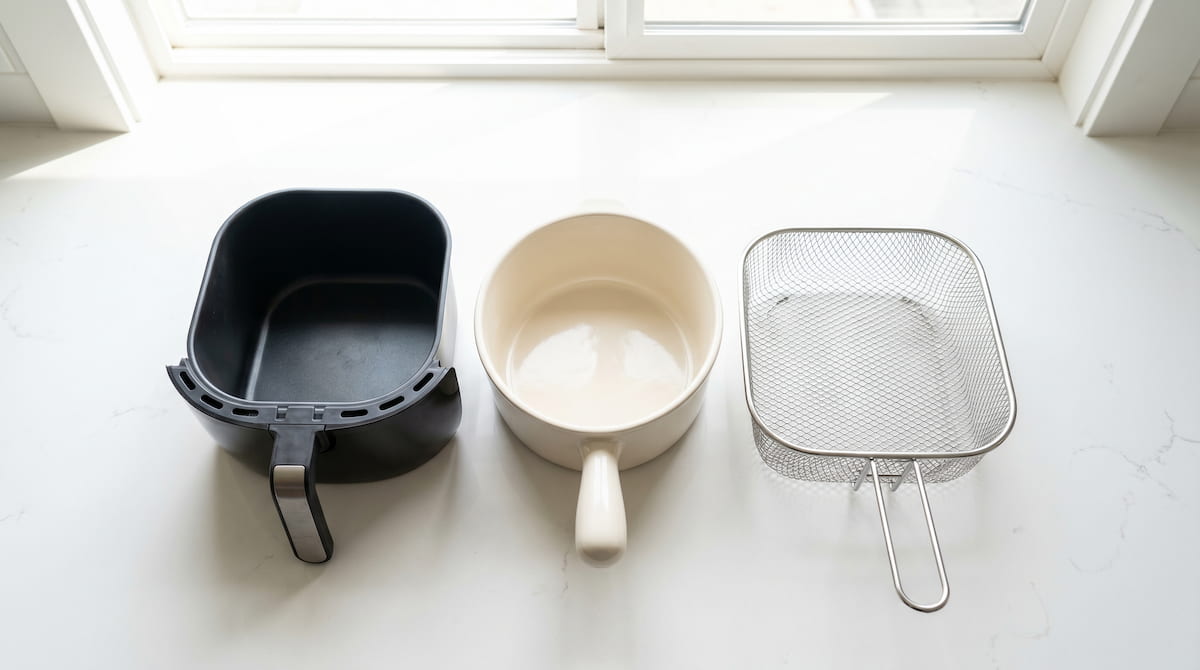
Not all air fryer coatings are equal — nonstick, ceramic, and stainless steel carry very different PFAS risk profiles.
Is the PFAS in Your Air Fryer Actually Dangerous?
This is where it gets nuanced. PTFE itself — the coating on most nonstick air fryer baskets — is considered chemically stable at normal cooking temperatures. It doesn’t leach into food the way some other chemicals do. The concern arises in two specific scenarios:
- Overheating: Above 500°F (260°C), PTFE begins to break down and release fluoropolymer fumes. These fumes can cause flu-like symptoms in humans and are potentially fatal to pet birds. I covered this in detail in my post on what temperature PTFE starts to break down.
- Coating damage: A scratched or flaking basket means small particles of the coating can end up in your food. Even if PTFE itself is inert, ingesting flaked coating material is something most people reasonably want to avoid. See my guide on how to tell if your air fryer coating is damaged.
What Is PFAS in Air Fryer Terms — A Simple Breakdown
| Term | What It Means | In Your Air Fryer |
|---|---|---|
| PFAS | Broad class of thousands of fluorochemicals | PTFE is technically a PFAS compound |
| PTFE | The actual nonstick coating (Teflon) | Found in most conventional air fryer baskets |
| PFOA | Processing chemical formerly used to make PTFE | Phased out by 2013 — most fryers now PFOA-free |
| PFAS-free | No fluoropolymer chemicals in the coating | Ceramic and stainless steel air fryers qualify |
How to Avoid PFAS in Your Air Fryer
The simplest solution is to choose an air fryer that doesn’t use fluoropolymer coatings at all. There are three main options:
1. Ceramic-Coated Air Fryers
Ceramic coatings use inorganic mineral compounds — no PTFE, no PFOA, no fluoropolymers. They’re naturally nonstick, run clean at high temperatures, and are the most accessible PFAS-free option. The Ninja AF150AMZ is my top pick — I’ve used it daily for over six months with zero coating concerns.
See Today’s Price on Amazon →2. Stainless Steel Air Fryers
No coating at all — just bare stainless steel. Nothing to flake, nothing to overheat, nothing to research. The Instant Pot Omni Plus 18L uses a stainless steel interior and is a great family-sized option. See my full Instant Pot Omni Plus review for details.
See Today’s Price on Amazon →3. Glass Air Fryers
A glass cooking chamber means no coating of any kind. The Big Boss 16Qt is the standout option here — I reviewed it in my Big Boss Glass Air Fryer review.
See Today’s Price on Amazon →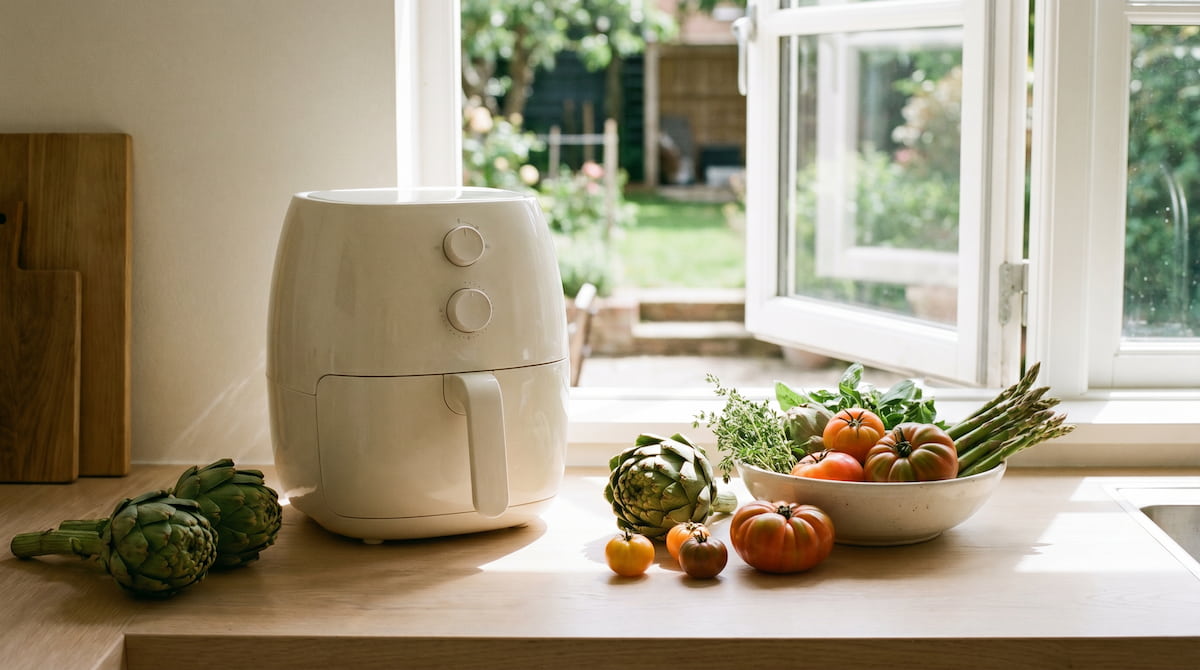
A ceramic air fryer with good kitchen ventilation is one of the simplest ways to eliminate PFAS risk from your daily cooking.
What About “PFAS-Free” Labels on Air Fryers?
Marketing language around PFAS can be confusing. Here’s how to read it:
- “PFOA-free” — means they stopped using one specific processing chemical. The PTFE coating is likely still there.
- “PTFE-free” — means no fluoropolymer nonstick coating. This is the label you want.
- “Ceramic coating” — generally means PTFE-free, but verify with the manufacturer if you want certainty.
- “Non-toxic coating” — vague marketing term. Look for specific material claims instead.
For a full breakdown of how to read air fryer labels and choose safely, see my guide on how to choose a non-toxic air fryer.
What Is PFAS in Air Fryer — Bottom Line
PFAS is a broad class of synthetic fluorochemicals, and PTFE — the nonstick coating in most conventional air fryers — is technically part of that family. At normal cooking temperatures, intact PTFE is considered low-risk. But if you want to eliminate the uncertainty entirely, ceramic and stainless steel air fryers are the straightforward solution. That’s the switch I made, and I haven’t looked back.
For a full list of the safest air fryer options available right now, visit my main guide: Best PFAS-Free Air Fryers (2026).