Affiliate Disclosure: This post contains affiliate links. If you purchase through my links, I may earn a small commission at no extra cost to you. I only recommend products I’ve personally researched and trust for my own family.
PFOA vs PTFE in air fryers — these two terms get used interchangeably all the time, but they’re actually very different chemicals with very different risk profiles. When I started researching what was in my old air fryer’s coating, untangling these two was one of the first things I had to do. Here’s the clearest breakdown I can give you.
PFOA vs PTFE: The Basic Difference
PTFE (polytetrafluoroethylene) is the actual nonstick coating — the slippery surface on your air fryer basket that keeps food from sticking. It’s been used in cookware since the 1940s and is still the dominant nonstick material in most conventional air fryers today.
PFOA (perfluorooctanoic acid) is a completely different chemical — it was used as a processing aid during the manufacturing of PTFE. PFOA itself was never intentionally in the coating, but trace amounts ended up in finished products. After research linked PFOA to serious health effects including kidney cancer, thyroid disease, and developmental issues, it was phased out in the US by 2013 under an EPA-led program.
So when a brand says “PFOA-free,” they mean they no longer use that manufacturing chemical. The PTFE coating itself is almost certainly still there.
Which One Should You Actually Worry About?
Historically, PFOA was the bigger concern — it’s persistent in the body, accumulates over time, and has been linked to a range of serious health conditions. The good news is that it’s largely gone from consumer products in the US. According to the U.S. Environmental Protection Agency (EPA), PFOA was eliminated from US manufacturing by 2013, and most imported products have followed suit.
PTFE is the ongoing question. At normal cooking temperatures — 350°F to 400°F — intact PTFE is considered chemically stable and low-risk. The concern kicks in above 500°F, when PTFE begins to break down and release fluoropolymer fumes. I covered exactly when this happens in my post on what temperature PTFE starts to break down.
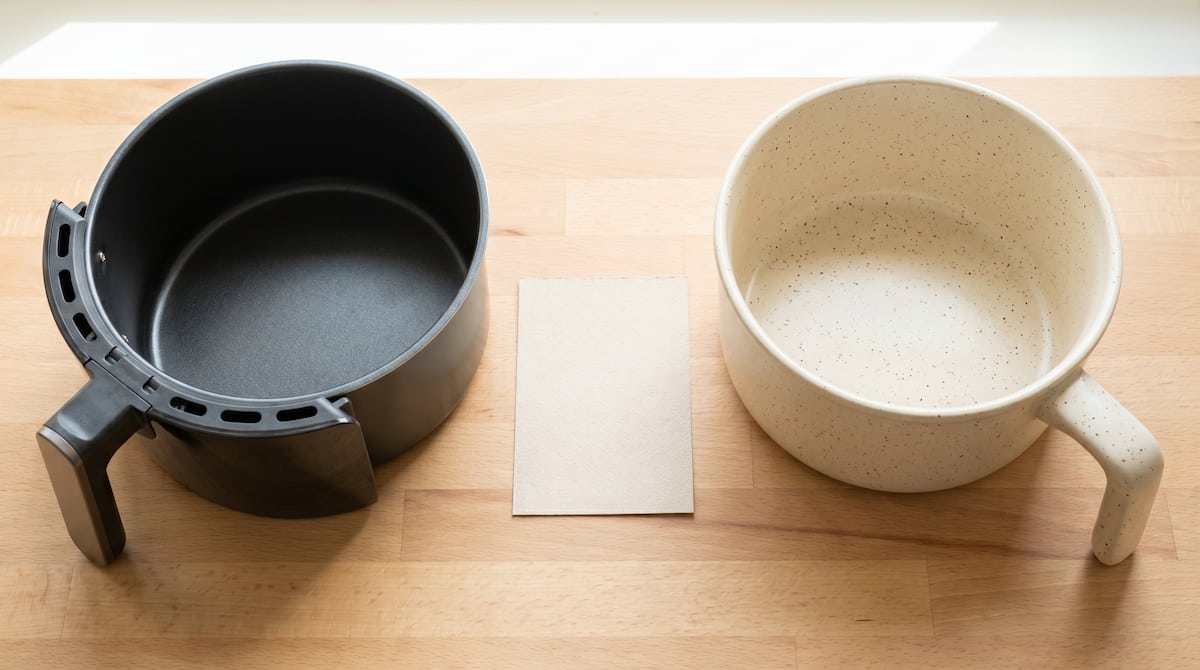
The dark nonstick basket contains PTFE coating — the light ceramic basket contains neither PFOA nor PTFE.
PFOA vs PTFE in Air Fryers: Side-by-Side Comparison
| Feature | PFOA | PTFE |
|---|---|---|
| What it is | Manufacturing processing aid | The actual nonstick coating |
| Still in products? | No — phased out by 2013 in US | Yes — widely used today |
| Health concern | Linked to cancer, thyroid, development | Fume risk above 500°F |
| Risk at normal cooking temps | N/A — no longer present | Low if coating is intact |
| How to avoid | Already avoided in modern products | Choose ceramic or stainless steel |
What “PFOA-Free” Actually Means on an Air Fryer Label
This is where a lot of shoppers get misled. When you see “PFOA-free” on an air fryer box, it sounds reassuring — and it is, to a point. It means the manufacturing process didn’t use that particular chemical. But it says nothing about PTFE.
A “PFOA-free” air fryer can still have a full PTFE nonstick coating. The label is technically accurate but incomplete. If you want to avoid fluoropolymers entirely, you need to look specifically for “PTFE-free” — or choose ceramic or stainless steel. I covered how to read these labels in detail in my guide on how to choose a non-toxic air fryer.
The Cleaner Alternative: No PFOA, No PTFE
If you want to sidestep both chemicals entirely, ceramic and stainless steel air fryers are the straightforward answer. Neither uses fluoropolymer coatings of any kind.
Ninja AF150AMZ — Ceramic, PTFE-Free, PFOA-Free
The Ninja AF150AMZ uses a ceramic-coated basket with no PTFE and no PFOA. It’s the model I switched to after my research, and after six months of daily use I’ve had zero coating concerns. Compact, easy to clean, and genuinely non-toxic. I reviewed it fully in my Ninja AF150AMZ review.
See Today’s Price on Amazon →Instant Pot Omni Plus 18L — Stainless Steel Interior
No coating at all — stainless steel interior means nothing to flake, nothing to overheat, no fluoropolymers of any kind. Great for families who want a larger capacity. See my full Instant Pot Omni Plus review.
See Today’s Price on Amazon →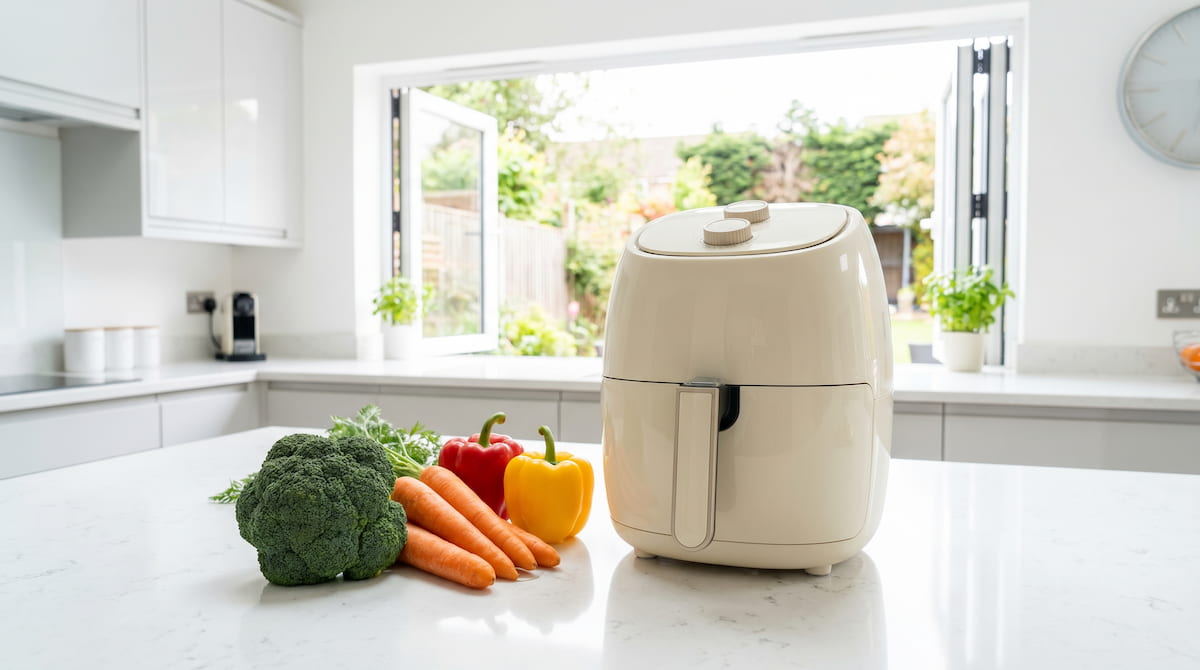
A ceramic air fryer eliminates both PFOA and PTFE concerns — the simplest upgrade for a non-toxic kitchen.
If You Still Have a PTFE-Coated Air Fryer
If switching isn’t in the budget right now, these habits significantly reduce your risk:
- Never preheat empty at max temperature — that’s the highest-risk scenario for fume release
- Always ventilate — open a window or run the range hood every time you cook
- Check the coating regularly — scratches and flaking are a signal to replace. See my guide on how to tell if your air fryer coating is damaged
- Keep pets out of the kitchen — especially birds, which are extremely sensitive to PTFE fumes
- Clean after every use — grease buildup causes higher smoke output on the next cook. My air fryer cleaning guide covers the safest method
PFOA vs PTFE in Air Fryers — Bottom Line
PFOA was the more serious historical concern and is now largely gone from US products. PTFE is the coating that’s still present in most conventional air fryers today — generally low-risk at normal temperatures, but worth eliminating if you cook frequently or have children and pets at home. Ceramic and stainless steel are the cleanest alternatives, and both are widely available at competitive prices.
For a full comparison of the safest air fryer materials available right now, visit my main guide: Best PFAS-Free Air Fryers (2026).