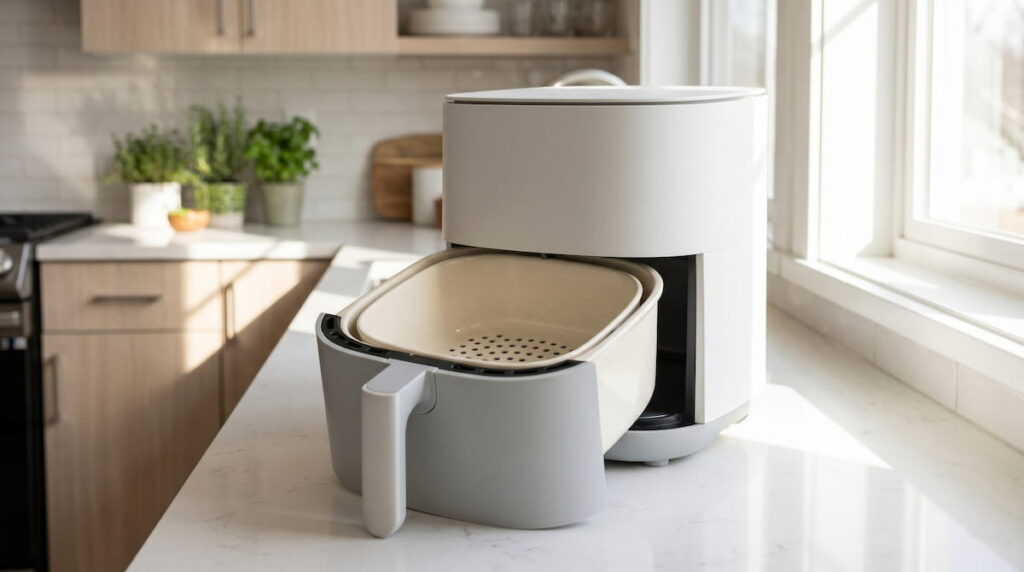
Is Cosori TurboBlaze PFAS-free? It’s a reasonable question — Cosori markets the TurboBlaze with ceramic coating language, but “ceramic” covers a wide range of coating quality and durability in the air fryer market, and the safety claim is only as good as the coating holding up over time.
I went through the TurboBlaze coating specifications, what Cosori actually discloses about the materials, and what long-term user reports show about how the ceramic surface performs under daily family cooking. Here’s the honest answer.
What Cosori Says About the TurboBlaze Coating
Cosori describes the TurboBlaze basket as ceramic-coated and explicitly states it is PTFE-free and BPA-free in product documentation. The ceramic coating designation is consistent with the silica-based sol-gel ceramic construction used across the non-PTFE air fryer market — the same general coating category used by Ninja and other brands marketing ceramic nonstick baskets.
Cosori does not use the term PFAS-free as consistently across their product documentation as Ninja does with the AF150AMZ, which is worth noting. The PTFE-free claim is the stronger and more consistently stated one. Since PTFE is the primary fluoropolymer of concern in nonstick cookware, a verified PTFE-free ceramic coating addresses the core PFAS concern — but the documentation language is worth being precise about.
What the Ceramic Coating Chemistry Actually Means
The TurboBlaze ceramic coating — like other silica-based ceramic nonstick coatings — does not use polytetrafluoroethylene (PTFE) or the per- and polyfluoroalkyl substances (PFAS) associated with traditional fluoropolymer nonstick manufacturing. The nonstick property comes from the smooth silica surface rather than from fluorine chemistry.
This means the TurboBlaze basket does not carry the PTFE-degradation concern at high temperatures that standard nonstick baskets do. At the temperatures the TurboBlaze operates at — up to 450°F — an intact ceramic coating does not produce the fluoropolymer breakdown byproducts that make PTFE a concern at elevated temperatures.
According to EPA guidance on PFAS compounds, the category of concern centers on fluoropolymer-based coatings. Silica-based ceramic coatings are not fluoropolymers and fall outside that category under current understanding. For a deeper look at how different coating types compare, see our guide on what chemicals air fryers release by material type.
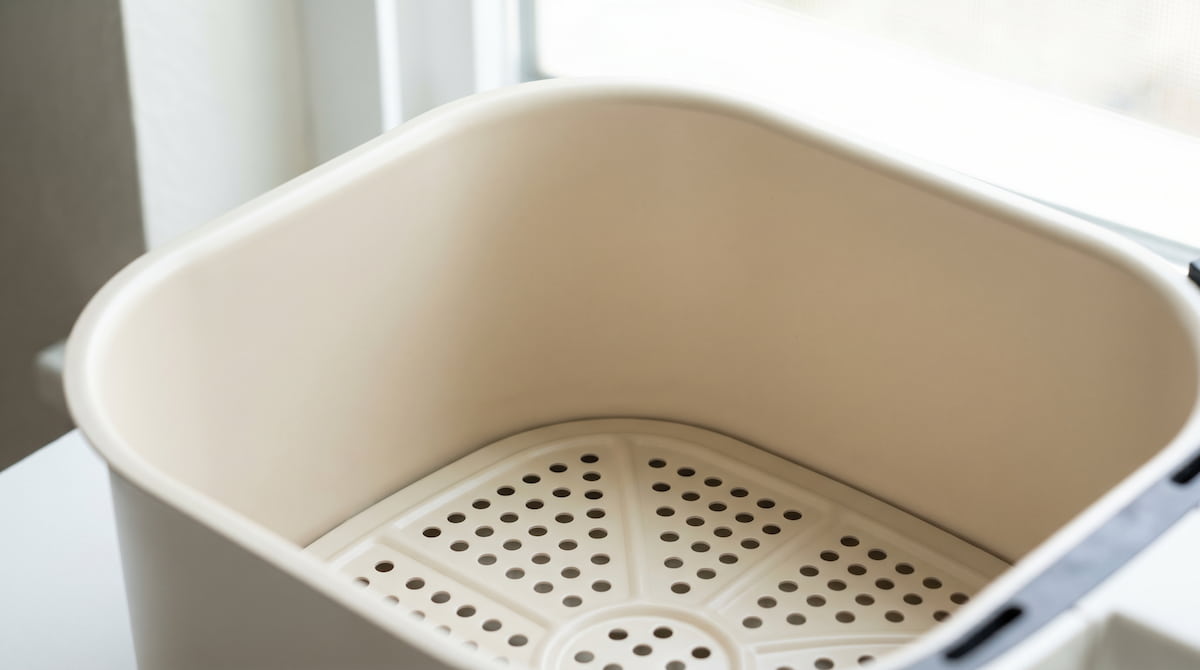
The TurboBlaze ceramic basket interior — silica-based coating, no PTFE, no fluoropolymer chemistry in the nonstick surface.
What Most People Get Wrong About the TurboBlaze Coating
The most common mistake is treating “ceramic-coated” and “PFAS-free” as interchangeable with “completely inert forever.” Ceramic coatings are significantly safer than PTFE-based nonstick — but they still require proper care to maintain their safety profile over time. A ceramic coating that’s scratched or chipped exposes the underlying aluminum, which is a different concern from PTFE fume release but still worth avoiding.
The second mistake is assuming that because the TurboBlaze is PTFE-free, it requires no maintenance or monitoring. Ceramic coatings can still degrade with abrasive cleaning, metal utensils, and dishwasher cycles — just without the fluorinated compound release that makes PTFE degradation a bigger concern. The safety advantage of ceramic over PTFE is real; the need to care for the surface properly doesn’t go away.
The third mistake is not comparing the TurboBlaze’s coating durability against established alternatives before purchasing. The TurboBlaze is a newer model with a shorter track record than the Ninja AF150AMZ. Both use ceramic coatings — but the AF150AMZ has more documented long-term user data at comparable use frequencies. For a direct comparison, see our guide on Ninja ceramic basket safety.
TurboBlaze Ceramic Coating Durability: The Honest Picture
This is where the TurboBlaze answer gets more nuanced than the basic PFAS-free claim. Cosori’s ceramic coating durability record across their air fryer lineup has been more variable than Ninja’s AF150AMZ over comparable use periods.
Earlier Cosori ceramic basket models accumulated user reports of coating wear — visible scratching, loss of nonstick performance — faster than the Ninja AF150AMZ at similar use frequencies. The TurboBlaze represents Cosori’s updated design, and early user reports on the TurboBlaze coating show improvement over previous Cosori models. However, the long-term durability track record for the TurboBlaze specifically is shorter than the established record for the Ninja AF150AMZ.
What this means practically: the TurboBlaze ceramic coating is PTFE-free and addresses the PFAS concern on day one. Whether it maintains that integrity over 12–18 months of daily family cooking is less established than the comparable Ninja track record at this point. Our guide on how long air fryer baskets last by coating type covers this comparison in detail.
Cosori TurboBlaze 9-in-1 Specs at a Glance
| Spec | Detail |
|---|---|
| Capacity | 6 quarts |
| Basket coating | Ceramic nonstick — PTFE-free, BPA-free |
| Cooking functions | 9 functions including air fry, bake, roast, broil, dehydrate |
| Temperature range | Up to 450°F |
| Wattage | 1,750W |
| Dishwasher safe | Basket — top rack (hand wash recommended for coating longevity) |
| Best for | 2–4 person households, larger batch cooking, versatile functions |
Where the TurboBlaze Has a Genuine Advantage
The 6-quart capacity is the TurboBlaze’s strongest practical argument over the Ninja AF150AMZ’s 4-quart basket. For households of three to four people cooking a full serving of fries, nuggets, or chicken pieces in a single round, that extra two quarts is meaningful — it’s the difference between one cook and two back-to-back batches for family-size portions.
The 450°F maximum temperature gives the TurboBlaze a wider cooking range than the Ninja AF150AMZ’s 400°F ceiling. For high-heat applications like searing or very crispy results, that additional temperature headroom makes a practical difference. The 9-in-1 cooking functions — baking, roasting, broiling, and dehydrating alongside air frying — add versatility that makes the TurboBlaze a more multi-purpose appliance than a single-function basket air fryer.
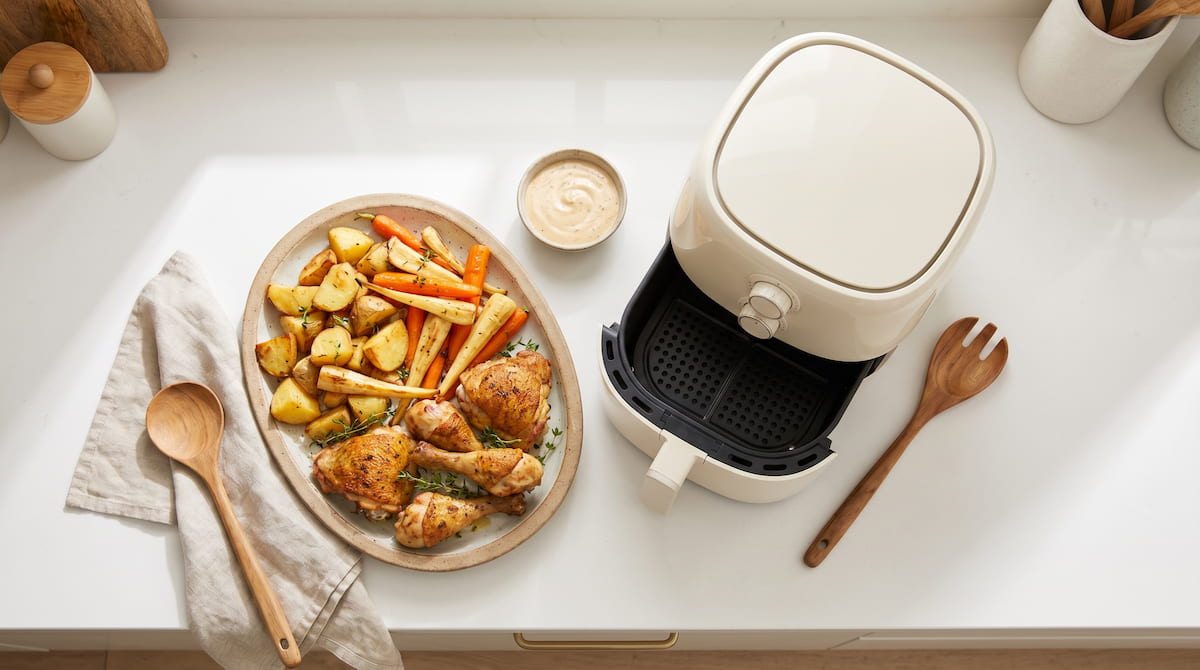
The TurboBlaze handles family-size portions in a single round — 6-quart capacity, ceramic basket, PTFE-free coating across all cooking functions.
Is the TurboBlaze the Right Choice for Your Family?
If the primary question is whether the TurboBlaze is PTFE-free and addresses the core PFAS concern — yes, it does. The ceramic coating is silica-based, not fluoropolymer-based, and the PTFE-free claim is consistent with the coating chemistry.
If the question is whether it’s the most reliable ceramic basket option for daily family cooking over 12–18 months — the Ninja AF150AMZ has the more established durability track record. For families who need the larger 6-quart capacity and are willing to follow careful ceramic coating maintenance — hand washing, silicone utensils, no abrasive cleaning — the TurboBlaze is a reasonable choice within that constraint.
See Cosori TurboBlaze on Amazon →For families of four or more who need larger capacity without any coating concern, the stainless steel Instant Pot Omni Plus 18L eliminates the coating durability question entirely — no coating to scratch, no coating to replace.
See Instant Pot Omni Plus on Amazon →Frequently Asked Questions
Is the Cosori TurboBlaze ceramic basket truly PFAS-free?
Yes — the TurboBlaze uses a silica-based ceramic coating that is PTFE-free and BPA-free. Silica-based ceramic coatings are not fluoropolymers and don’t produce the PTFE breakdown byproducts associated with traditional nonstick coatings under normal cooking temperatures.
How does the TurboBlaze compare to the Ninja AF150AMZ on safety?
Both use PTFE-free ceramic coatings and address the core PFAS concern. The Ninja AF150AMZ has a more established long-term durability track record at comparable daily use frequencies. The TurboBlaze offers a larger 6-quart capacity and higher 450°F maximum temperature. On day-one safety, both are equivalent — the difference is coating durability over time.
Does the Cosori TurboBlaze release toxic fumes?
No — under normal cooking conditions with an intact ceramic basket, the TurboBlaze does not release the fluoropolymer fumes associated with PTFE-coated baskets. The silica-based ceramic coating is stable at all temperatures the TurboBlaze reaches. As with any coated basket, maintaining coating integrity through proper care is essential to maintaining that safety profile.
Can I put the TurboBlaze basket in the dishwasher?
Technically yes — Cosori rates it as dishwasher safe on the top rack. In practice, hand washing with warm water and a soft sponge extends ceramic coating life significantly. Repeated dishwasher cycles accelerate surface wear on any ceramic-coated basket, including the TurboBlaze.
Is the Cosori TurboBlaze safe for households with birds?
Yes — the PTFE-free ceramic coating does not produce the fluoropolymer fumes that are acutely toxic to birds. For bird households, any verified PTFE-free model is a safe choice. Glass-interior models like the Big Boss 16Qt are the most complete solution if eliminating every coating variable is the priority. See our guide on air fryer safety for pets and birds for the full picture.
How long does the TurboBlaze ceramic coating last?
With proper care — hand washing, silicone utensils, no thermal shock — ceramic coatings typically last 2–4 years. The TurboBlaze’s specific coating has a shorter established track record than the Ninja AF150AMZ, so following maintenance guidelines carefully matters more here than with a model that has years of documented daily use data behind it.
The Bottom Line: Is Cosori TurboBlaze PFAS-Free?
Yes — the TurboBlaze ceramic basket is PTFE-free, addressing the core fluoropolymer PFAS concern in nonstick cookware. The coating chemistry is silica-based ceramic, not fluoropolymer-based, and it does not carry the high-temperature degradation concern associated with PTFE coatings.
The honest caveat is coating durability over time and the shorter established track record compared to the Ninja AF150AMZ. For families who need the larger capacity and are willing to follow careful maintenance practices, the TurboBlaze is a sound PTFE-free choice. For those prioritizing the most established ceramic durability record, the Ninja AF150AMZ remains the benchmark.
For a full comparison of PFAS-free air fryer options across ceramic, stainless, and glass formats, our PFAS-free air fryer guide covers everything you need to make a confident choice for your family.