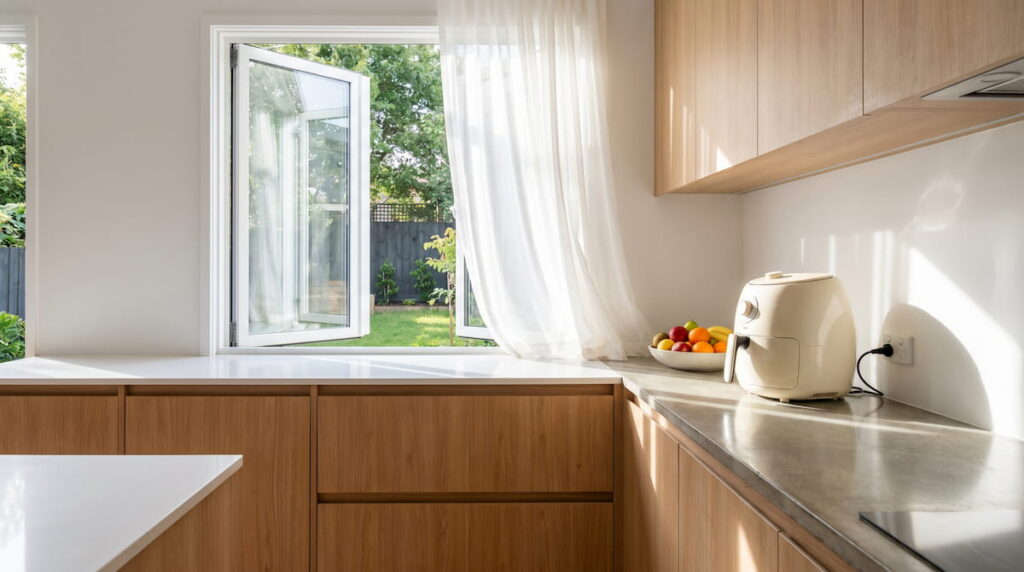
How long air out kitchen after air fryer is something I started paying attention to after switching to a ceramic model and realizing I still had cooking vapor lingering in our small kitchen longer than I expected. The answer depends on what you cooked, how big your kitchen is, and how many windows you have open. Here’s what I found after testing different scenarios.
Why Ventilating After Air Frying Actually Matters
Even a PFAS-free ceramic air fryer produces cooking vapor during operation — water steam, fat aerosol, and volatile organic compounds from food browning at high heat. These are the same compounds any high-heat cooking method produces, and they’re not unique to air fryers. What is unique to air fryers is the concentrated way they vent: hot air exits from the back or sides of the unit in a focused stream rather than dispersing gradually the way an oven does.
In a well-ventilated kitchen, these compounds clear quickly and present no meaningful concern. In a smaller kitchen with limited airflow — a studio apartment, a galley kitchen, or any space without cross-ventilation — cooking vapor can linger for 10 to 30 minutes after the cook cycle ends if no active ventilation step is taken. For households with young children, pregnant family members, or anyone with respiratory sensitivity, that lingering matters.
For a PTFE-coated air fryer, ventilation after cooking is even more important — the coating can off-gas fluorinated compounds during the cook cycle that benefit from active clearance. Our guide on air fryer fumes covers what those compounds are and when they become a concern.
How Long to Air Out Your Kitchen: By Scenario
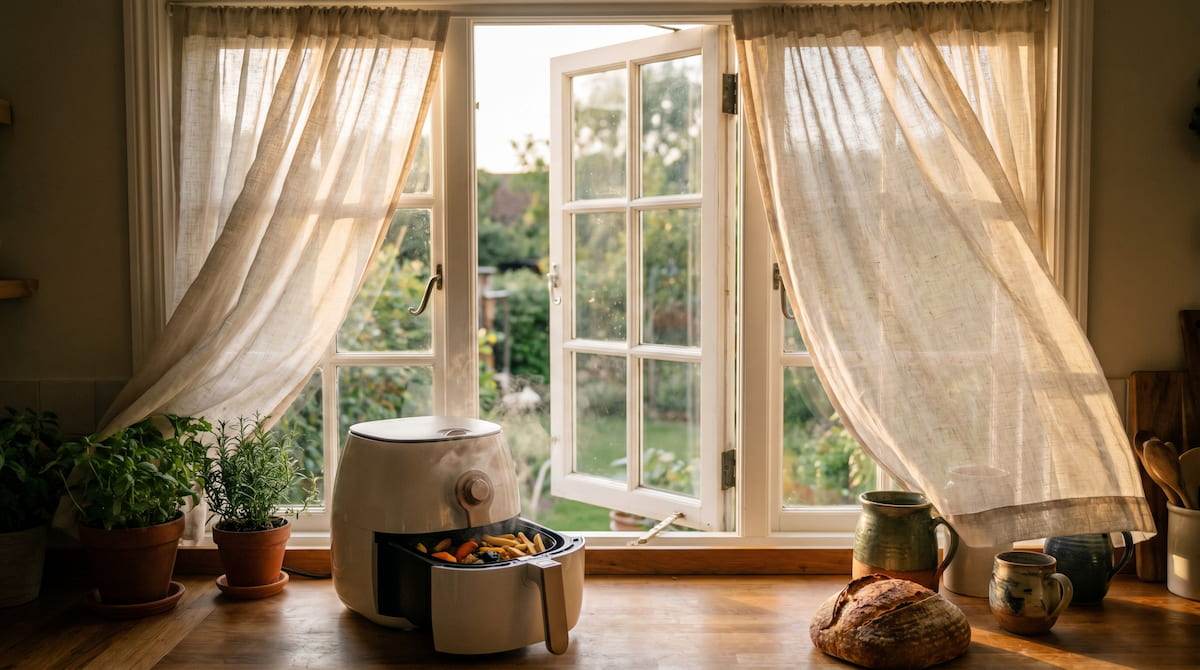
A single open window with good airflow clears cooking vapor from most kitchen sizes within 10 to 15 minutes after the cook cycle ends.
| Scenario | Recommended Air-Out Time | Notes |
|---|---|---|
| Large kitchen, 2+ windows open, ceramic basket | 5–10 minutes | Good airflow clears vapor quickly |
| Medium kitchen, 1 window open, ceramic basket | 10–15 minutes | Standard household scenario |
| Small kitchen / studio, 1 window, ceramic basket | 15–20 minutes | Limited volume slows clearance |
| Any kitchen, no windows open, ceramic basket | 30+ minutes | Always open at least one window |
| Any kitchen, PTFE basket (scratched or worn) | 20–30 minutes minimum | Additional chemical compounds require longer clearance |
| High-fat cook (bacon, sausage) any basket | 20–25 minutes | Grease aerosol lingers longer than water vapor |
How Long Air Out Kitchen After Air Fryer — Key Variables
Three variables determine how long your kitchen needs to ventilate after air frying: kitchen size, number of open windows, and what you cooked.
Kitchen size is the most obvious factor. A larger kitchen has more air volume to dilute cooking vapor, which means even without active ventilation the concentration drops faster. A studio apartment or galley kitchen with the same vapor output has much less volume to work with — the same amount of cooking vapor produces a noticeably higher concentration in a smaller space.
Number of open windows determines airflow rate. One open window provides air exchange but no cross-ventilation — vapor exits slowly as indoor and outdoor air gradually mix. Two windows on opposite sides of the kitchen create cross-ventilation, where outdoor air actively pushes indoor air out. Cross-ventilation clears a kitchen roughly twice as fast as a single open window at the same outdoor conditions.
What you cooked matters because different foods produce different types and amounts of airborne compounds. Lean proteins and vegetables produce mostly water vapor, which clears quickly. High-fat foods like bacon, sausage, or skin-on chicken thighs produce grease aerosol — fine fat particles that linger in the air longer than water vapor and settle on surfaces if not ventilated out. Starchy foods cooked at high heat produce acrylamide-related volatile compounds that also benefit from active clearance.
Cross-Ventilation: The Fastest Way to Clear Your Kitchen
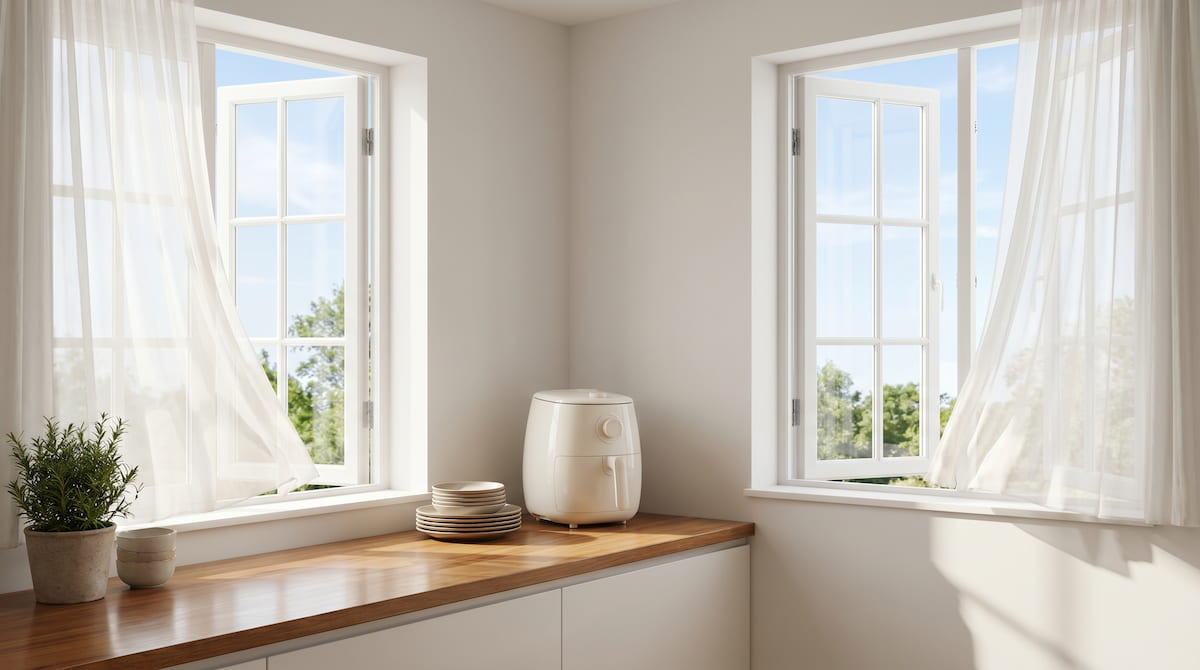
Cross-ventilation — two windows open on opposite sides — clears cooking vapor from a kitchen roughly twice as fast as a single open window.
If your kitchen layout allows it, cross-ventilation is the most effective ventilation strategy for post-air-fryer clearance. Open one window in or near the kitchen and a second window on the opposite side of the space — a living room window, a bedroom window, or a hallway window all work. The pressure difference between the two openings creates a directed airflow that actively moves indoor air out rather than relying on passive mixing.
In an apartment or home where cross-ventilation isn’t possible, a small portable fan placed near the kitchen window and directed outward can simulate the effect — pushing cooking vapor out of the window rather than just circulating it around the room.
Should You Stay Out of the Kitchen During Air-Out Time
For a ceramic-coated air fryer cooking lean proteins or vegetables, staying nearby during the air-out period is fine — the compounds in question are mild and disperse quickly with even minimal airflow. The air-out time is more about good habit than acute risk.
For a PTFE-coated air fryer with a scratched or worn basket, stepping away from the kitchen for the first 10 to 15 minutes after cooking is a reasonable precaution — particularly for pregnant family members, young children, or anyone with respiratory sensitivity. The EPA has flagged PFAS-related compounds as an area of ongoing health concern, and minimizing inhalation exposure during the highest-concentration period after cooking is a practical step.
The Easiest Long-Term Fix: Eliminate the Coating Variable
The simplest way to reduce post-cooking air-out requirements is to remove the coating concern entirely. A ceramic-coated air fryer produces only food-based cooking vapor — water steam, fat aerosol, and food volatiles that clear with 10 to 15 minutes of normal ventilation in most kitchens. No fluorinated compounds, no extended air-out time, no stepping away from the kitchen while things clear.
The Ninja AF150AMZ is the ceramic-coated model I use daily. After cooking lean proteins and vegetables, our kitchen is clear within 10 minutes of opening a window — no lingering smell, no grease haze, nothing that requires special attention. For a family cooking every day, that simplicity is worth as much as the safety benefit.
For a full breakdown of PFAS-free air fryer options and why coating choice matters for daily kitchen air quality, our PFAS-free air fryer guide covers everything worth knowing before your next purchase.