
Can air fryer cause carbon monoxide poisoning? That question came up after a neighbor mentioned she never uses her air fryer without opening a window because she was worried about CO buildup. I wanted to know if that concern was grounded in how air fryers actually work — or whether it was a confusion with something else. Here’s what I found.
How Carbon Monoxide Is Actually Produced
Carbon monoxide is produced by incomplete combustion — when a fuel source burns without enough oxygen to complete the chemical reaction. Gas stoves, gas ovens, gas furnaces, wood-burning fireplaces, and internal combustion engines all produce carbon monoxide because they burn fuel directly.
This is the critical distinction: carbon monoxide production requires burning a fuel. Electric appliances that use resistive heating elements — toasters, electric ovens, electric kettles, and air fryers — do not burn fuel. They convert electrical energy into heat through resistance in a metal coil. There is no combustion, no fuel oxidation, and therefore no carbon monoxide produced by the heating mechanism itself.
Can Air Fryer Cause Carbon Monoxide — The Direct Answer
No. An electric air fryer cannot produce carbon monoxide through its normal heating operation. The heating element works by electrical resistance, not combustion. Without combustion, there is no pathway to CO production from the appliance itself — the same reason your electric toaster, electric oven, or electric kettle does not produce carbon monoxide.
The concern about air fryers and CO likely stems from two sources of confusion: the general association between cooking appliances and air quality, and the fact that gas stoves and ovens — which do produce CO — look similar to electric versions from a user perspective. If you have a gas stove and an electric air fryer in the same kitchen, the CO risk comes from the gas appliance, not the air fryer.
What Most People Get Wrong About Air Fryers and Carbon Monoxide
The most common mistake is assuming that because a CO detector went off during air fryer use, the air fryer must be producing CO. It isn’t. Modern combination detectors include sensors for smoke particles and volatile organic compounds alongside the dedicated CO sensor. Fumes from a degrading PTFE coating — not CO — are the most common reason an air fryer triggers these devices. Our guide on why air fryers trigger CO detectors covers exactly what’s causing the alarm.
The second mistake is thinking that because CO isn’t a risk, ventilation isn’t necessary. CO is just one of many airborne compounds produced during cooking. Cooking smoke, grease aerosol, and food-based VOCs all benefit from ventilation — and in a small kitchen, these can accumulate faster than you’d expect during a 20-minute air fry session. Opening a window is still the right habit regardless of CO risk.
The third mistake is conflating the CO concern with the PTFE fume concern. These are completely separate issues. CO comes from combustion — air fryers don’t produce it. PTFE fumes come from degrading fluoropolymer coatings — ceramic and stainless models don’t produce them. Understanding which concern applies to your specific appliance helps you make the right changes. Our guide on what chemicals air fryers actually release covers both in detail.
What Air Fryers Do Produce During Cooking
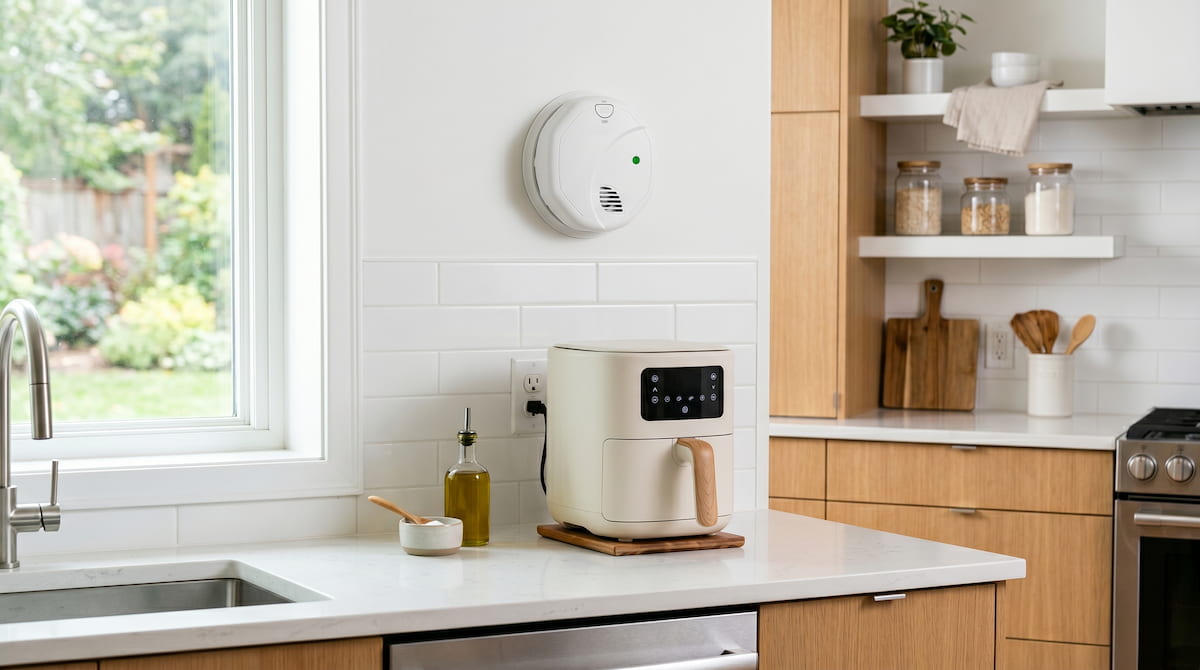
A CO detector in the kitchen is good safety practice — especially if you have gas appliances. An electric air fryer itself does not produce carbon monoxide.
While electric air fryers don’t produce carbon monoxide, they do produce other airborne compounds during cooking worth understanding. These come from two sources: the food itself and — in some models — the basket coating.
Food-based cooking emissions include water vapor, volatile organic compounds from fat and protein oxidation, and acrylamide from starchy foods cooked at high temperatures. These are the same compounds produced by any high-heat cooking method and benefit from kitchen ventilation.
Coating-based emissions are specific to air fryers with PTFE nonstick baskets. When PTFE is overheated or scratched, it releases fluorinated compounds — not carbon monoxide, but a different category of chemical concern. The EPA has flagged PFAS-related compounds as an area of ongoing health concern. Ceramic-coated baskets produce none of these emissions.
Air Fryer Emissions: What’s Real and What’s Not
| Emission Type | Does Air Fryer Produce It? | Notes |
|---|---|---|
| Carbon monoxide (CO) | ❌ No | No combustion = no CO production |
| Water vapor / steam | ✅ Yes | Normal cooking byproduct — harmless |
| Cooking smoke (from grease) | ✅ Yes (if dirty or high-fat) | Manageable with ventilation and clean basket |
| Acrylamide (from starchy foods) | ✅ Yes | Less than deep frying — manageable with temperature control |
| PTFE/PFAS fumes | ⚠️ PTFE models only | Not present in ceramic or stainless models |
| VOCs from food | ✅ Yes | Same as any high-heat cooking method |
When to Use a CO Detector in Your Kitchen
Even though an electric air fryer cannot produce carbon monoxide, a CO detector in or near your kitchen is still a sound safety investment — particularly if you have any gas appliances in the home. Gas stoves, gas ovens, gas water heaters, and gas furnaces all produce CO and can malfunction in ways that allow dangerous concentrations to build up in enclosed spaces.
The CDC recommends CO detectors on every level of a home and within 10 feet of sleeping areas. If you have a combined kitchen and living space, a CO detector near the cooking area is particularly important if gas appliances are present. Your air fryer won’t trigger it — but your gas stove could.

Opening a window while cooking is good practice for any kitchen — it clears cooking vapor and smoke regardless of the appliance you’re using.
Ventilation: Still Worth Doing Even Without CO Risk
The fact that your air fryer doesn’t produce carbon monoxide doesn’t mean ventilation is unnecessary. Cooking vapor, grease smoke, and food-based volatile compounds all benefit from airflow — and in a small kitchen, these can build up faster than you’d expect during a 20-minute air fry session.
The ventilation habit that makes the most difference is simple: open at least one window before every cook session, and run a range hood fan if you have one. Our full guide on air fryer breathing safety covers what compounds accumulate and how quickly ventilation clears them.
Which Air Fryer Is Safest for Indoor Air Quality?
A ceramic-coated air fryer like the Ninja AF150AMZ eliminates the coating concern entirely, leaving only the normal cooking vapor that any high-heat appliance produces — and that an open window handles easily. For families who want to go further, the Big Boss 16Qt glass air fryer produces the cleanest air profile of any format — no coating chemistry of any kind at any temperature.
For a full comparison of the safest options, see our PFAS-free air fryer guide.
See Ninja AF150AMZ on Amazon → See Big Boss Glass Air Fryer on Amazon →Frequently Asked Questions
Can an electric air fryer produce carbon monoxide?
No — electric air fryers use resistive heating elements, not combustion. Carbon monoxide requires burning a fuel source, which electric appliances don’t do. An electric air fryer has no chemical pathway to CO production under any normal operating condition.
Why did my CO detector go off when I used my air fryer?
Almost certainly not because of actual CO. Combination detectors respond to smoke particulates and some VOCs, not just CO gas. Fumes from a degrading PTFE coating or grease smoke from a dirty basket are the most common causes. If there’s a chemical smell with the alarm, inspect your basket coating immediately. See our full guide on why air fryers trigger CO detectors.
Is it safe to use an air fryer in a closed room?
With a ceramic or stainless basket and no CO risk, the main concern in a closed room is cooking vapor and grease smoke accumulation. Opening a window or running a fan is still recommended — not for CO, but for general air quality during and after cooking.
Do air fryers produce any harmful gases?
Not carbon monoxide. The main emission concern specific to air fryers is fluoropolymer fumes from PTFE-coated baskets that are overheated or degrading. These are not CO, but they are a legitimate health concern for households with birds, infants, or respiratory conditions. Ceramic and stainless models don’t produce these fumes.
Should I have a CO detector if I only use electric appliances?
Yes — if your home has any gas appliances (heating, water heater, dryer), a CO detector is important regardless of what you cook with. If your home is fully electric, CO risk from appliances is essentially zero, but a detector is still useful for garage-adjacent spaces or attached parking areas where vehicle exhaust can accumulate.
Is air fryer smoke dangerous?
Cooking smoke from grease or food is an irritant but not the same category of danger as CO. PTFE coating fumes are a more specific concern — these can trigger respiratory symptoms and are acutely dangerous for pet birds. Our guide on whether air fryer smoke is toxic covers exactly what each type of smoke contains.
The Bottom Line: Can Air Fryer Cause Carbon Monoxide?
No — electric air fryers cannot cause carbon monoxide poisoning. CO requires combustion, and electric air fryers don’t combust anything. The real air fryer emissions worth managing are cooking smoke from grease buildup, VOCs from food, and PTFE fumes from nonstick-coated baskets — none of which are carbon monoxide.
A ceramic-coated or glass-interior air fryer eliminates the coating concern entirely. Combined with basic kitchen ventilation, daily air fryer cooking presents no meaningful CO risk and very low overall air quality concern for most families. For a full comparison of safe options, our PFAS-free air fryer guide covers the complete 2026 landscape.