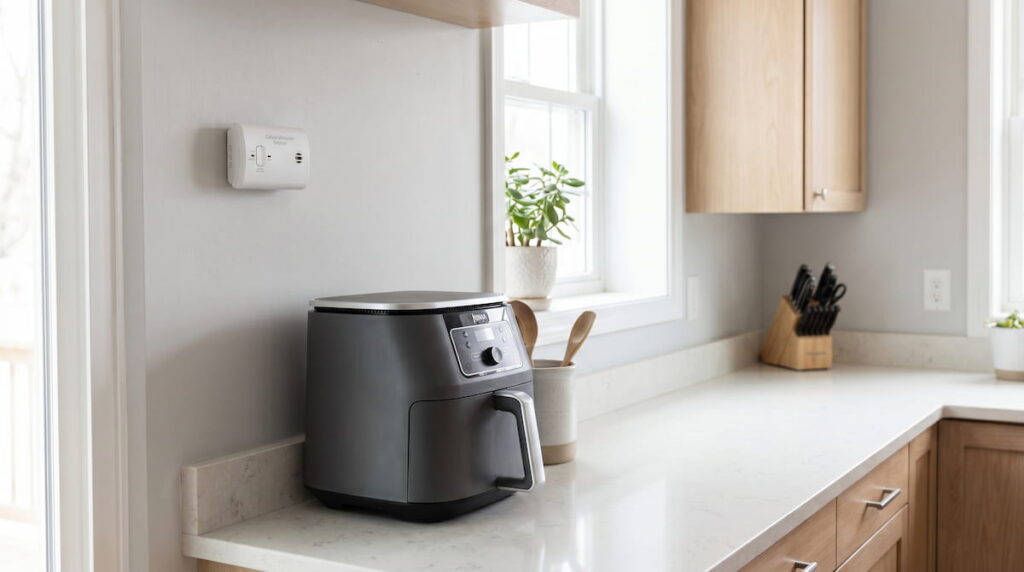
Can air fryers trigger carbon monoxide detectors? Yes — under certain conditions an air fryer can set off a CO detector, but it’s almost never because of actual carbon monoxide. Understanding what’s really happening, and when it signals a genuine safety risk, is what every family cooking daily needs to know.
I’m Wook, a bus driver and dad of two teenage boys. Our CO detector went off twice in the first month we used our old air fryer. After digging into why, I found the answer most people never get from a quick Google search. Here’s the full picture.
Can Air Fryers Trigger Carbon Monoxide Detectors? The Real Explanation
Standard air fryers do not produce carbon monoxide under normal operating conditions. CO is generated by incomplete combustion — the kind that happens with gas appliances, wood burning, or fuel-powered engines. An electric air fryer uses a heating element and a fan, with no combustion involved whatsoever.
So why does the detector go off? Two reasons:
Reason 1: Smoke and Particulates Confuse the Sensor
Many CO detectors — especially combination smoke and CO units — respond to airborne particulates, not just carbon monoxide gas. When an air fryer produces smoke from burnt grease, overheated food, or a degrading coating, those particulates can trigger the detector’s smoke sensor even when no CO is present.
Reason 2: Overheated or Degrading Coatings Release Detectable Gases
This is the part most families don’t hear about. When a PTFE-coated basket is overheated or has existing damage, it can release fluoropolymer fumes. Some electrochemical CO sensors are sensitive to a wider range of gases than just CO — and certain organic fumes can produce a false positive reading.
According to the EPA’s PFAS resource page, fluoropolymer breakdown products from overheated PTFE coatings have raised health concerns independent of CO risk — meaning even if it’s not technically carbon monoxide, what’s in the air may still warrant attention. For a full breakdown of what these coatings release, see our guide on what chemicals air fryers release by material type.
When Should You Actually Be Concerned?
| Situation | Likely Cause | Action |
|---|---|---|
| Alarm during first few uses | Protective coating burning off | ✅ Normal — ventilate and continue |
| Alarm when cooking fatty foods | Grease smoke triggering sensor | ✅ Normal — clean basket, open window |
| Alarm with chemical smell | Coating degradation or overheating | ⚠️ Stop use — inspect basket immediately |
| Alarm every single cook session | Ongoing fume issue or detector placement | ⚠️ Investigate basket and ventilation |
| Alarm with headache or dizziness | Possible real fume exposure | ❌ Leave room immediately — ventilate fully |
What Most People Get Wrong About Air Fryers and CO Detectors
The biggest misconception is that a triggered CO detector automatically means your air fryer is producing carbon monoxide. It doesn’t — and treating it as a CO problem leads families to the wrong solution. The detector is almost always responding to something real, but that something is smoke particulates or coating fumes, not CO gas.
The second misconception is that moving the detector further away is the right fix. If coating fumes are triggering the alarm, moving the detector just delays the warning — it doesn’t address the source. A basket with a degrading PTFE coating needs to be inspected and likely replaced, not just detected from further away.
The third misconception is that the alarm is just a “sensitive detector” problem and can be ignored. Some combination detectors do have smoke sensors that trip on normal cooking steam — that’s a placement issue worth addressing. But a detector triggering specifically during air fryer use, especially with any chemical smell, is telling you something specific about your basket. Our guide on what happens when air fryer coating gets scratched explains exactly what a degrading coating releases and when replacement is the right call.
What Our Family Did After Our Detector Went Off
The first time our detector triggered, I assumed it was a false alarm and kept cooking. The second time, I noticed a faint chemical smell alongside the alarm — and that’s when I took it seriously.
After inspecting the basket I found early-stage scratching on the PTFE coating. That was enough for us to switch. We replaced our unit with the Ninja AF150AMZ, which uses a ceramic basket that’s PTFE-free and PFAS-free. Our detector hasn’t triggered once since — not because we cook differently, but because there’s no degrading fluoropolymer coating producing fumes anymore.
If you’re dealing with recurring alarms, check whether your basket coating is intact. Our guide on Ninja’s ceramic basket explains exactly what PFAS-free means in practice and why the coating difference matters for daily indoor air quality.
Quick Safety Checklist
✅ Low concern situations:
- First 2–3 uses trigger alarm with no smell — normal burn-off, ventilate and continue
- Alarm only when cooking very fatty foods — grease smoke, clean basket more frequently
⚠️ Investigate immediately:
- Chemical or plastic smell accompanies the alarm — inspect basket coating
- Alarm happens every session regardless of food — check basket damage and detector placement
❌ Stop cooking immediately:
- Headache, nausea, or dizziness with alarm — leave the room, ventilate fully before returning
- Visible peeling on basket and recurring alarms — replace basket or unit before next use

How to Prevent Your Air Fryer From Triggering the Detector
- Open a window or run the range hood — even light airflow prevents particulate buildup that triggers sensors
- Keep the basket clean — grease residue is the most common cause of smoke during cooking
- Don’t exceed recommended temperatures — most coatings are stable below 400°F; going higher accelerates breakdown
- Inspect the basket monthly — catch scratches and peeling before they become a fume source
- Move the detector if it’s directly above the air fryer — placement within two feet of the unit will trigger even low-particulate cooking
For more on how to keep kitchen air clean during air fryer use, our air fryer breathing safety guide and guide on air fryer VOC emissions cover the full picture.
Does Switching to a PFAS-Free Air Fryer Stop the Alarms?
In our experience, yes — significantly. With a ceramic PTFE-free basket, the fume profile during cooking is dramatically different. There’s no fluoropolymer chemistry degrading under heat, which means the only thing that could trigger a detector is genuine smoke from burnt food — the same as any other cooking method.
For families who want to go even further, the Big Boss 16Qt Glass Air Fryer produces the cleanest air profile of any air fryer. Cooking in glass and stainless steel generates no coating-related fumes regardless of temperature or cooking frequency.
Our PFAS-Free Air Fryer Guide covers the full range of coating-free options with detailed material breakdowns for families making this switch.
See Ninja AF150AMZ on Amazon → See Big Boss Glass Air Fryer on Amazon →Frequently Asked Questions
Can air fryers trigger carbon monoxide detectors?
Yes — but not because they produce CO. Electric air fryers don’t combust fuel, so they cannot generate carbon monoxide. Detectors trigger because of smoke particulates from grease or food, and in some cases fumes from degrading PTFE coatings that certain sensor types can detect.
Do air fryers produce carbon monoxide?
No. Carbon monoxide requires combustion — a chemical process that doesn’t occur in any electric appliance. For a full explanation of what air fryers actually release, see our guide on whether air fryers produce carbon monoxide.
Why did my CO detector go off when I used my air fryer?
Most likely causes are grease smoke from cooking, initial burn-off from a new unit, or fumes from a degrading PTFE basket. If there’s a chemical smell alongside the alarm, inspect your basket for scratches or peeling immediately.
Is it safe to keep cooking if the detector goes off?
If there’s no smell and no physical symptoms, it’s likely a smoke particulate trigger — ventilate the kitchen and continue with caution. If there’s a chemical smell, headache, or dizziness, stop cooking, leave the room, and ventilate fully before investigating.
Will a PFAS-free air fryer stop triggering my detector?
In most cases, yes. Switching from a PTFE-coated basket to a ceramic or stainless steel surface eliminates the coating fume variable. Grease smoke from food can still trigger a closely placed detector, but that’s true of any cooking method and is addressed with ventilation and detector placement.
How far should my CO detector be from my air fryer?
At least three to five feet is recommended. Detectors placed directly above or adjacent to any cooking appliance are prone to nuisance trips from normal cooking steam and particulates regardless of what’s actually in the air.
What should I do if my CO detector goes off and I smell something chemical?
Stop cooking immediately, leave the kitchen, and ventilate the space by opening windows and doors. Once the air clears, inspect your basket coating carefully for scratches, peeling, or discoloration. If the coating is damaged, replace the basket before cooking again.
The Bottom Line on Air Fryers and CO Detectors
Air fryers can trigger CO detectors — but almost always through smoke particulates or PTFE coating fumes, not actual carbon monoxide. A single alarm during a new unit’s first few uses is normal. Recurring alarms with a chemical smell point to basket coating degradation and warrant immediate inspection and likely replacement.
Switching to a ceramic or glass-interior model eliminates the coating fume variable entirely, which is why families who make that switch typically stop experiencing detector trips during normal cooking. For a full comparison of safe material options, our PFAS-free air fryer guide covers everything you need to make a confident choice.