Disclosure: This post contains affiliate links. If you purchase through them, I earn a small commission at no extra cost to you. I only recommend products I personally trust for my family.
How to know if your air fryer is unsafe is something every family that cooks with one regularly should be able to assess — not just when something goes obviously wrong, but as a routine check before problems escalate. I’m Wook, a bus driver and dad who cooks for my family almost every night. I kept our first air fryer in rotation well past the point where it was genuinely safe, because I didn’t know what to look for. This guide covers exactly what I wish I’d known.
The 10 Signs Your Air Fryer Is Unsafe to Use
1. Coating Is Flaking or Peeling — Stop Immediately
This is the clearest and most urgent unsafe signal. Visible pieces of coating lifting, peeling, or flaking from the basket surface mean coating particles are entering your food with every cook. For PTFE-based nonstick coatings, these particles may contain PFAS compounds. According to the U.S. EPA, PFAS chemicals are persistent in the body and environment with ongoing health research. Do not use a flaking basket under any circumstances.
2. Chemical or Plastic Smell That Wasn’t There Before
A chemical smell that developed gradually over months of use — and that cleaning doesn’t resolve — indicates coating degradation. This is different from the grease smell of a dirty unit. It’s a distinct chemical or plastic character that gets worse rather than better, and it means the coating is off-gassing during cooking. This smell is the unit telling you it has crossed from worn to chemically unsafe.
3. Food Consistently Tastes Metallic or Chemical
When food starts tasting slightly off — metallic, chemical, or with a flavor that doesn’t match the ingredients — coating particles or decomposition products are reaching your food. This taste change is one of the most reliable indicators that a coating has degraded past safe use, because it means transfer is already happening rather than just being a risk.
4. Visible Rust Anywhere Inside the Unit
Rust inside the cooking chamber or on the basket indicates the protective coating or material has failed completely in that area. Rust particles in food are a direct health hazard. A rusted air fryer is unsafe regardless of how well it otherwise functions — replace immediately.
5. Electrical Smell or Burning Wire Odor
A sharp, acrid electrical smell is categorically different from cooking smells or coating smells. It signals something happening in the wiring, motor, or electrical components — all of which are fire risk situations. Unplug immediately and do not use again until the source is confirmed and resolved, which for most consumer air fryers means replacement.
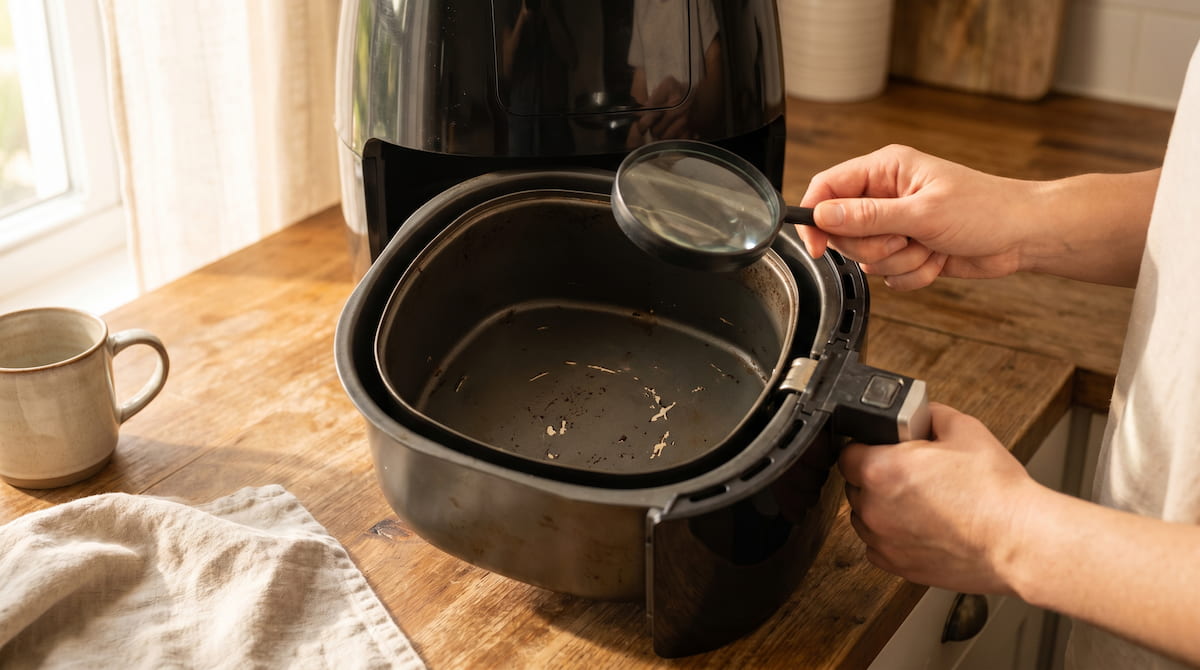
Regular visual inspection of the basket coating is the most reliable way to catch safety issues before they escalate.
6. Repeated Unexpected Shutoffs Under Normal Conditions
A single shutoff from overheating or a basket bump is normal safety features working. Repeated shutoffs under normal cooking conditions — proper clearance, clean unit, normal cook times — indicate a failing thermostat, control board, or internal component that’s making the unit unreliable and potentially dangerous.
7. Unit Runs Significantly Hotter Than Set Temperature
If food burns consistently at temperatures that should be safe, or if an oven thermometer confirms the unit runs 30°F+ hotter than set, the temperature sensor has failed. A unit that can’t regulate temperature accurately is both a food safety risk and an accelerated coating degradation risk — it may be running at temperatures that break down the basket coating faster than normal use would.
8. Grinding or Squealing Fan That Doesn’t Resolve
A fan producing grinding or high-pitched sounds that persist after cleaning the fan area has worn bearings. A failing fan motor is both a performance problem and a fire risk — motors that overheat from bearing failure can cause electrical failures in adjacent components. A grinding fan that doesn’t improve after cleaning is a replacement signal, not a monitor-and-continue situation.
9. Visible Cord Damage
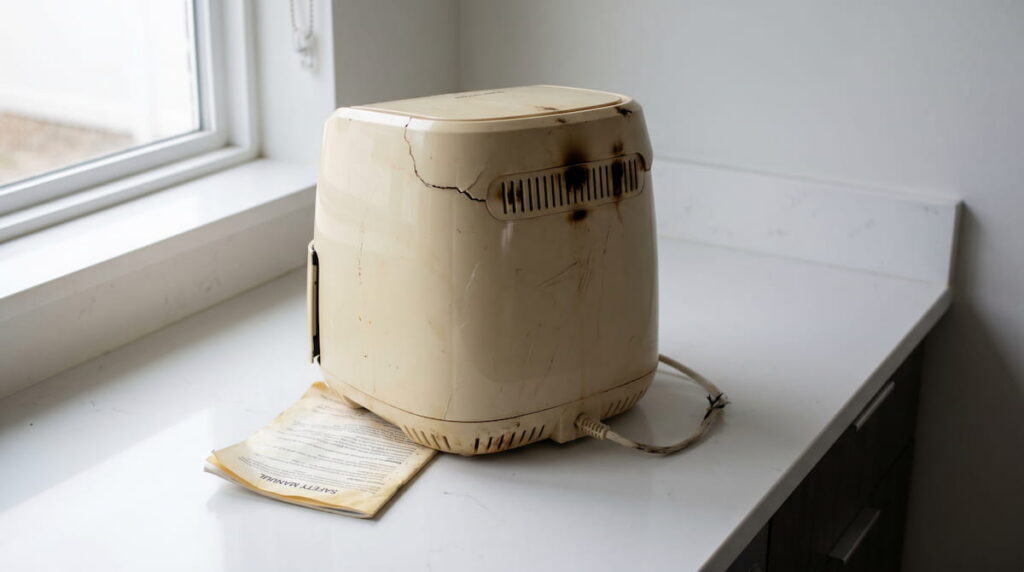
Any kinking, fraying, cracking, or discoloration of the power cord makes the unit unsafe to use. A damaged cord is a fire hazard regardless of how well the unit otherwise functions. Do not use an air fryer with a visibly damaged cord.
10. Smoke From a Clean Unit on Normal Food
Smoke from a unit that’s been properly cleaned, cooking food that normally doesn’t produce smoke, is the unit generating smoke from its own components rather than from food or grease. This is an immediate stop-use signal — the source needs to be identified before any further use.
Quick Safety Check — Do This Monthly

A monthly safety check takes under five minutes and catches most problems before they become dangerous.
| Check | What to Look For | If Found |
|---|---|---|
| Basket coating | Scratches, flaking, discoloration | Replace basket or unit |
| Power cord | Kinks, fraying, discoloration | Stop use, contact manufacturer |
| Interior walls | Rust, heavy grease buildup | Rust: replace. Grease: deep clean |
| Fan operation | Grinding, squealing, slow rotation | Clean first, replace if persists |
| Smell during empty preheat | Chemical, electrical, or burning | Identify source before use |
| Temperature accuracy | Food burning at normal settings | Test with thermometer, replace if off |
Unsafe vs. Just Worn: How to Tell the Difference
A worn air fryer performs worse than a new one — longer cook times, less crispy results, more cleaning required. An unsafe air fryer creates health or fire risks that performance measures don’t capture. The distinction matters because worn units can continue in service with adjusted expectations, while unsafe units need to stop immediately regardless of how inconvenient replacement is.
For the complete replacement decision guide with specific timelines by basket type: How to Tell When Your Air Fryer Needs to Be Replaced (Safety Signs)
And if your unit is showing overheating signs alongside these other signals: Air Fryer Overheating: Is It Dangerous and What Should You Do?
Bottom Line
Knowing how to know if your air fryer is unsafe comes down to ten specific signals — four of which require immediate stop-use regardless of anything else. Flaking coating, electrical smell, visible rust, and cord damage are non-negotiable replacement triggers. The remaining six signals require assessment and action within a short timeframe. Run the monthly safety check, respond to what you find, and when replacement is indicated, choose a PFAS-free ceramic or stainless steel option that gives you a safer starting point for the next few years of daily cooking.