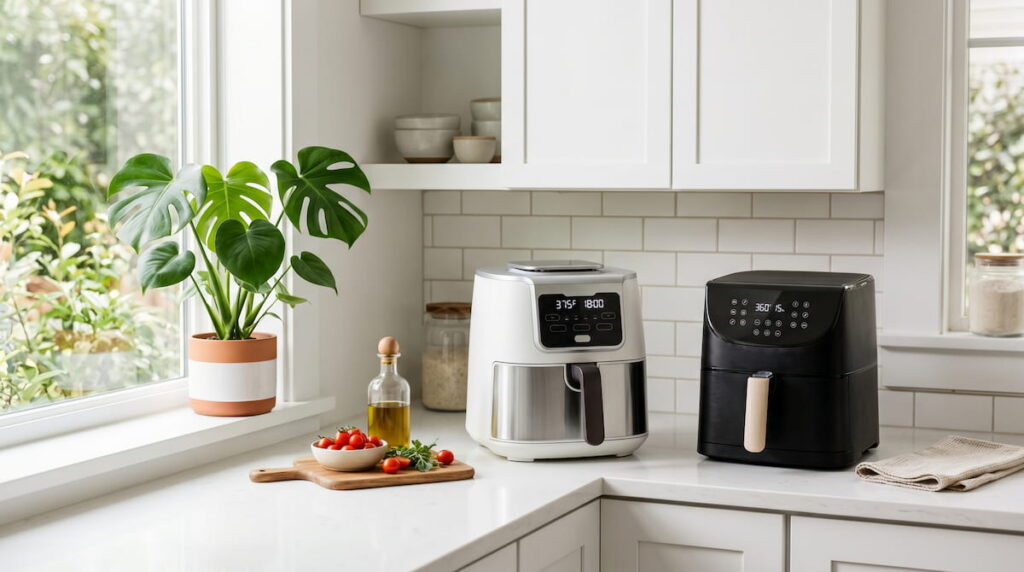
The best air fryer sensitive lungs households need is one that skips PTFE coatings entirely — because that’s where the most irritating cooking fumes come from. For anyone dealing with COPD, chronic bronchitis, asthma, chemical sensitivities, or simply lungs that react strongly to kitchen fumes, the basket material inside your air fryer matters far more than the brand on the outside.
That’s why finding the best air fryer sensitive lungs households can rely on means looking past marketing claims and directly at material certifications.I put this guide together after spending time researching what air fryers actually release during normal cooking — and finding that the difference between a PTFE-coated basket and a ceramic or glass interior is significant enough to affect daily air quality in a closed kitchen. Here’s what that research found, and which models come out on top for lung-sensitive households.
What Makes an Air Fryer Safe for Sensitive Lungs?
People with sensitive lungs react to airborne irritants at lower concentrations than the general population. The compounds most likely to cause problems during air fryer use are:
- PTFE decomposition byproducts — released when Teflon-style coatings overheat or degrade; the most acutely irritating class of air fryer fumes for sensitive airways
- VOCs from heated coatings — formaldehyde, acrolein, and acetaldehyde that off-gas from nonstick surfaces under heat
- Ultrafine particles — generated by high-heat cooking and grease combustion; penetrate deep into lung tissue
- PFAS compounds — chronic exposure concern from fluorinated coating materials
A lung-safe air fryer eliminates or minimizes all four categories. That means verified PTFE-free, PFAS-free cooking surfaces — ceramic, stainless steel, or glass. Our full breakdown of what chemicals air fryers release by material explains exactly how each coating type compares.
Best Air Fryers for Sensitive Lungs in 2026
🥇 #1 — Ninja AF150AMZ (Best Everyday Pick for Sensitive Lungs)
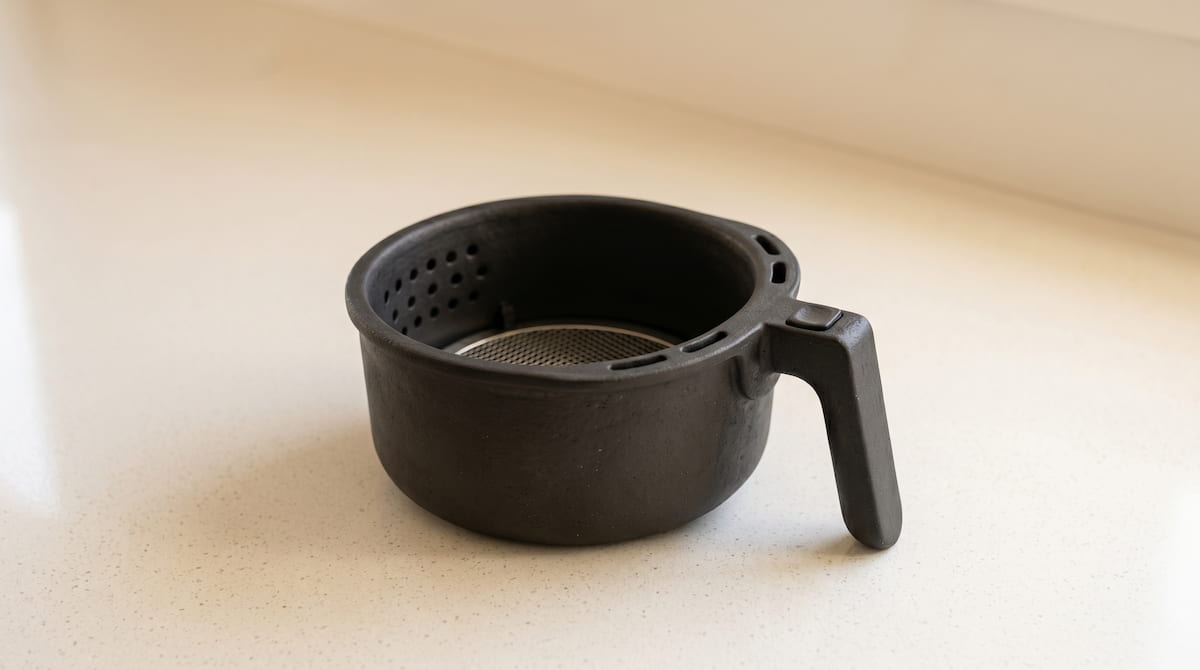
The Ninja AF150AMZ ceramic basket is PTFE-free and PFAS-free — the most important criteria for households with lung-sensitive members.
The Ninja AF150AMZ earns the top spot for lung-sensitive households because it combines verified non-toxic materials with the kind of reliable daily performance that doesn’t require compromises. Its ceramic-coated basket is explicitly PTFE-free and PFAS-free — meaning the two highest-risk fume categories are eliminated at the source.
| Feature | Details |
|---|---|
| Basket Material | Ceramic-coated — PTFE-free, PFAS-free |
| Capacity | 5.5 Qt — ideal for 2–4 people |
| Temperature Control | Digital precision — reduces unintended overheating |
| Fume Risk | ✅ Very Low — no PTFE off-gassing |
| Cleaning | Dishwasher-safe basket |
| Best For | Daily cooking, asthma, COPD, chemical sensitivities |
Why it works for sensitive lungs: Ceramic coatings are inorganic silica-based compounds that don’t contain PTFE or PFAS. Even under sustained high-heat use, they don’t release the fluorinated compounds that are the primary fume concern for sensitive airways. Digital temperature control also prevents the accidental overheating that spikes fume output in manual-dial models.
See Ninja AF150AMZ on Amazon →🥈 #2 — Big Boss 16Qt Glass Air Fryer (Best for Maximum Lung Protection)
For households where lung sensitivity is severe — COPD, pulmonary fibrosis, extreme chemical sensitivity — the Big Boss 16Qt removes the coating variable entirely. A borosilicate glass cooking chamber is completely chemically inert at any cooking temperature, with zero coating compounds to off-gas regardless of how long or how hot you cook.
| Feature | Details |
|---|---|
| Cooking Chamber | Borosilicate glass — zero coating of any kind |
| Capacity | 16 Qt — large family or batch cooking |
| Fume Risk | ✅ Lowest possible — glass is inert |
| PTFE / PFAS | None — glass cooking surface only |
| Cleaning | Glass bowl washes easily — no coating to protect |
| Best For | COPD, severe lung conditions, maximum fume reduction |
Why it works for sensitive lungs: Glass is the most chemically inert cooking surface in any air fryer format. It cannot degrade in ways that produce coating byproducts, cannot be scratched in ways that change its off-gassing profile, and contains no PTFE, PFAS, or silica-based coating compounds of any kind. For lungs that react to things others don’t notice, this level of inertness matters.
See Big Boss Glass Air Fryer on Amazon →🥉 #3 — Instant Pot Omni Plus 18L (Best for Large Lung-Sensitive Households)
The Instant Pot Omni Plus offers a stainless steel interior alongside its air frying functions — making it the strongest option for larger families where lung sensitivity is a concern and cooking volume is high. Stainless steel doesn’t off-gas coating compounds because there is no coating — just bare metal that stays inert under heat.
| Feature | Details |
|---|---|
| Interior Material | Stainless steel — no nonstick coating |
| Capacity | 18L — large family cooking |
| Functions | Air fry, bake, roast, broil, toast, dehydrate |
| Fume Risk | ✅ Very Low — no coating to degrade |
| Best For | Large families, lung-sensitive households needing volume |
Side-by-Side Comparison for Sensitive Lungs
| Model | Material | PTFE-Free | Fume Risk | Capacity |
|---|---|---|---|---|
| Ninja AF150AMZ | Ceramic | ✅ Yes | Very Low | 5.5 Qt |
| Big Boss Glass | Glass | ✅ Yes | Lowest | 16 Qt |
| Instant Pot Omni Plus | Stainless Steel | ✅ Yes | Very Low | 18 L |
| Standard Nonstick | PTFE Coating | ❌ No | High | Varies |
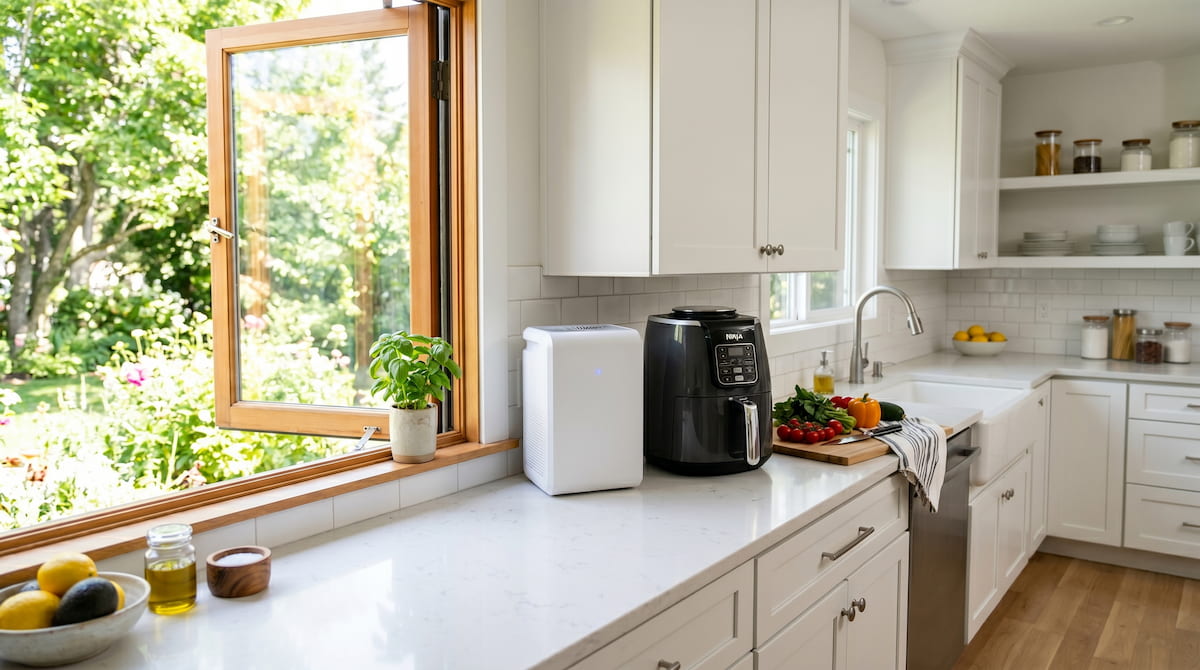
Pairing a non-toxic air fryer with a HEPA air purifier near the kitchen is the most effective combination for protecting sensitive lungs during daily cooking.
Habits That Support Lung Safety Beyond the Air Fryer Model
Even the safest air fryer performs better for sensitive lungs when paired with these daily habits:
- Always ventilate during cooking — open a window, run the range hood, use a fan. Our kitchen ventilation guide covers room-by-room strategies
- Run a HEPA air purifier near the kitchen — captures ultrafine particles that ventilation alone doesn’t fully address
- Stay out of the kitchen during the first 5–10 minutes — particle and fume concentration peaks at the start of each cooking session
- Cook at 350–380°F when possible — lower temperatures reduce particle generation and coating stress
- Use parchment or silicone liners — reduces direct oil contact with the basket, cutting down on VOC output from grease combustion
- Clean the basket after every use — prevents grease buildup that adds unnecessary compounds to the next cooking session
For more on the breathing side of this equation, our guide on air fryer breathing safety for families covers what compounds accumulate and how quickly they clear with different ventilation approaches.
Frequently Asked Questions
What is the safest air fryer for someone with COPD?
The Big Boss 16Qt glass air fryer is the most thorough option for COPD, as its glass cooking chamber produces zero coating off-gassing. For everyday practicality with strong safety credentials, the Ninja AF150AMZ ceramic model is the most accessible choice with verified PTFE-free and PFAS-free materials.
Is ceramic coating safe for sensitive lungs?
Yes — verified ceramic coatings are PTFE-free and PFAS-free, meaning they don’t release the fluorinated compounds most associated with lung irritation. They still produce minor food-related particles during cooking, but the coating itself is far less reactive than traditional nonstick under heat.
Can air fryers worsen lung conditions?
A PTFE-coated air fryer with a degrading basket, used in a closed kitchen, can produce fume concentrations that worsen symptoms in people with COPD, asthma, or chemical sensitivities. Switching to a non-toxic material and maintaining consistent ventilation significantly reduces this risk.
Is stainless steel safer than ceramic for sensitive lungs?
Both are significantly safer than PTFE-based nonstick. Stainless steel has no coating to degrade at all, making it theoretically the most durable non-toxic option. Ceramic coatings add convenience with nonstick properties while maintaining a safe chemical profile. Either is appropriate for lung-sensitive households.
Do air fryer liners help protect sensitive lungs?
Yes. Parchment and silicone liners reduce direct oil contact with the basket surface, which cuts down on grease combustion VOCs — one of the more controllable sources of cooking-related airborne compounds. They’re a useful addition to any lung-safe cooking setup.
The Bottom Line: Best Air Fryer for Sensitive Lungs
The best air fryer for sensitive lungs is one with a verified PTFE-free, PFAS-free cooking surface — ceramic, stainless steel, or glass. The Ninja AF150AMZ covers most households with practical daily performance and strong non-toxic credentials. The Big Boss glass model is the right choice when lung sensitivity is severe and eliminating every possible coating variable matters most.
Pair either model with consistent ventilation and a HEPA purifier, and daily air fryer cooking becomes a genuinely low-risk activity even for the most sensitive respiratory systems. Our PFAS-free air fryer guide covers the full range of safe options if you want to compare further before deciding.