
Best air fryer for indoor air quality choices focus on reducing fumes, odors, and airborne particles while cooking indoors. Indoor air quality during cooking is a real concern: according to the EPA’s indoor air quality research, cooking appliances are among the leading contributors to elevated VOC and ultrafine particle levels inside homes, often reaching 2–5 times outdoor concentrations.
The difference between a PTFE-coated basket and a ceramic or glass interior isn’t subtle when it comes to what ends up in your kitchen air. I put this guide together after tracking down exactly which materials make the biggest difference — and which models our family trusts for daily use with kids at home.
What Does an Air Fryer Release Into Your Indoor Air?
Understanding the best air fryer for indoor air quality starts with knowing what you’re actually trying to minimize. Air fryers can release four main categories of airborne compounds during cooking:
- PTFE decomposition byproducts — fluorinated compounds from overheated or degrading Teflon-style coatings; the most acutely irritating class of air fryer emissions
- VOCs — volatile organic compounds including formaldehyde and acrolein from heated coating surfaces and burnt oil residue
- Ultrafine particles — generated by high-heat cooking; small enough to penetrate deep into lung tissue and pass through standard air filters
- PFAS compounds — chronic exposure concern from fluorinated coating materials that accumulate in the body over time
The basket material determines how much of the first two categories you’re exposed to. Food-related particles exist regardless of basket type, but coating-related emissions are entirely avoidable with the right material choice. Our full breakdown of what chemicals air fryers release by material covers each compound in detail.
What Makes an Air Fryer Good for Indoor Air Quality?
A genuinely air-quality-friendly air fryer meets these criteria:
- ✅ Basket verified PTFE-free by the manufacturer
- ✅ PFAS-free certification or explicit material disclosure
- ✅ Ceramic, stainless steel, or glass cooking surface
- ✅ Precise digital temperature control to prevent accidental overheating
- ✅ No plastic components directly in the cooking chamber
For households with asthma, COPD, infants, or anyone with respiratory sensitivity, these criteria shift from “nice to have” to genuinely important daily decisions. See our guides on air fryer fumes and asthma and best air fryers for sensitive lungs for condition-specific guidance.
Best Air Fryers for Indoor Air Quality in 2026
🥇 #1 — Ninja AF150AMZ (Best Everyday Pick for Air Quality)
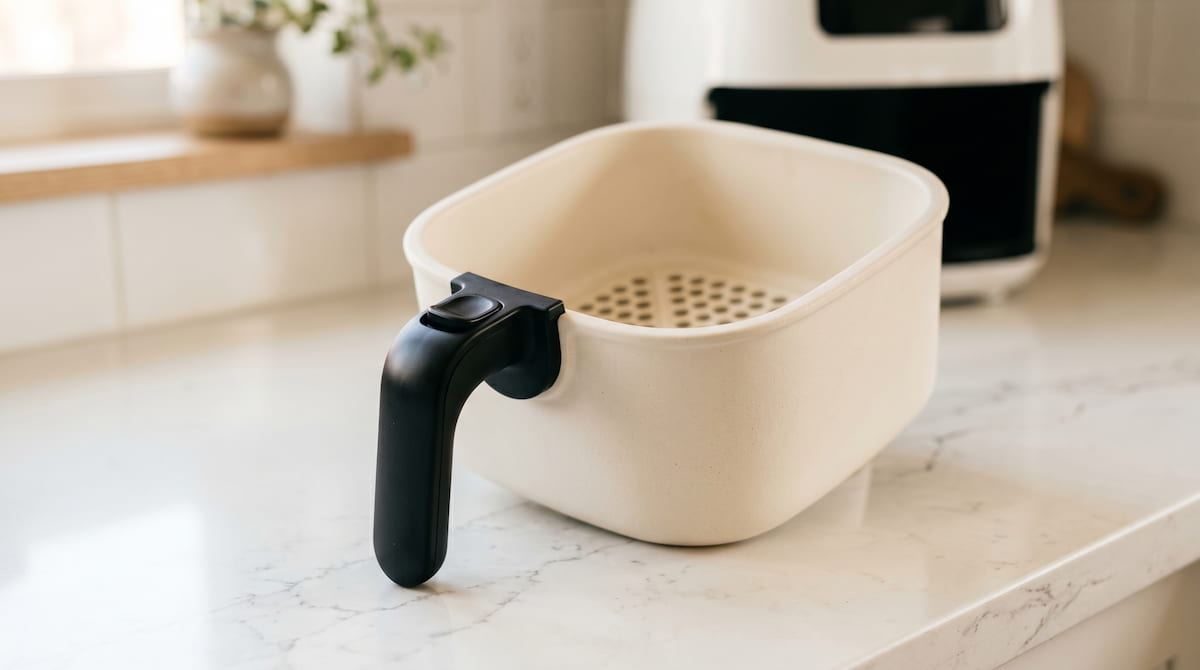
The Ninja AF150AMZ ceramic basket is PTFE-free and PFAS-free — the most important material criteria for protecting indoor air quality during daily cooking.
The Ninja AF150AMZ is our top pick for indoor air quality because it removes the highest-risk emission source — PTFE coating byproducts — while delivering the kind of everyday performance that doesn’t require trade-offs in cooking quality or convenience.
| Feature | Details |
|---|---|
| Basket Material | Ceramic-coated — PTFE-free, PFAS-free |
| Capacity | 5.5 Qt — ideal for 2–4 people |
| Temperature Control | Digital precision — prevents accidental overheating |
| Air Quality Impact | ✅ Very Low — no fluorinated coating emissions |
| Cleaning | Dishwasher-safe basket |
| Best For | Daily family cooking, air quality conscious households |
Why it’s good for indoor air quality: Ceramic coatings are inorganic silica-based — they don’t contain PTFE or PFAS, so even under sustained heat they don’t release the fluorinated compounds that are the primary coating-related air quality concern. Digital temperature control adds a second layer of protection by preventing the accidental high-heat spikes that stress any cooking surface unnecessarily.
See Ninja AF150AMZ on Amazon →🥈 #2 — Big Boss 16Qt Glass Air Fryer (Best for Maximum Air Quality Protection)
For households where indoor air quality is a top priority — whether due to respiratory conditions, infants, or simply a preference for the cleanest possible cooking environment — the Big Boss 16Qt glass air fryer is the most thorough solution available. A borosilicate glass cooking chamber is completely chemically inert under any cooking temperature, with zero coating compounds to off-gas.
| Feature | Details |
|---|---|
| Cooking Chamber | Borosilicate glass — zero coating of any kind |
| Capacity | 16 Qt — large family or batch cooking |
| Air Quality Impact | ✅ Lowest possible — glass is chemically inert |
| PTFE / PFAS | None — glass cooking surface only |
| Cleaning | Glass bowl washes easily — no coating to protect |
| Best For | Maximum air quality protection, large families, respiratory conditions |
Why it’s the best for air quality: Glass doesn’t degrade, doesn’t scratch in ways that change its chemical profile, and contains no PTFE, PFAS, or silica-based coating compounds whatsoever. For households where eliminating every possible coating emission source is the goal, this is the most complete solution in the air fryer market.
See Big Boss Glass Air Fryer on Amazon →🥉 #3 — Instant Pot Omni Plus 18L (Best for Large Families Prioritizing Air Quality)
The Instant Pot Omni Plus brings a stainless steel interior to the table — no coating of any kind on the cooking surfaces, which means no coating-related emissions regardless of temperature or years of use. For large families who need volume and want the cleanest possible indoor air during cooking, it fills a gap that smaller ceramic models can’t.
| Feature | Details |
|---|---|
| Interior Material | Stainless steel — no nonstick coating |
| Capacity | 18L — large family cooking |
| Functions | Air fry, bake, roast, broil, toast, dehydrate |
| Air Quality Impact | ✅ Very Low — no coating to degrade or off-gas |
| Best For | Large families, high-volume cooking, air quality priority |
Air Quality Comparison: All Three Models
| Model | Material | PTFE-Free | Air Quality Risk | Capacity |
|---|---|---|---|---|
| Ninja AF150AMZ | Ceramic | ✅ Yes | Very Low | 5.5 Qt |
| Big Boss Glass | Glass | ✅ Yes | Lowest | 16 Qt |
| Instant Pot Omni Plus | Stainless Steel | ✅ Yes | Very Low | 18 L |
| Standard Nonstick | PTFE Coating | ❌ No | High | Varies |
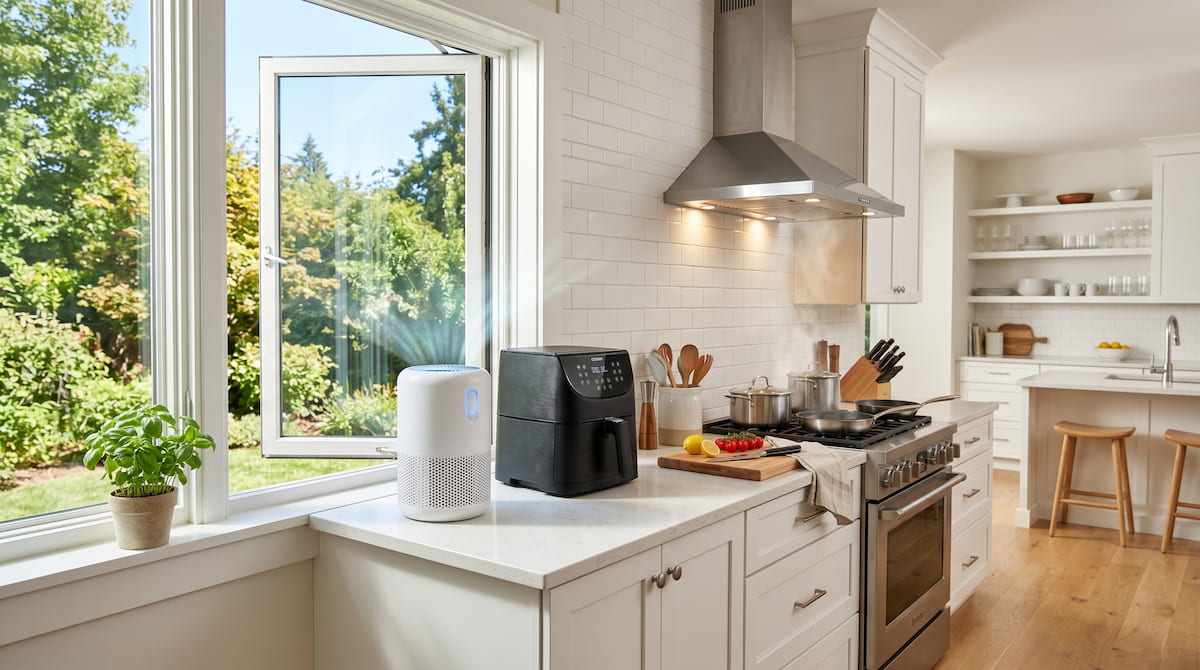
A non-toxic air fryer paired with a HEPA purifier and open window creates the most complete indoor air quality setup for daily cooking.
Habits That Protect Indoor Air Quality During Air Fryer Use
Even the best air fryer for indoor air quality performs better when paired with these daily habits:
- Ventilate every session without exception — open a window, run the range hood, or use a fan directed toward a vent. Our kitchen ventilation guide covers room-by-room strategies including small apartments
- Run a HEPA air purifier near the kitchen — captures ultrafine particles that ventilation alone doesn’t fully address, especially in closed kitchen layouts
- Cook at 350–380°F when possible — lower temperatures reduce particle generation and coating stress compared to max-heat cooking
- Use parchment or silicone liners — reduces direct oil contact with the basket, cutting down on grease combustion VOCs
- Clean the basket after every use — grease residue burning during the next cook adds unnecessary compounds to your kitchen air
- Inspect the basket monthly — for ceramic models, catching early coating wear prevents the increase in off-gassing that comes with surface damage
For a deeper look at how air fryer use affects indoor air specifically, see our guide on air fryer VOC emissions by material type.
Frequently Asked Questions
Do air fryers significantly affect indoor air quality?
They can — especially PTFE-coated models in closed kitchens. Ceramic, stainless, and glass models produce significantly lower coating-related emissions. Food-related particles exist with any cooking method, but the coating variable is entirely controllable by material choice.
Is ceramic better than stainless steel for indoor air quality?
Both are significantly better than PTFE-based nonstick. Stainless steel has no coating at all, making it the most durable option over years of use. Ceramic coatings add nonstick convenience while maintaining a safe chemical profile. Either is appropriate for air-quality-conscious households.
Does a HEPA purifier help with air fryer emissions?
Yes — a HEPA purifier positioned near the kitchen captures ultrafine particles down to 0.3 microns that ventilation alone may not fully address. It’s a useful addition to any air-quality-focused cooking setup, especially in smaller kitchens or apartments without strong natural ventilation.
How long do air fryer emissions linger in a kitchen?
In a well-ventilated kitchen, cooking-related particles and VOCs typically clear within 15–30 minutes after cooking ends. In a closed kitchen without active ventilation, they can persist for an hour or more — reinforcing why ventilation during cooking matters more than just after.
Is the Ninja AF150AMZ actually better for air quality than a standard nonstick air fryer?
Yes — meaningfully so. The ceramic basket eliminates PTFE and PFAS coating emissions entirely. The difference is most significant if your standard nonstick basket is scratched, aging, or frequently pushed to high temperatures — all conditions that increase off-gassing from PTFE coatings specifically.
The Bottom Line: Best Air Fryer for Indoor Air Quality
The best air fryer for indoor air quality eliminates PTFE and PFAS coating emissions at the source — and all three models above do exactly that through ceramic, glass, or stainless steel cooking surfaces. The Ninja AF150AMZ is the most practical everyday choice, the Big Boss glass model is the most thorough solution for maximum air quality protection, and the Instant Pot Omni Plus covers large families who need volume without coating compromise.
Pair any of these with consistent ventilation and a HEPA purifier, and daily air fryer cooking becomes a genuinely low-impact activity for your indoor air. For a broader comparison of safe materials across every budget, our PFAS-free air fryer guide covers everything you need to make a confident final choice.