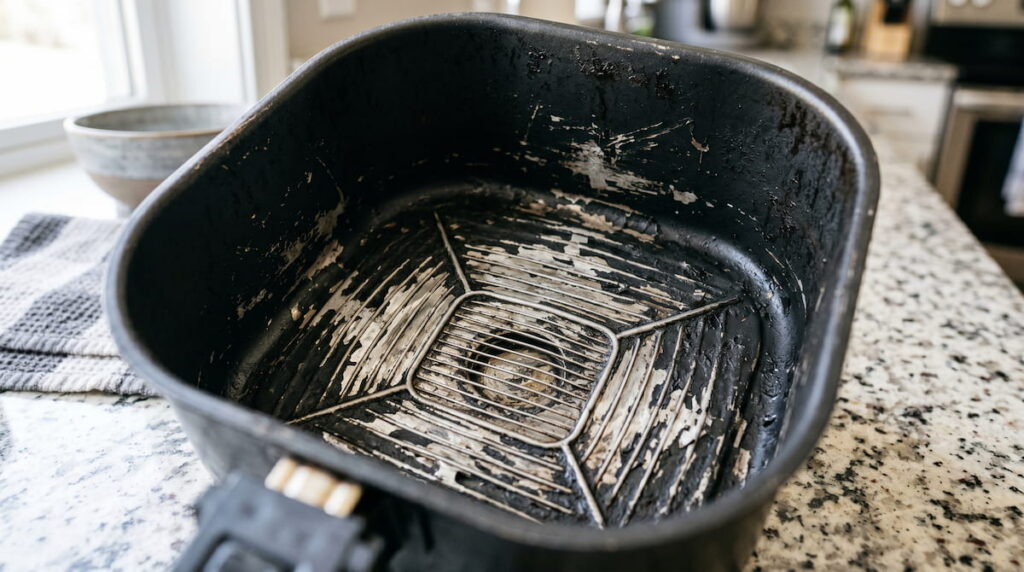
Scratched air fryer basket chemicals are a real concern — and the answer to whether they’re released depends almost entirely on what the basket is made of. A scratched PTFE nonstick basket and a scratched ceramic basket are not the same situation. Understanding the difference is what determines whether you need to replace your basket immediately or whether you have a window to plan.
I went through this process with our old nonstick air fryer after noticing surface scratches from tong use. What I found about what a damaged PTFE coating actually releases — and how quickly degradation accelerates after scratching — changed how seriously I take basket maintenance. Here’s the complete picture.
What Does a Scratched Air Fryer Basket Actually Release?
The answer depends entirely on coating type. There are two completely different chemical profiles for scratched baskets:
Scratched PTFE Nonstick Basket
PTFE — polytetrafluoroethylene — is the fluoropolymer compound used in most standard nonstick coatings. When an intact PTFE coating is heated, it is largely chemically stable at temperatures below 500°F. But when that coating is scratched, two things change:
- Physical particles enter food — small flakes of PTFE coating can detach from scratched areas and end up in whatever you’re cooking. PTFE itself is considered chemically inert and passes through the body without absorption, but ingesting coating material is something most families reasonably want to avoid
- Off-gassing threshold drops — a scratched PTFE surface degrades under heat faster than an intact one. The damaged areas are thinner and more reactive, meaning fluorinated compound release begins at lower temperatures than the 500°F threshold cited for intact coatings
According to the EPA’s PFAS resource page, fluoropolymer breakdown products are an area of ongoing health concern — particularly for repeated daily exposure in enclosed spaces. A scratched PTFE basket that’s used daily in a closed kitchen represents exactly that scenario.
Scratched Ceramic Basket
Ceramic coatings are silica-based — they contain no PTFE and no PFAS compounds. When a ceramic basket is scratched, the main consequence is reduced nonstick performance and potential exposure of the underlying aluminum substrate. What it doesn’t produce is fluorinated compound release, because there are no fluorinated compounds in the coating to release.
A scratched ceramic basket is an inconvenience. A scratched PTFE basket is a chemical exposure concern. That distinction is the most important thing to understand when evaluating whether your basket needs immediate replacement.
Scratched Air Fryer Basket Chemicals: What Gets Released by Material
| Basket Material | What a Scratch Releases | Risk Level | Replacement Urgency |
|---|---|---|---|
| PTFE nonstick | Fluorinated particles + accelerated off-gassing | ❌ High | Replace immediately |
| Ceramic (PTFE-free) | No fluorinated compounds — reduced nonstick only | ⚠️ Low | Replace when performance drops |
| Stainless steel | Nothing — no coating to scratch | ✅ None | No coating-related replacement |
| Glass | Nothing — no coating at all | ✅ None | No coating-related replacement |
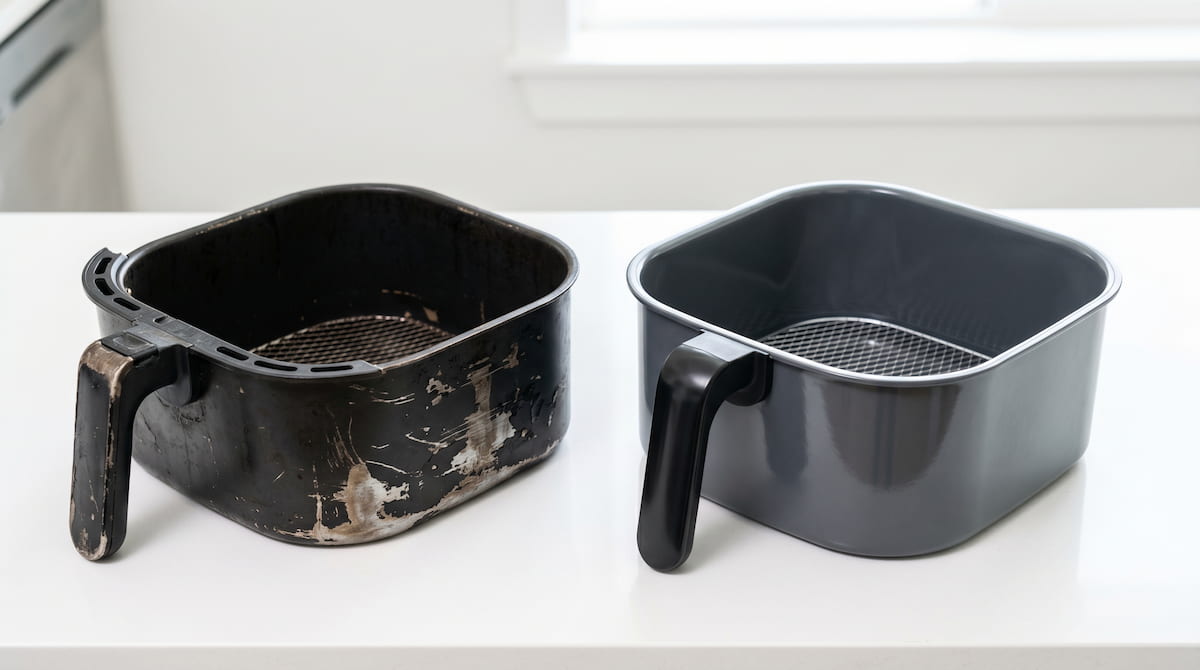
A scratched PTFE basket (left) releases fluorinated compounds under heat — a scratched ceramic basket (right) loses nonstick performance without the chemical release concern.
What Most People Get Wrong About Scratched Baskets
The most common mistake is waiting for visible flaking before acting on a scratched PTFE basket. By the time coating is visibly flaking off in pieces, it has already been releasing increased compounds at the scratch sites for weeks or months. The scratch is the starting point of accelerated degradation — not a stable state that holds until flaking appears.
The second mistake is treating ceramic and PTFE scratches as equivalent. They aren’t. A scratch on a ceramic basket means the silica-based coating is compromised — the underlying aluminum is exposed and nonstick performance will decline. A scratch on a PTFE basket means a fluoropolymer coating is compromised — and that means a different class of compounds is now entering your food and kitchen air at every subsequent cook.
The third mistake is assuming that using parchment liners on a scratched PTFE basket makes it safe to continue using indefinitely. Liners reduce direct food contact with the damaged surface, which is a meaningful short-term mitigation. But the coating continues degrading under heat at the scratch sites regardless of whether food touches it directly — off-gassing happens whether or not food is in contact with the surface. Liners buy time; they don’t solve the underlying problem. Our guide on what happens when air fryer coating gets scratched explains this degradation process in full detail.
How Quickly Does Chemical Release Increase After Scratching?
This is the question most families want a specific answer to — and the honest answer is that it depends on several factors:
- Depth of the scratch — a light surface scuff that doesn’t break through to the substrate is lower concern than a visible scratch exposing aluminum
- Cooking temperature — higher temperatures accelerate degradation at scratch sites. A scratched basket used at 400°F degrades faster than the same basket at 350°F
- Age of the coating — an older coating is already thinner and closer to degradation across its entire surface. A scratch on a 2-year-old basket is more concerning than the same scratch on a new one
- Frequency of use — daily cooking means daily heat cycling through the scratch site. Each cycle contributes to further breakdown at that point
The practical takeaway: there is no safe “wait and see” window for a visibly scratched PTFE basket. The chemistry at the scratch site is already different from an intact coating, and it doesn’t improve with continued use.
Chemical Safety Checklist for Scratched Baskets
✅ Lower concern situations:
- Scratch is on a verified ceramic-coated basket — plan replacement when performance drops, not immediately
- Light surface scuff with no visible break in coating depth on any basket type
- Stainless steel or glass interior — no coating means no scratch-related chemical concern
⚠️ Use caution and plan immediate replacement:
- Visible scratch on a PTFE nonstick basket — even without flaking
- Multiple scratches across the basket surface
- Any scratch accompanied by discoloration at the scratch site
❌ Stop using immediately:
- Any flaking or peeling on any basket type
- Chemical smell during cooking from a scratched basket
- Visible bare metal at scratch sites on a PTFE basket
What to Do If Your Air Fryer Basket Is Scratched
- Identify the coating type first — check your model’s product page for “PTFE-free” or “ceramic coating” language. If it says “nonstick” without specification, assume PTFE
- Assess the scratch depth — light surface marks on ceramic are lower urgency than any visible scratch on PTFE
- For PTFE baskets with visible scratches — start using parchment liners immediately, lower cooking temperature to 350–375°F, and order a replacement. Don’t continue using it as normal while you wait
- Ventilate every cooking session — keep a window open and range hood running until replacement arrives. Our guide on how to ventilate your kitchen when using an air fryer covers specific strategies
- Consider upgrading rather than replacing like-for-like — a ceramic or stainless basket eliminates this concern for the next 2–4 years minimum

Ventilating the kitchen during every cooking session is especially important while using a scratched basket and waiting for a replacement to arrive.
The Permanent Fix: Switching to a Non-Toxic Basket
The most reliable solution to the scratched basket chemical concern is switching to a coating that doesn’t carry the same risk when it wears. Our family uses the Ninja AF150AMZ — its ceramic-coated basket is PTFE-free and PFAS-free. When the ceramic surface eventually shows wear, the consequence is reduced nonstick performance, not fluorinated chemical release. That’s a fundamentally different maintenance situation.
For families who want to eliminate the coating inspection question entirely, the Big Boss 16Qt glass air fryer has no basket coating of any kind — nothing to scratch, nothing to release, nothing to replace on a coating safety timeline. For a full comparison of both options, see our PFAS-free air fryer guide.
See Ninja AF150AMZ on Amazon → See Big Boss Glass Air Fryer on Amazon →Frequently Asked Questions
Do scratched air fryer baskets release chemicals?
PTFE-coated baskets do — a scratched PTFE surface releases fluorinated particles into food and accelerates off-gassing under heat compared to an intact coating. Ceramic baskets don’t release the same class of compounds when scratched because they contain no PTFE or PFAS chemistry. Coating type is the determining factor.
Is a scratched nonstick air fryer basket dangerous?
For PTFE-coated baskets — yes, meaningfully so. The scratch accelerates degradation at that site and lowers the effective temperature threshold for compound release. It’s not an emergency like a flaking basket, but it’s not a stable situation that resolves with continued use either. Plan replacement promptly.
Can I use a scratched ceramic air fryer basket?
With caution — yes, temporarily. A scratched ceramic basket exposes aluminum but doesn’t release fluorinated compounds. Use parchment liners to reduce direct food contact with the damaged area, and plan replacement when nonstick performance drops noticeably or when bare substrate becomes visible.
Do parchment liners make a scratched basket safe?
They reduce direct food contact with the damaged surface, which is a meaningful short-term mitigation. However, a scratched PTFE coating continues off-gassing under heat regardless of whether food touches it — the liner addresses food particle exposure but not airborne compound release. Use liners as a bridge to replacement, not a permanent solution.
How do I know if my air fryer basket is PTFE or ceramic?
Check the manufacturer’s product page for “PTFE-free,” “PFAS-free,” or “ceramic coating” language. If it says “nonstick” without further specification, assume PTFE until confirmed otherwise. Many budget models don’t disclose coating composition clearly — that lack of transparency is itself worth noting when evaluating the basket.
What happens if I accidentally eat air fryer coating particles?
PTFE particles are considered chemically inert and pass through the digestive system without absorption — accidental ingestion of small amounts is not considered an acute health emergency. The longer-term concern is repeated daily exposure to compounds released from a degrading coating over weeks and months, not a single incident.
The Bottom Line on Scratched Air Fryer Basket Chemicals
Scratched air fryer baskets release different compounds depending on coating type — and that difference determines how urgently you need to act. A scratched PTFE basket warrants prompt replacement and interim ventilation. A scratched ceramic basket warrants monitoring and planned replacement when performance drops. Stainless steel and glass interiors have no coating to scratch and no coating-related chemical concern at any age.
For a full safety timeline by coating type, see our guide on how long air fryer coating lasts. For a full comparison of safe replacement options, our PFAS-free air fryer guide covers ceramic, stainless, and glass models side by side.