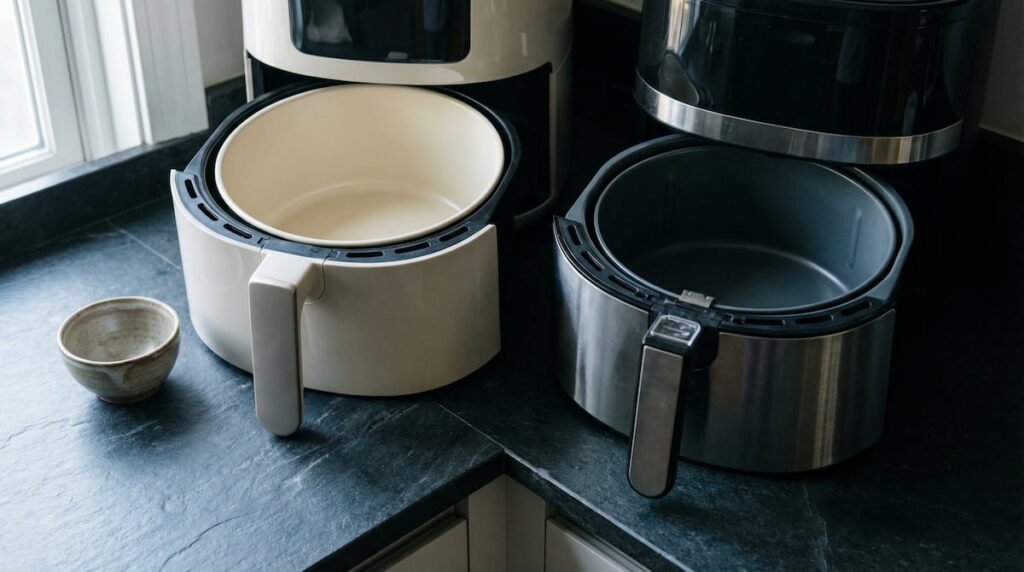
I’ve used both. For about eight months, I cooked with a standard PTFE nonstick air fryer without thinking much about it. Then I started paying closer attention to what my family was actually eating off of — and that’s when I started comparing ceramic vs nonstick air fryers seriously.
This guide is what I found. Not marketing language — actual differences that matter for everyday family cooking.
The Core Difference: What the Basket Is Actually Made Of
Both ceramic and nonstick air fryers do the same job — circulate hot air around food to cook it quickly with minimal oil. The difference is entirely in the basket coating, and that coating is what comes into direct contact with your food every time you cook.
Traditional nonstick baskets use PTFE — polytetrafluoroethylene, the compound behind the Teflon brand. PTFE is part of the broader PFAS chemical family, sometimes called “forever chemicals” because they break down slowly in the environment and the body. Modern PTFE coatings are considered stable at normal cooking temperatures, but many households now prefer to avoid them regardless.
Ceramic-coated baskets use a silica-based coating instead — no fluoropolymers involved. That’s the main reason ceramic is marketed as PFAS-free. It’s not a perfect solution (ceramic coatings have their own limitations), but it does remove the PTFE question from the equation entirely. For a deeper look at what these coatings release under heat, see our guide on what chemicals air fryers release by material type.
What Most People Get Wrong About Ceramic vs Nonstick
The most common mistake is treating this as a binary “safe vs unsafe” comparison. Neither coating is toxic under normal conditions with an intact surface — the real question is what happens as each coating ages and wears.
When PTFE wears, scratches, or degrades under heat, it releases fluorinated compounds. When ceramic wears, it loses nonstick performance and exposes the underlying aluminum — an inconvenience, not a chemical hazard. That difference in failure mode is the most important thing to understand when comparing the two materials.
The second mistake is assuming ceramic coatings are fragile across the board. Early ceramic cookware from a decade ago earned that reputation — but modern ceramic-coated air fryer baskets, particularly from brands like Ninja, are significantly more durable than those early products. The Ninja AF150AMZ ceramic basket has held up to daily family use well beyond what older ceramic products managed.
The third mistake is ignoring the coating type when buying a budget model. Many budget air fryers use nonstick coatings without disclosing whether they’re PTFE-based. “Nonstick” without further specification almost always means PTFE. Our guide on what happens when air fryer coating gets scratched explains exactly why this matters over time.
Ceramic Air Fryers: What’s Actually Better (And What Isn’t)
Ceramic coatings have improved significantly in recent years. The early ceramic pans from the early 2010s were notoriously fragile — the coating chipped within months and nonstick performance degraded fast. Newer ceramic air fryer baskets are more durable, but they still have real limitations worth understanding.
What ceramic does well: No PTFE, no PFOA, no fluoropolymers. Food releases reasonably well when the coating is new. Easy to clean with a soft sponge. Most ceramic baskets handle temperatures up to 450°F without issue. Even when worn, the failure mode doesn’t carry chemical release risk.
What ceramic doesn’t do well: Ceramic coatings are more fragile than PTFE under the wrong conditions. Metal utensils scratch the surface quickly. Dishwashers accelerate wear. Once the ceramic coating starts to degrade — usually visible as dull patches or food starting to stick — it needs replacing. Most quality ceramic baskets last 2–4 years with proper care, less if handled roughly.
See Ninja AF150AMZ on Amazon →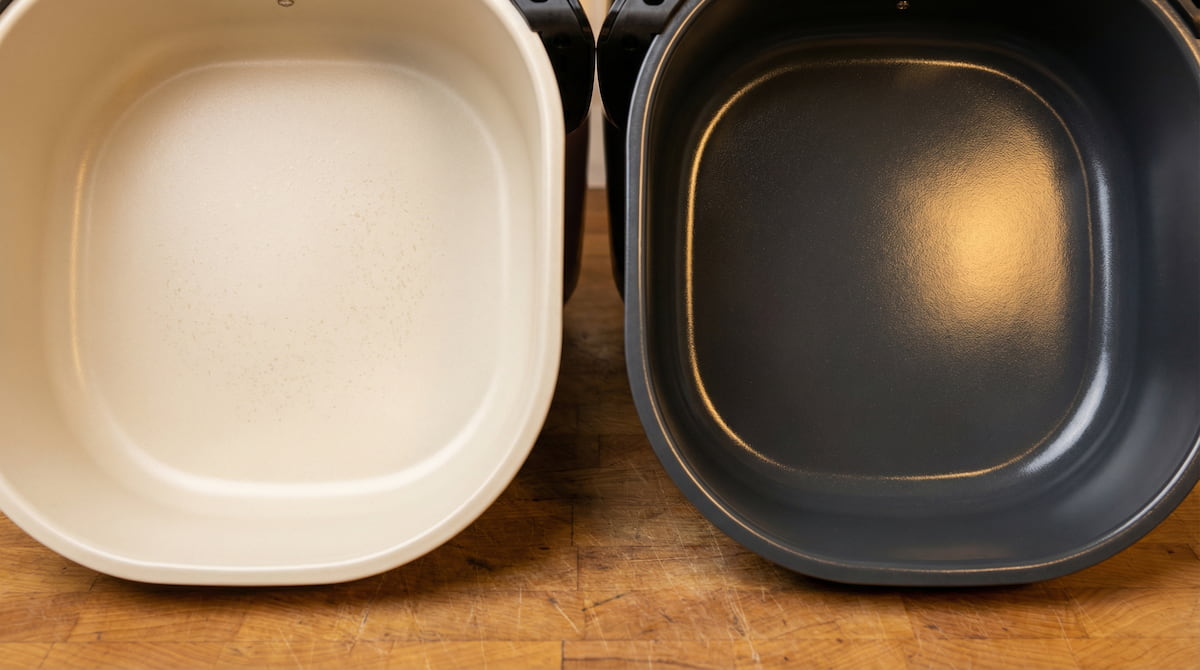
Ceramic coating (left) vs PTFE nonstick (right) — the surface chemistry difference is invisible to the eye but significant for long-term family safety.
Nonstick (PTFE) Air Fryers: Why They’re Still Dominant
PTFE nonstick coatings have been used in cookware for decades, and there’s a reason they haven’t gone away: they work exceptionally well. Food doesn’t stick, cleanup is effortless, and the coatings hold up better than ceramic under heavy use.
The health concern with PTFE is real but often overstated. At normal air fryer temperatures (300–400°F), PTFE is chemically stable and doesn’t release harmful compounds. The risk increases significantly above 500°F — temperatures most home air fryers don’t reach in normal use. But air fryer basket surfaces can run 50–100°F hotter than what the display shows, which narrows that safety margin more than most people realize. Our guide on what temperature PTFE breaks down covers this gap in detail.
The bigger practical concern is coating wear. A scratched or peeling PTFE basket is a different situation from an intact one — that’s when replacement matters most.
Side-by-Side Comparison
| Feature | Ceramic | Nonstick (PTFE) |
|---|---|---|
| Coating type | Silica-based | PTFE (Teflon-type) |
| PFAS-free | ✅ Yes | ❌ No |
| Safe if scratched | ✅ No chemical release | ⚠️ Fluorinated particles |
| Safe for birds/pets | ✅ Yes | ❌ No |
| Food release | Good when new | Excellent |
| Durability | 2–4 years with care | 1–2 years daily use |
| Dishwasher safe | Hand wash recommended | Often yes |
| Fume risk at high heat | ✅ None | ⚠️ Above 500°F |
Which One Should You Choose?
Choosing between ceramic and nonstick comes down to one question: is eliminating PTFE from your daily cooking a priority?
If avoiding PTFE is a priority — for health reasons, peace of mind, or because you’re building a less chemically complex kitchen — ceramic is the straightforward choice. It removes the PFAS question from daily cooking entirely, and the failure mode when it eventually wears is far safer than degrading PTFE.
If you prioritize performance and durability and aren’t concerned about PTFE at normal cooking temperatures, a quality nonstick basket will outlast most ceramic options. The key is keeping the coating intact — no metal utensils, no abrasive scrubbing, replace when visibly worn.
If you want to eliminate the coating question entirely, a stainless steel interior model like the Instant Pot Omni Plus or a glass bowl model like the Big Boss 16Qt is a third option worth considering — no coating to degrade, no coating to replace.
See Instant Pot Omni Plus on Amazon → See Big Boss Glass Air Fryer on Amazon →Frequently Asked Questions
Are ceramic air fryers actually safer than nonstick?
Yes — in the ways that matter most for long-term family cooking. Ceramic coatings don’t use fluoropolymers, so they don’t carry the PTFE fume risk or the chemical release concern when scratched. For everyday cooking at normal temperatures with an intact coating, both are considered safe — but the failure mode of ceramic is significantly less concerning than the failure mode of PTFE.
Do ceramic coatings wear out faster than nonstick?
With proper care, modern ceramic baskets actually last longer than PTFE — 2–4 years vs 1–2 years for PTFE under daily use. Ceramic is more sensitive to metal utensils and abrasive cleaning, but with silicone utensils and hand washing, it outlasts most PTFE alternatives.
Can I use a nonstick air fryer safely?
At normal cooking temperatures with an intact coating — yes, the risk is low for most adults. The concern rises with a scratched or degrading basket, regular high-heat use, and poor ventilation. Households with birds, infants, or respiratory conditions should prioritize ceramic or stainless over PTFE regardless of coating condition.
What is the safest air fryer coating for families?
Ceramic for the best combination of safety and nonstick convenience. Stainless steel for the most durable coating-free option. Glass for the most chemically inert cooking surface available. All three are significantly safer than PTFE-based nonstick for daily family use. Our PFAS-free air fryer guide compares all three in detail.
Is the Ninja AF150AMZ ceramic basket better than nonstick?
For families prioritizing PFAS-free cooking — yes. The Ninja AF150AMZ ceramic basket is verified PTFE-free and PFAS-free, holds up well to daily use with proper care, and doesn’t carry the fluorinated compound release risk that comes with PTFE degradation. Our Ninja ceramic basket safety guide covers the material verification in full detail.
How do I know if my air fryer is ceramic or nonstick?
Check the manufacturer’s product page for explicit “ceramic coating,” “PTFE-free,” or “PFAS-free” language. If it says “nonstick” without further specification, assume PTFE until confirmed otherwise. Many budget models don’t disclose coating composition clearly — that lack of transparency is itself worth noting.
The Bottom Line: Ceramic vs Nonstick Air Fryer
Ceramic wins on safety — no PTFE, no PFAS, no toxic fume risk if the coating wears. Nonstick wins on durability and performance — better food release, longer coating life under heavy use. For most families who cook daily and want to reduce chemical exposure without sacrificing convenience, ceramic is the right choice.