Disclosure: This post contains affiliate links. If you purchase through them, I earn a small commission at no extra cost to you. I only recommend products I personally trust for my family.
Air fryer safety tips most people ignore are not the obvious ones — everyone knows not to touch the hot basket. The tips that actually prevent problems are the ones that feel unnecessary until they aren’t. I’m Wook, a bus driver and dad who cooks for my family almost every night. These are the specific habits I wish I’d known from day one — the ones that would have prevented the smoke incidents, the coating damage, and the units I replaced earlier than I should have.
Safety Tip 1: Use the Bread Trick for Every Fatty Cook
Place one slice of bread in the bottom drawer beneath the basket before cooking bacon, sausage, chicken thighs, or any high-fat food. The bread absorbs dripping grease before it accumulates in the drawer and reaches ignition temperature. This single habit — costing less than five cents per cook — eliminates the primary cause of air fryer fires in home kitchens. Most people have never heard of it. The ones who have used it never cook fatty foods without it.
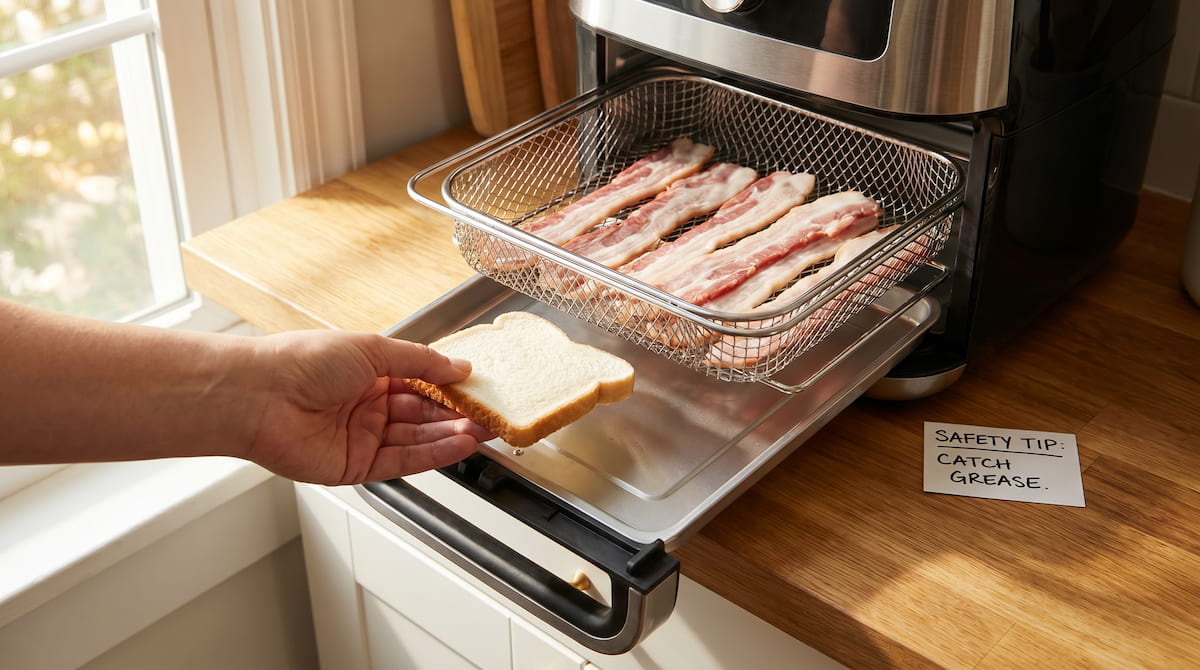
A single bread slice in the bottom drawer absorbs dripping grease before it can accumulate and ignite — the most underused air fryer safety tip.
Safety Tip 2: Open a Window Before Every Cook — Not Just Smoky Ones
Most people open the kitchen window when the air fryer starts smoking. The tip most ignore is opening it before every cook, not just reactive ones. Air fryers release cooking VOCs, grease aerosols, and in units with aging coatings, chemical compounds — all from the first minute of cooking, before any visible smoke appears. Ventilating proactively keeps compound concentrations low rather than diluting them after they’ve already built up in a closed kitchen. According to the U.S. EPA, indoor air can be 2–5 times more polluted than outdoor air during cooking — ventilation is the most effective single response to that reality.
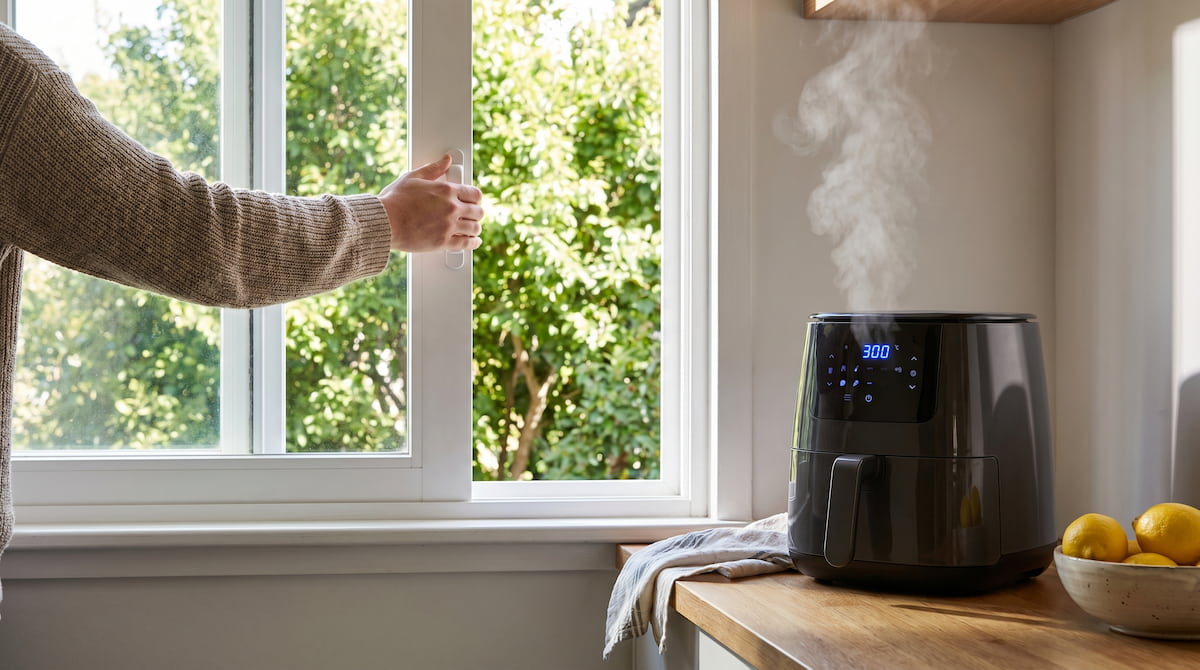
Opening a window before every cook — not just when smoke appears — keeps air quality consistently lower throughout the cooking session.
Safety Tip 3: Run an Empty Preheat After Any Long Storage Period
If the air fryer hasn’t been used for more than a week, run it empty at 350°F for 3–5 minutes before cooking food. This burns off any dust, moisture, or residue that settled inside during storage — and more importantly, it’s your early warning system. If the empty preheat produces an unusual smell or smoke, you know about it before food is in the basket rather than discovering it mid-cook.
Safety Tip 4: Check the Basket Coating in Strong Light — Not Kitchen Light
Most people inspect their basket under normal kitchen lighting, which is often overhead and directional in ways that obscure surface damage. Take the basket to a window or use a flashlight held at a low angle to the surface. Low-angle light catches scratches, discoloration, and early flaking that overhead kitchen lighting completely misses. This inspection takes 30 seconds and reveals coating damage months before it would otherwise be noticed.
Safety Tip 5: Wipe the Drawer While the Grease Is Still Warm
Most people let the unit cool completely before cleaning — which is correct for the basket but counterproductive for the drawer. Warm grease in the drawer wipes away with a paper towel in 30 seconds. The same grease after cooling takes 10 minutes of soaking and scrubbing to remove. Opening the drawer immediately after cooking (carefully — it’s hot), letting it cool for 5 minutes, then wiping while still warm is the habit that prevents the grease accumulation that causes both smoke and fire risk.
Safety Tip 6: Never Put the Basket Away Wet
Storing a basket that’s still damp — even slightly — creates two problems most people don’t connect to storage: accelerated coating degradation from moisture trapped against the surface, and the conditions for mold growth in the recessed areas around the handle and basket base. Always dry completely with a towel and then air dry for 20+ minutes before storing. The extra drying time is the difference between a basket that lasts two years and one that needs replacing in one.
Safety Tip 7: Photograph Your Basket Every 3 Months
Daily familiarity with an appliance makes gradual changes invisible — you normalize them because you see the basket every day. A photo taken every 3 months and compared to the previous one makes gradual coating wear, discoloration, and damage visible in a way that daily visual checks can’t. This takes 10 seconds and is the most effective way to catch coating issues that daily use makes easy to miss.
Safety Tip 8: Check What’s Above the Unit Every Time
The clearance above the air fryer — to cabinets, shelves, or mounted items — is the most commonly violated clearance dimension because it’s easy to forget about. Hot air rises, and the exhaust concentrates against whatever is directly overhead. Cabinet undersides directly above an air fryer take significant heat damage over months of daily use. Before every cook, look up. Eight inches of clear space above the unit is the minimum — and many kitchen setups don’t have it.
Safety Tip 9: Use the Timer Even for Short Cooks
Some people skip the timer for short reheating tasks, planning to check manually. The timer is not just a convenience — it’s the mechanism for the automatic shutoff that prevents the unit from running indefinitely if you get distracted, get a phone call, or simply forget. Always set the timer, for every cook, regardless of how short. The 10 seconds it takes to set it is the only guarantee the unit won’t run unmonitored indefinitely.
Safety Tip 10: Trust Smells More Than Looks
Most people investigate their air fryer visually when they suspect a problem — looking for visible damage, smoke, or discoloration. But coating degradation and electrical issues produce smells before they produce visible signs. A chemical smell from a visually clean basket, an electrical smell from a unit that looks fine, or a burning smell from a recently cleaned drawer all signal problems that aren’t yet visible. Your nose detects air fryer safety issues before your eyes do — treat new smells as diagnostic information worth acting on immediately.
The Ignored Tips That Matter Most — Summary
| Safety Tip | What It Prevents | Time Cost |
|---|---|---|
| Bread trick for fatty foods | Grease fire | 5 seconds |
| Window open before every cook | Air quality buildup | 5 seconds |
| Empty preheat after storage | Hidden residue, early warning | 5 minutes |
| Low-angle light basket check | Missed coating damage | 30 seconds |
| Warm drawer wipe | Grease accumulation, fire risk | 60 seconds |
| Quarterly basket photos | Normalized coating degradation | 10 seconds |
For the complete daily safety routine that incorporates all of these habits into one structured checklist: Air Fryer Safety Checklist for Everyday Use
And for the full picture of what daily air fryer use does over time without these habits in place: Hidden Dangers of Using an Air Fryer Daily
Bottom Line
The air fryer safety tips most people ignore are ignored precisely because they feel unnecessary — until the smoke alarm goes off, the coating starts flaking, or the unit needs replacing years early. The bread trick, proactive ventilation, warm drawer wiping, and low-angle coating inspection together take under three minutes per cook day and prevent the majority of real air fryer problems. Build them into your routine before you need them, not after.