Disclosure: This post contains affiliate links. If you purchase through them, I earn a small commission at no extra cost to you. I only recommend products I personally trust for my family.
What makes an air fryer unsafe is a question that doesn’t have a single answer — because air fryer safety isn’t binary. It’s a combination of the materials the unit is made from, how it’s used, how it’s maintained, and how long it’s been in service. I’m Wook, a bus driver and dad who cooks for my family almost every night. After years of daily air fryer use and everything I’ve learned through research and firsthand experience, this is the complete picture of what actually makes an air fryer unsafe — and what keeps one safe.
Category 1: Unsafe Materials
Traditional PTFE Nonstick Coatings
The basket coating is the starting point for evaluating air fryer safety. Traditional nonstick coatings use PTFE — polytetrafluoroethylene — which is chemically stable when intact but breaks down progressively with age, heat cycling, and physical wear. As the coating degrades, it releases particles and decomposition byproducts into food and kitchen air.
According to the U.S. EPA, PFAS chemicals associated with PTFE manufacturing are persistent in both the environment and the human body, with ongoing health research. A unit with a PTFE coating isn’t automatically unsafe — but it carries a risk category that ceramic and stainless steel don’t, and that risk grows with every month of daily use.
Unknown or Undocumented Coating Materials
Budget air fryers from manufacturers who can’t or won’t specify their coating chemistry are a category of material risk that’s harder to assess than known PTFE — because with unknown chemistry, there’s no framework for evaluating degradation risk at all. Reputable brands with ceramic claims provide third-party testing documentation. Opacity about coating materials is itself a safety red flag.
Damaged or Degraded Coatings
A coating that was safe when new becomes unsafe as it degrades. Scratches, flaking, discoloration, and off-gassing smells all indicate a coating that’s no longer providing the chemical barrier it was designed to provide. The material risk of an air fryer isn’t static — it increases with every heat cycle on a degrading surface.
Category 2: Unsafe Setup
Insufficient Clearance
An air fryer placed too close to walls, cabinets, or other appliances creates fire risk from exhaust heat concentration and overheating risk from restricted airflow. The setup that was safe six months ago may no longer be safe if kitchen items have gradually encroached on the unit’s clearance space. Five inches minimum on all sides, eight inches above — measured, not estimated.
Extension Cord or Power Strip Use
Air fryers draw 1,400–1,800 watts — beyond what standard household extension cords handle safely at sustained load. An undersized cord overheats at the connection points and along its length, creating electrical fire risk that’s entirely separate from anything happening inside the air fryer itself.
Placement Near Flammable Materials
Paper towels, dish cloths, curtains, and wooden cutting boards near an operating air fryer create fire ignition points from exhaust heat. The unit doesn’t need to malfunction to ignite nearby materials — normal exhaust temperatures are sufficient if the material is close enough.
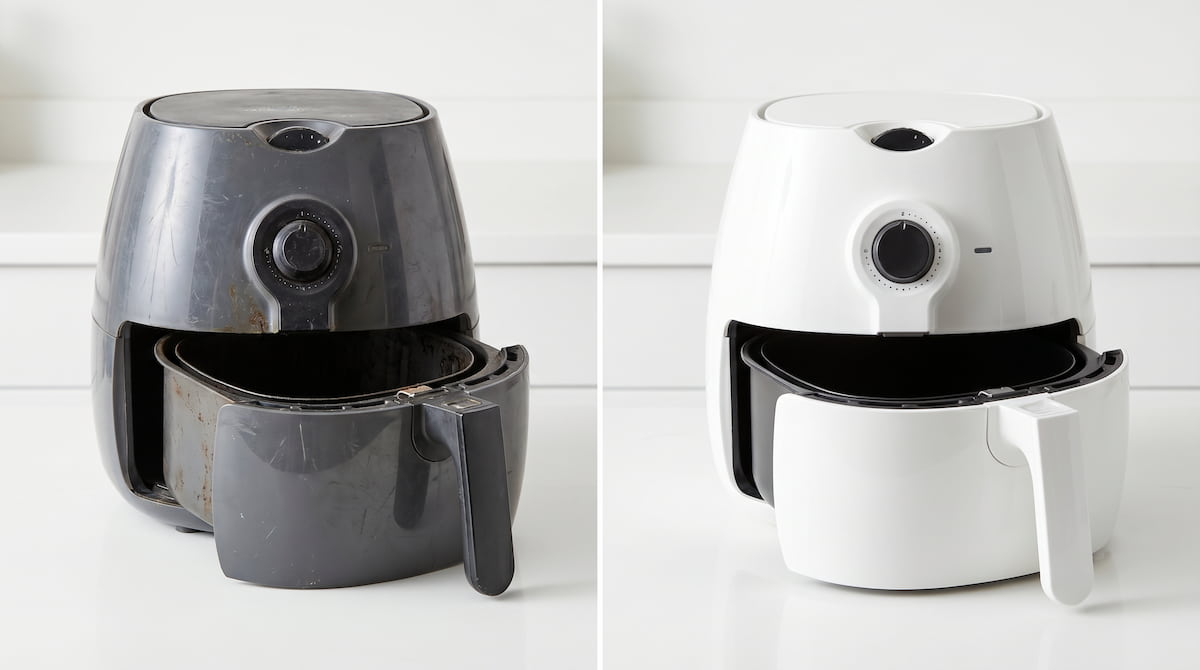
A worn nonstick unit with coating damage versus a clean ceramic unit — the safety gap between these two states is significant and grows with every cook cycle.
Category 3: Unsafe Use Habits
Overfilling the Basket
Overfilling creates three simultaneous problems: restricted airflow causing overheating, uneven cooking creating food safety issues with raw proteins, and grease overflow into the drawer creating fire risk. Single layer loading eliminates all three with one habit change.
Metal Utensils
Every metal utensil contact scratches the basket coating. Scratches accumulate invisibly until they’ve caused significant coating damage — making this the most common source of the gradual coating degradation that turns a safe basket into a chemically unsafe one.
Aerosol Cooking Spray
Aerosol propellants and emulsifiers build up as a polymer film that damages coating integrity and produces chemical smoke during cooking. A pump mister with real oil eliminates this risk entirely with no cooking quality compromise.
Leaving the Unit Running Unattended in High-Risk Situations
Leaving the unit unattended while cooking high-fat foods, in a unit with known issues, or while leaving the home creates a scenario where a developing problem — smoke, grease ignition, electrical issue — has no human response. The automatic shutoff and thermal protection handle normal situations, not actively developing emergencies.
Category 4: Unsafe Maintenance
Grease Accumulation
Grease that builds up in the drawer and on the heating element between cleanings reaches ignition temperature faster with each cook cycle as the layers compound. For daily users, this accumulation reaches dangerous levels within 2–3 weeks without regular cleaning — not months.
Ignoring Warning Signs
New chemical smells, electrical odors, grinding fan sounds, repeated unexpected shutoffs, and food tasting off are all diagnostic signals that something has changed. Normalizing these changes rather than investigating them is what allows manageable early-stage problems to become genuine safety issues.
Keeping the Unit Past Its Safe Lifespan
Function and safety are not the same metric. An air fryer that still heats food can simultaneously have a coating producing chemical exposure, a fan motor approaching failure, and electrical components at end of life. Daily-use nonstick units have a realistic safe lifespan of 1–2 years. Ceramic units last 2–4 years. Stainless steel interiors last significantly longer — but the electrical components in any unit have a finite lifespan regardless of basket material.
What Makes an Air Fryer Safe: The Complete Opposite
| Risk Factor | What Makes It Unsafe | What Makes It Safe |
|---|---|---|
| Basket material | Degraded PTFE coating | Intact ceramic or stainless steel |
| Placement | Corner, under cabinets, near flammables | Open counter, measured clearance |
| Power connection | Extension cord or power strip | Direct wall outlet, dedicated circuit |
| Loading | Overfilled, stacked proteins | Single layer, space between pieces |
| Cleaning | Basket only, heating element ignored | All surfaces including element |
| Unit age | Past safe lifespan, ignored signs | Replaced on condition, not calendar |
The Safest Setup for Daily Family Cooking

A PFAS-free ceramic basket, proper clearance, direct outlet connection, and consistent cleaning create the safest possible daily air fryer setup for families.
For our family, the combination that provides the highest safety level for daily cooking is the Ninja AF150AMZ ceramic basket — PFAS-free coating, documented materials, properly placed on an open counter with a dedicated outlet, cleaned after every use with a heating element clean every two weeks. None of these individually guarantees safety. Together they address every category of air fryer risk simultaneously.
For the complete inspection routine that keeps any air fryer in its safest operating state: Air Fryer Safety Checklist for Everyday Use
And for exactly when the combination of factors tips from manageable to requiring replacement: How to Know If Your Air Fryer Is Unsafe to Use
Bottom Line
What makes an air fryer unsafe falls into four categories — materials, setup, use habits, and maintenance — and unsafe status in any one of them is enough to create real risk regardless of how safe the others are. A ceramic basket in a poorly placed unit with grease buildup is still dangerous. A well-placed, clean unit with a flaking nonstick basket is still dangerous. Safety requires getting all four categories right simultaneously — and maintaining that standard consistently over the full lifespan of the unit. That’s not as complicated as it sounds. It’s a few habit changes, a monthly inspection, and replacing the unit when the condition signals it’s time — not when it stops working.