Disclosure: This post contains affiliate links. If you purchase through them, I earn a small commission at no extra cost to you. I only recommend products I personally trust for my family.
Air fryer smell like burning wires is one of the most serious warning signs your appliance can give you. I’m Wook, a bus driver and dad who cooks for my family almost every night. Unlike a burning food smell or even a plastic smell from coating degradation, a burning wire smell means something electrical is happening inside your unit — and that category of problem moves fast if ignored.
This guide covers every cause of a burning wire smell from an air fryer, how to tell them apart, and exactly what to do in each situation.
Why Does My Air Fryer Smell Like Burning Wires? 5 Causes
1. Overheating Internal Wiring
The most common cause of a true burning wire smell. When an air fryer overheats — from blocked vents, insufficient clearance, or extended continuous use — the internal wiring insulation begins to break down under sustained high heat. This produces a sharp, acrid smell distinctly different from burning food or plastic. The insulation degrading around wires is a direct fire precursor and requires immediate action.
2. Damaged Power Cord
A power cord that has been kinked, pinched under the unit, bent repeatedly at the same point, or run over by furniture develops internal wire damage that isn’t always visible externally. As current flows through the damaged section, localized heat builds up and produces a burning wire smell at the cord itself. According to the U.S. Consumer Product Safety Commission, damaged appliance cords are a primary cause of home kitchen fires — inspect the full cord length immediately if you suspect this is the source.
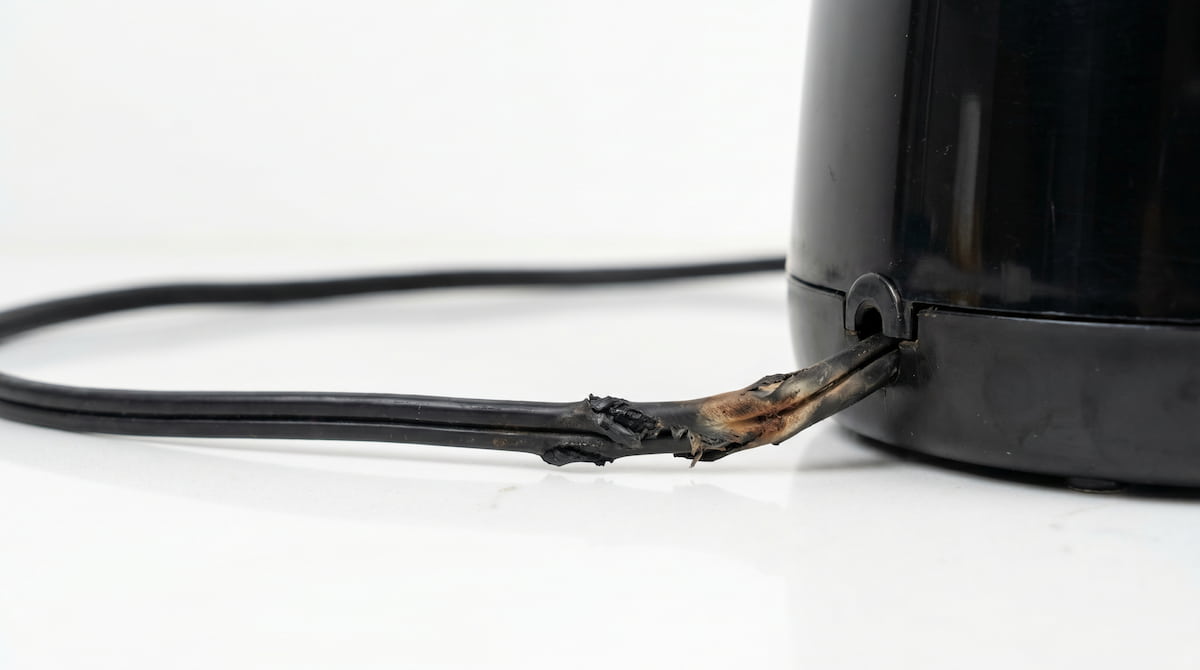
Heat damage and discoloration on the power cord is a visible sign matching a burning wires smell from an air fryer.
3. Electrical Arcing Between Components
Arcing occurs when electrical current jumps a gap between internal components — producing both a sharp burning smell and sometimes a crackling or popping sound. This can happen from moisture inside the unit, a loose internal connection from vibration over time, or component failure. Arcing is an active fire hazard. If the burning wire smell is accompanied by any crackling sounds or visible sparking, treat it as a fire emergency immediately.
4. Motor Overheating
The fan motor contains copper windings with insulation coating. When the motor overheats from age, bearing failure, or grease-induced drag on the fan blades, the winding insulation breaks down and produces a smell closely resembling burning wires. This typically comes with a change in fan sound — slower rotation, grinding, or unusual pitch — before the smell becomes noticeable.
5. First-Use Manufacturing Residue (Non-Urgent)
A brand new air fryer may produce a mild burning or metallic smell during the first 1–3 uses as protective coatings on internal electrical components burn off during initial heating. This is the only burning-type smell from an air fryer that doesn’t require immediate action. It should completely resolve within 3 uses. If it persists or intensifies beyond that point, it is no longer normal burn-off.
Burning Wire Smell: How Serious Is Each Cause?
| Cause | Risk Level | Immediate Action |
|---|---|---|
| Overheating internal wiring | High | Unplug, do not use until resolved |
| Damaged power cord | High | Unplug, inspect cord, do not reuse |
| Electrical arcing | Emergency | Unplug immediately, fire extinguisher ready |
| Motor overheating | High | Unplug, replace unit |
| First-use burn-off | Low | Run empty 2–3 more times, monitor |
What to Do When Your Air Fryer Smells Like Burning Wires
Step 1 — Unplug From the Wall Immediately
Don’t just switch the unit off — pull the plug from the wall outlet. An electrical issue inside the unit can continue to develop even when switched off if it remains connected to power. This is the single most important first step regardless of which cause you suspect.
Step 2 — Move Away From Flammable Materials
Place the unplugged unit on a non-flammable surface in an open area — away from cabinets, paper towels, dish cloths, and curtains — while it cools and while you investigate. If you see any smoke continuing after unplugging, keep a fire extinguisher rated for electrical fires nearby.
Step 3 — Inspect the Power Cord
Once cool, examine the entire cord length from the unit to the plug for discoloration, melting, kinking, or any point where the outer insulation looks damaged. Any visible cord damage means the unit should never be used again — contact the manufacturer about warranty replacement.
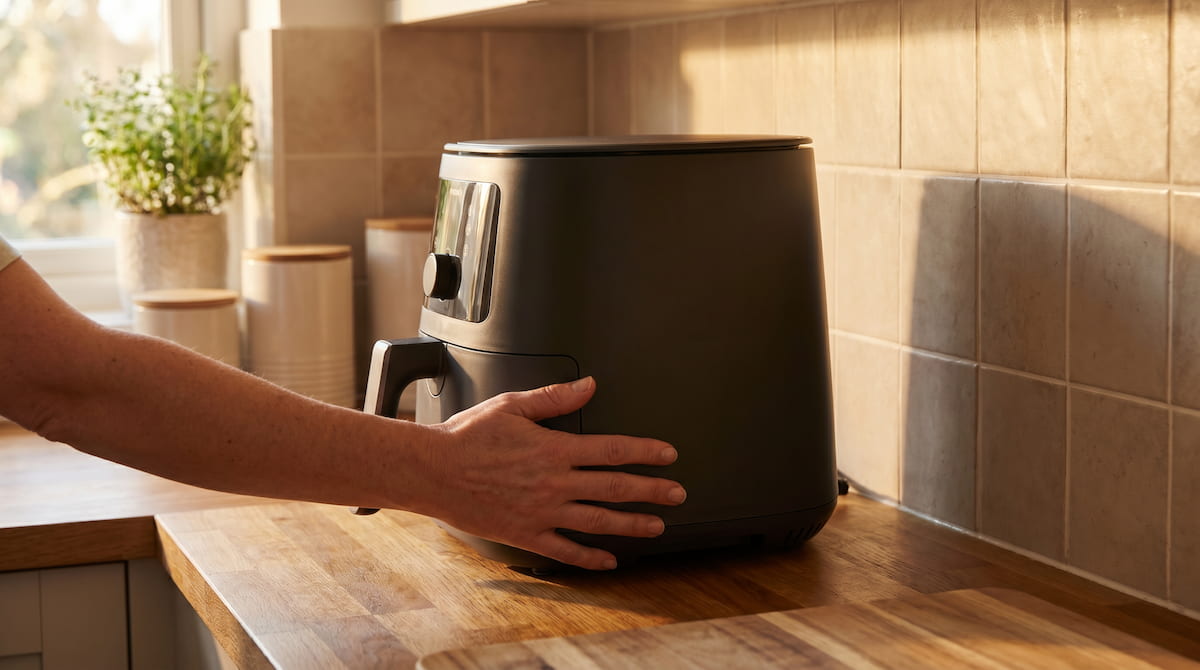
Placing the air fryer in open space with full clearance prevents the overheating that leads to wiring damage and burning smells.
Step 4 — Do Not Use Until Source Is Confirmed
A burning wire smell from a new unit on its first use — where the smell resolves quickly and no other symptoms exist — may be safe to continue monitoring. In every other situation, the unit should remain unplugged until the source is confirmed and resolved. For most consumer air fryers, a confirmed electrical smell means replacement rather than repair.
Burning Wires vs. Other Air Fryer Smells
The burning wire smell is sharp, acrid, and metallic — distinctly different from the plastic-chemical smell of coating degradation or the greasy burning smell of food residue. If you’re not sure which type of smell you’re dealing with, this covers the electrical smell category in full detail: Why Does My Air Fryer Smell Electrical? (Warning Signs You Shouldn’t Ignore)
And if the burning wire smell is accompanied by visible fumes entering your kitchen air, the health implications are covered here: Are Air Fryer Fumes Dangerous? What You’re Actually Breathing
Bottom Line
An air fryer that smells like burning wires is giving you a serious warning that needs immediate response — not monitoring. Unplug from the wall, move away from flammable materials, inspect the power cord, and do not use the unit again until the source is confirmed. Four of the five causes of burning wire smell in air fryers are fire risks. The only exception is first-use burn-off from a brand new unit, which resolves within three uses. If your unit is not brand new and smells like burning wires, treat it as a replacement situation and upgrade to a safer, more reliable model.