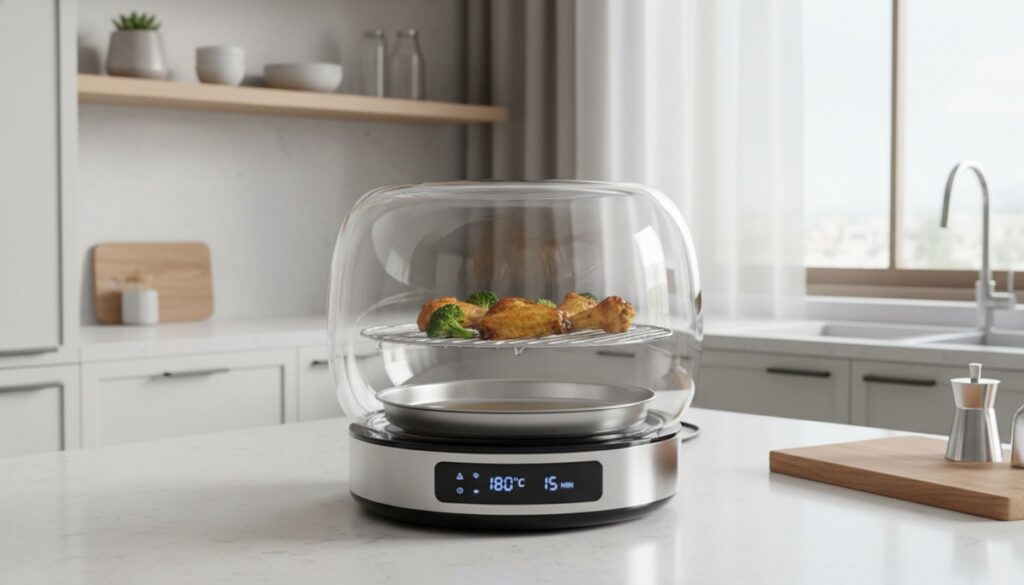
When I first started looking into non-toxic cooking, glass air fryers seemed almost too good to be true. No coating. No PFAS concerns. You can literally see the food cooking through the bowl.
But after everything I’ve learned about what’s actually in air fryer coatings, I wanted to understand whether glass was genuinely safer — or just marketed that way. Here’s what I found.
How Glass Air Fryers Actually Work
Most glass air fryers use a halogen heating element combined with a powerful fan. Hot air circulates around the food inside a large transparent glass bowl, creating the same crispy result you’d expect from a basket-style air fryer.
The key difference is what the food touches. In a standard air fryer, food sits in a coated metal basket — and that coating is what most people are trying to avoid. In a glass model, the cooking surface is just glass. There’s nothing to flake, nothing to degrade, and no PTFE layer sitting between your food and the heat.
The glass bowl is also dishwasher safe in most models, and because it’s transparent, you can watch the food cook without lifting the lid. That sounds like a small thing, but it’s actually useful for anything you’d normally have to guess on timing.
Are They Actually Safer? The Honest Answer
For the specific concern of coating exposure — yes, glass is genuinely safer. There’s no non-stick layer to worry about, no PFAS chemicals, and no risk of microscratches releasing particles into your food over time.
But “safer” has limits here, and I think it’s worth being honest about them.
Even glass air fryers have plastic components externally. The safety benefit applies specifically to the cooking chamber — the part that actually touches your food. The outer housing, the controls, the fan housing — those are still plastic and still get hot. If you’re trying to eliminate every synthetic material from the cooking process, glass gets you much closer than a coated basket, but it doesn’t get you all the way there.
The other thing worth knowing: not all “glass” models are equally transparent about their other materials. Always check whether the heating element and frame components are stainless steel, and verify that the glass bowl is borosilicate — the heat-resistant type designed for rapid temperature changes. Standard glass wouldn’t survive the thermal stress of air frying.
Glass vs. Other Non-Toxic Options
| Feature | Glass Bowl | Ceramic Coated | Stainless Steel |
|---|---|---|---|
| Coating risk | None | Low (if certified) | None |
| Non-stick ease | Fair | Excellent | Poor — needs oil |
| Durability | Low — breakable | Medium | Very high |
| Visibility | Full 360° | None | None |
| Model variety | Limited | Wide | Moderate |
I covered the ceramic and stainless steel side of this in more detail in my ceramic air fryer safety guide and the stainless steel comparison if you want to go deeper on either of those.
The Best Glass Air Fryer Options in 2026
Best Overall: Big Boss 16Qt Glass Air Fryer
This is the most widely available and recognized glass air fryer on the market. The 16-quart glass bowl is large enough for family cooking, and the halogen heating system works well for most everyday recipes. The 360° visibility is genuinely useful — I find myself checking on food less because I can just look at it.
The downsides are real though: it’s heavy, takes up significant counter space, and the halogen element is bright during operation. If you’re in a small kitchen, it’s worth measuring before you buy.
Best Compact Option: Ninja Crispi 4-in-1 Portable Glass Air Fryer
Ninja’s glass container option brings brand reliability to the glass air fryer category. More compact than the Big Boss, better suited for smaller households or counter-space-conscious kitchens. The 4-in-1 functionality also makes it more versatile for daily use.
See our full non-toxic air fryer comparison →
Best Budget Entry: NutriChef Glass Bowl Air Fryer
If you want to try a glass air fryer without committing to a higher price point, NutriChef’s model is a reasonable starting point. Simpler controls, smaller capacity, but the glass cooking chamber is the same concept. Good for testing whether glass works for your cooking style before investing more.
Who Should Actually Buy a Glass Air Fryer
Glass makes the most sense if your main concern is coating contact with food. If you’re cooking for kids regularly, if you’ve already switched most of your cookware to non-reactive materials, or if you’ve been bothered by the chemical smell issue that comes with some coated baskets — glass removes those concerns completely.
It’s probably not the right choice if you want something compact, lightweight, or easy to move around. The glass bowl models are bulkier than basket-style fryers, and dropping one is an expensive mistake.
FAQ
Do glass air fryers contain any plastic?
Yes — the external housing and controls are typically plastic. The cooking chamber itself is glass, which is the important part for food contact safety.
Is borosilicate glass safe for air frying temperatures?
Yes. Borosilicate is specifically designed for high heat and rapid temperature changes. Standard glass would not be safe — always verify the bowl material before buying.
Do glass air fryers cook differently from basket models?
The results are similar, but cooking times can vary slightly. The halogen heating system in most glass models works differently from a standard resistance element, so expect a small adjustment period.
My Take
Glass air fryers are genuinely one of the safest options if coating exposure is your main concern. They’re not perfect — fragile, bulky, limited model selection — but for what they’re trying to do, they do it well.
If you’re not ready to commit to glass, a certified ceramic basket is the next best thing for daily cooking. But if you want to fully remove the coating question from the equation, glass is the cleanest answer available.
For a full comparison of all non-toxic air fryer options across materials, see the complete non-toxic air fryer guide.