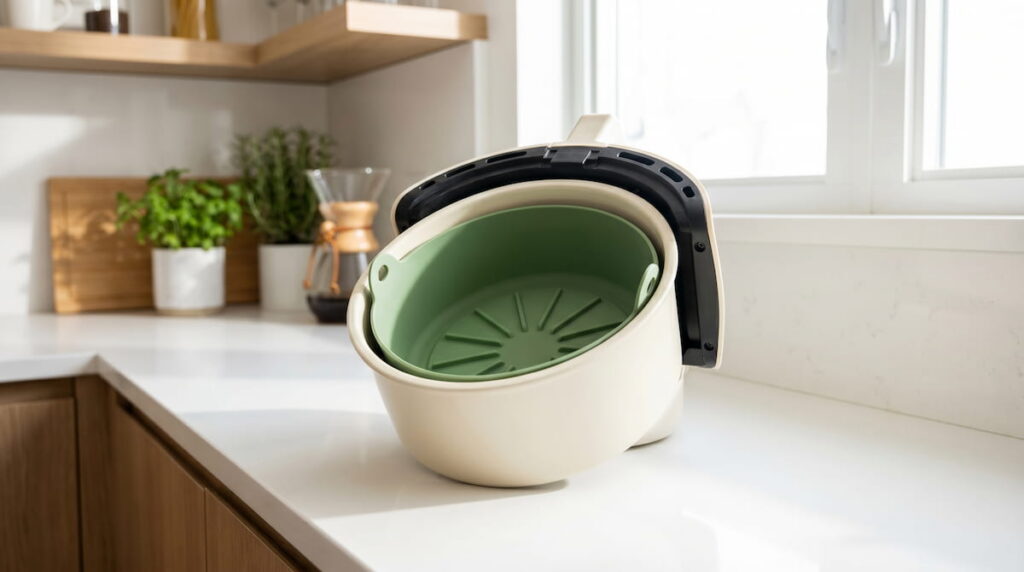
The best silicone air fryer liners do two things at once — protect your basket from sticky food and grease buildup, and eliminate the need for parchment or foil that has to be replaced after every use. But not all silicone liners are food-grade or safe at air fryer temperatures. Here’s what actually matters when choosing one for a non-toxic cooking setup.
Why Silicone Liners Make Sense for Non-Toxic Air Frying
If you’ve invested in a ceramic or PFAS-free basket, a silicone liner is a natural complement. It protects the ceramic surface from scratches caused by metal utensils or rough food contact, makes cleanup faster, and handles saucy or sticky foods that would otherwise leave residue baked into the basket.
The key is choosing food-grade silicone rated for the temperatures your air fryer reaches — typically 400–450°F. Food-grade silicone at those temperatures is chemically stable and doesn’t release detectable fumes. Low-grade silicone or silicone with fillers, however, can off-gas at high heat — which defeats the purpose of a non-toxic setup entirely. Our guide on air fryer liner safety covers this in detail.
What to Look for in a Non-Toxic Silicone Air Fryer Liner
- Food-grade silicone: Must be explicitly labeled food-grade — not just “silicone”
- Temperature rating of 450°F or higher: Air fryers can reach 400°F+ — the liner needs headroom above that
- Perforated design: Holes allow hot air to circulate properly — a solid liner blocks airflow and defeats the purpose of air frying
- Right size for your basket: Should fit flat with clearance on all sides — never fold or bunch a liner inside the basket
- BPA-free certification: Minimum standard for any food-contact silicone product
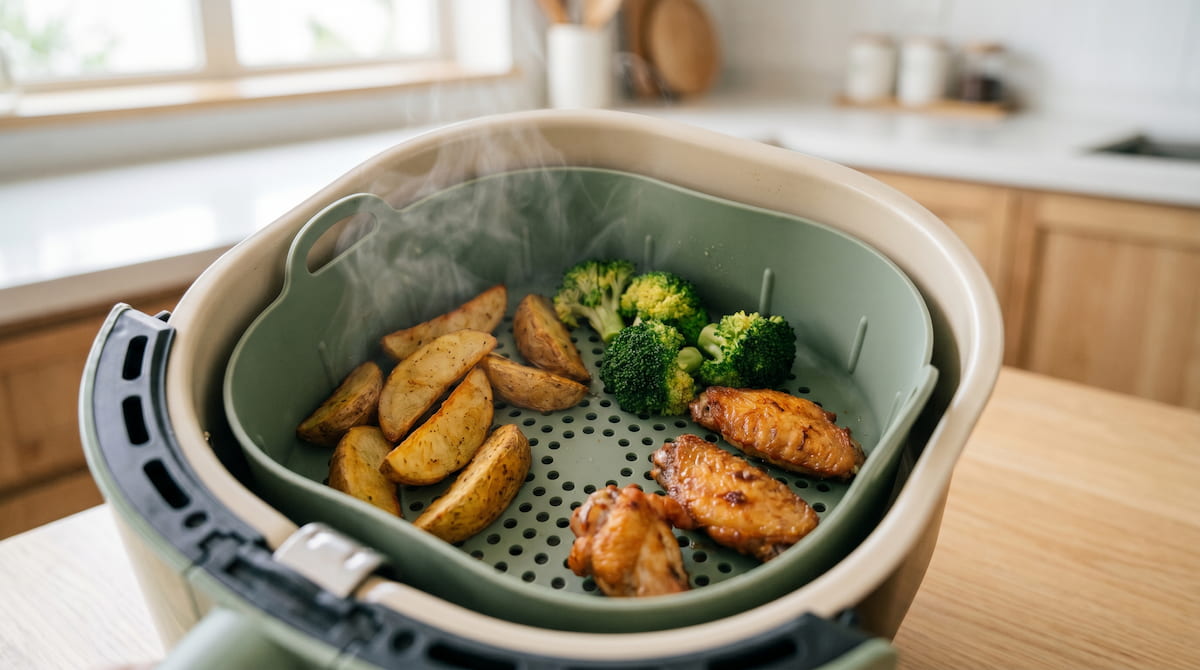
A perforated silicone liner allows hot air to circulate properly while protecting the basket surface.
Silicone vs Parchment vs Foil Liners: Which Is Safest?
| Liner Type | Reusable? | Non-Toxic? | Airflow? | Best For |
|---|---|---|---|---|
| Food-grade silicone | ✅ Yes | ✅ Yes (if rated 450°F+) | ✅ Yes (perforated) | Daily use, all food types |
| Unbleached parchment | ❌ No | ✅ Yes (unbleached only) | ✅ Yes (perforated) | Occasional use, saucy foods |
| Bleached parchment | ❌ No | ⚠️ Dyes/bleach concern | ✅ Yes (perforated) | Avoid for non-toxic setup |
| Aluminum foil | ⚠️ Limited | ⚠️ Acidic food concern | ❌ Blocks airflow | Avoid solid foil in basket |
| Low-grade silicone | ✅ Yes | ❌ Off-gassing risk | ✅ Yes | Avoid entirely |
Our Pick: Best Silicone Air Fryer Liner for Non-Toxic Cooking
For a non-toxic setup, food-grade perforated silicone liners rated to 450°F are the most practical daily-use option. They’re reusable, dishwasher safe, protect your ceramic basket from wear, and handle everything from sticky sauces to greasy proteins without leaving residue baked into the basket surface.
The perforated design is non-negotiable — it maintains the hot air circulation that makes air frying work. A solid silicone mat in an air fryer basket turns it into a slow oven, not an air fryer.
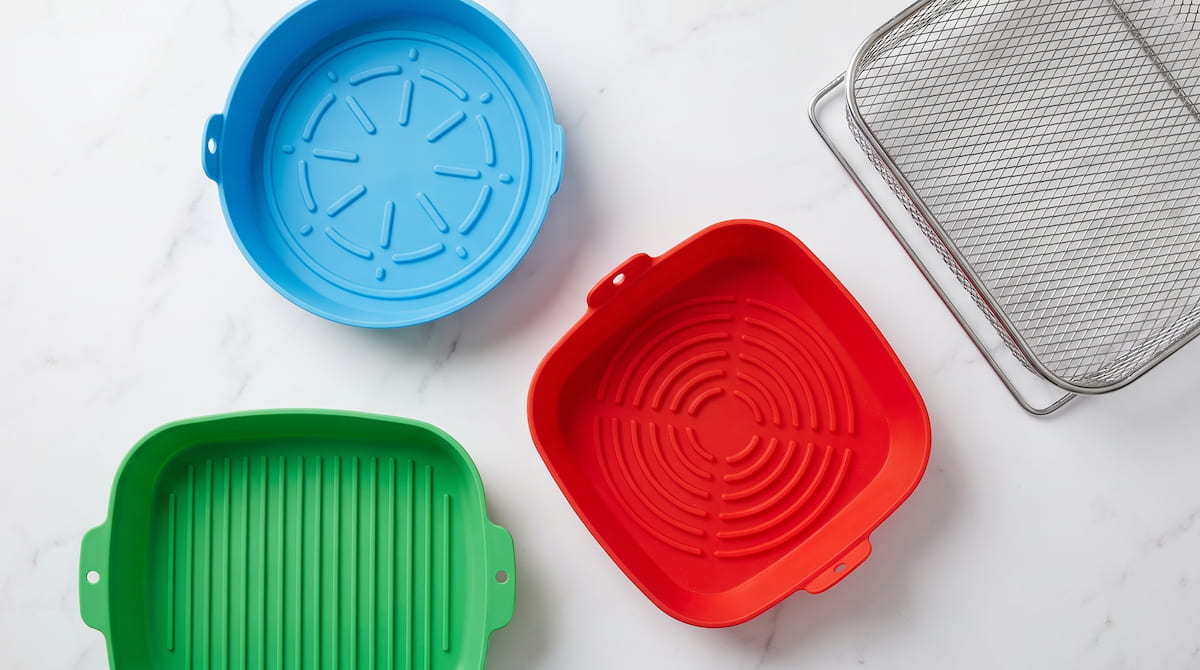
Silicone liners come in round, square, and rectangular sizes — match the shape and size to your specific basket.
How to Choose the Right Size Silicone Liner
Sizing is the most common mistake people make with silicone liners. The liner must fit flat inside your basket with at least half an inch of clearance on all sides — if it’s too large it will fold up against the basket walls and block airflow, and if it’s too small food falls around the edges onto the basket surface.
- Round baskets (most common): Measure the inner diameter of the basket at the base — common sizes are 6″, 7″, and 8″
- Square baskets: Measure the inner base dimensions — most square basket liners are 6″×6″ or 7″×7″
- Oven-style trays: Measure the tray dimensions — rectangular liners are available for most standard tray sizes
- When in doubt, go smaller: A liner that’s slightly too small is better than one that folds up and blocks airflow
How to Use Silicone Liners Safely
- Never preheat with liner inside: Place the liner in the basket after preheating, with food already on it — an empty silicone liner can lift and hit the heating element during preheat
- Always add food weight: The liner needs food weight to stay flat — never run a cycle with an empty liner inside
- Clean after every use: Grease and food residue baked onto silicone between uses can cause smoke on the next cycle
- Check for damage regularly: If the liner tears, develops sticky spots, or produces any smell during cooking, replace it immediately
- Don’t use with metal utensils directly on liner: Cuts or punctures compromise the food-grade surface
Which Air Fryers Work Best With Silicone Liners?
Silicone liners work with any basket-style air fryer but pair especially well with ceramic-coated baskets — the liner protects the ceramic surface from scratches while the ceramic basket provides the PFAS-free cooking environment. The Ninja AF150AMZ ceramic basket is the most popular pairing — its smooth ceramic surface and standard round basket dimensions work with most 7″ round silicone liners.
For the Instant Pot Omni Plus, rectangular silicone tray liners are available that fit the oven-style trays — useful for roasting vegetables or fish without the tray developing staining over time.
Quick Safety Checklist: Silicone Air Fryer Liners
✅ Safe silicone liner setup:
- Explicitly labeled food-grade silicone
- Temperature rated 450°F or higher
- Perforated design for airflow
- BPA-free certification
- Correct size — fits flat with clearance on all sides
- Food added before inserting into preheated basket
⚠️ Watch out for:
- Liners with strong smell out of the package — wash thoroughly before first use
- Liners that fit too tightly — should never touch basket walls
- Grease buildup between uses — clean thoroughly each time
❌ Never do:
- Preheat with empty liner inside basket
- Use solid (non-perforated) silicone mat in air fryer
- Continue using a torn, sticky, or smell-producing liner
- Use low-grade silicone without food-grade or temperature rating
FAQ
Are silicone air fryer liners safe?
Food-grade silicone liners rated to 450°F are safe for air fryer use. The key is verifying the food-grade rating and temperature certification — not all silicone products meet these standards, and low-grade silicone can off-gas at high temperatures.
Do silicone liners affect air fryer cooking performance?
A perforated silicone liner has minimal impact on cooking performance — the holes maintain hot air circulation. A solid silicone mat significantly reduces airflow and extends cooking time. Always use perforated liners in an air fryer.
Can silicone liners go in the dishwasher?
Most food-grade silicone air fryer liners are dishwasher safe — check the product specifications to confirm. Top rack dishwasher placement is recommended for most silicone products.
How long do silicone air fryer liners last?
With proper care — cleaning after every use, no metal utensils, no overheating — a quality food-grade silicone liner typically lasts 6–12 months of regular use before showing wear. Replace immediately if any tearing, stickiness, or unusual smell develops.
What size silicone liner fits the Ninja AF150AMZ?
The Ninja AF150AMZ has a round basket — a 7-inch round perforated silicone liner fits the base with appropriate clearance on the sides. Verify the inner basket diameter of your specific model before ordering, as basket dimensions can vary slightly between versions.
For our complete guide to non-toxic air fryer accessories and which materials are actually safe, visit the PFAS-free air fryer guide — we cover everything from basket materials to accessories for a fully non-toxic cooking setup.