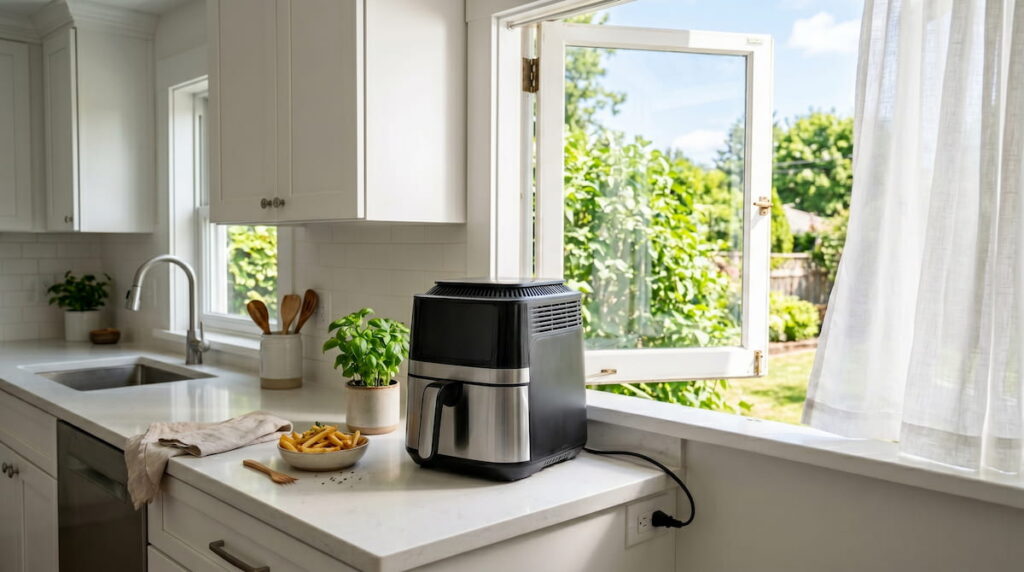
If you’re asking whether air fryers need ventilation, the answer is yes — and the reason goes beyond just smoke management. Even a PFAS-free ceramic basket air fryer produces airborne cooking particles, grease vapor, and heat that need somewhere to go. In a small or poorly ventilated kitchen, these accumulate in ways that affect both air quality and cooking performance. Here’s the complete safe kitchen setup guide.
Do Air Fryers Need Ventilation?
Yes — all air fryers need adequate ventilation for three reasons: the unit itself needs airflow clearance to operate safely, the cooking process produces airborne particles that need to disperse, and the heat output needs to dissipate rather than build up in a small enclosed space.
This doesn’t mean you need a commercial kitchen exhaust system — it means opening a window, running a range hood fan, or at minimum ensuring the air fryer has proper clearance around it and the kitchen door is open during cooking. The ventilation requirement is modest but real, and ignoring it creates avoidable problems. Our guide on air fryers and indoor air quality covers what’s actually in the air during cooking in detail.
Why Ventilation Matters — The Three Reasons
1. Unit Performance and Safety
Air fryers work by rapidly circulating hot air through the cooking chamber and venting it out. The exhaust vent needs clearance behind and above the unit to release this hot air effectively. Without clearance, the unit recirculates hot exhaust air, which raises internal temperature, reduces cooking efficiency, and in extreme cases triggers thermal shutoffs or causes overheating.
2. Airborne Cooking Particles
Any cooking at high heat produces airborne particles — grease vapor, steam, and fine food particles. In a well-ventilated kitchen these disperse quickly. In a closed small kitchen or studio apartment, they accumulate on surfaces and in the air. A ceramic or stainless basket significantly reduces the chemical component of this output — no PTFE fumes — but the physical cooking particles still need somewhere to go.
3. Smoke Management
High-fat foods — bacon, fatty cuts of meat, heavily oiled vegetables — produce smoke during air frying. Adequate ventilation prevents this smoke from accumulating to smoke-detector-triggering levels and removes the cooking smell from your living space faster. This is particularly important in open-plan apartments where the kitchen and living area share the same air volume.
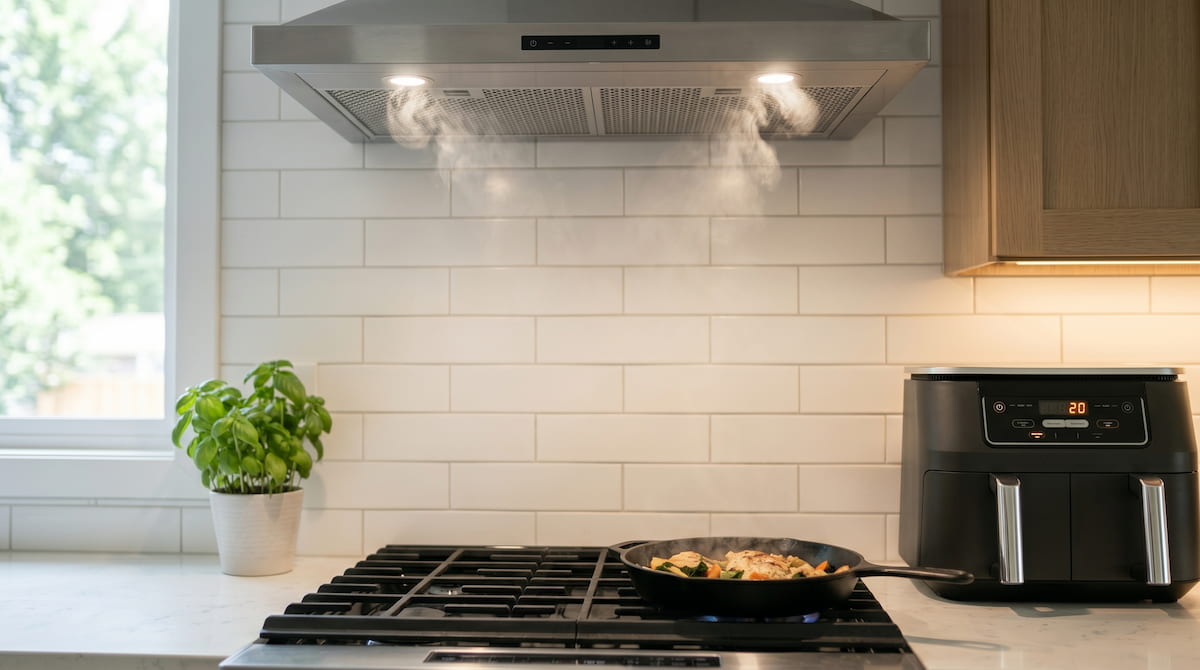
Running a range hood fan during air fryer use is the most effective single ventilation step for kitchen air quality.
Ventilation Requirements by Kitchen Type
| Kitchen Type | Minimum Ventilation | Recommended |
|---|---|---|
| Large open kitchen | Proper unit clearance | Range hood fan on low |
| Standard home kitchen | Window open or fan running | Range hood + window |
| Small apartment kitchen | Window open + kitchen door open | Window + portable fan exhausting out |
| Studio apartment | Window open during and 10 min after | Window + fan + air purifier |
| Closed kitchen (no windows) | Door open + fan in doorway | Portable air purifier with HEPA filter |
| Office breakroom | Door open during use | Window or exhaust fan + door open |
Air Fryer Clearance Requirements
Beyond room ventilation, the unit itself needs physical clearance to operate safely. These are the minimum clearance distances for safe air fryer placement:
- Rear clearance: At least 5–6 inches from any wall — the exhaust vent at the back needs unobstructed space to release hot air
- Side clearance: At least 3–4 inches on both sides for models with side vents — check your specific model’s vent locations
- Top clearance: At least 8–10 inches from any upper cabinet or shelf — hot air venting upward needs room to dissipate
- Surface: Always on a flat, level, heat-resistant surface — never on cloth, paper, or near flammable materials
- Away from walls: Never pushed flush against a wall — the clearance requirement is non-negotiable for safe operation
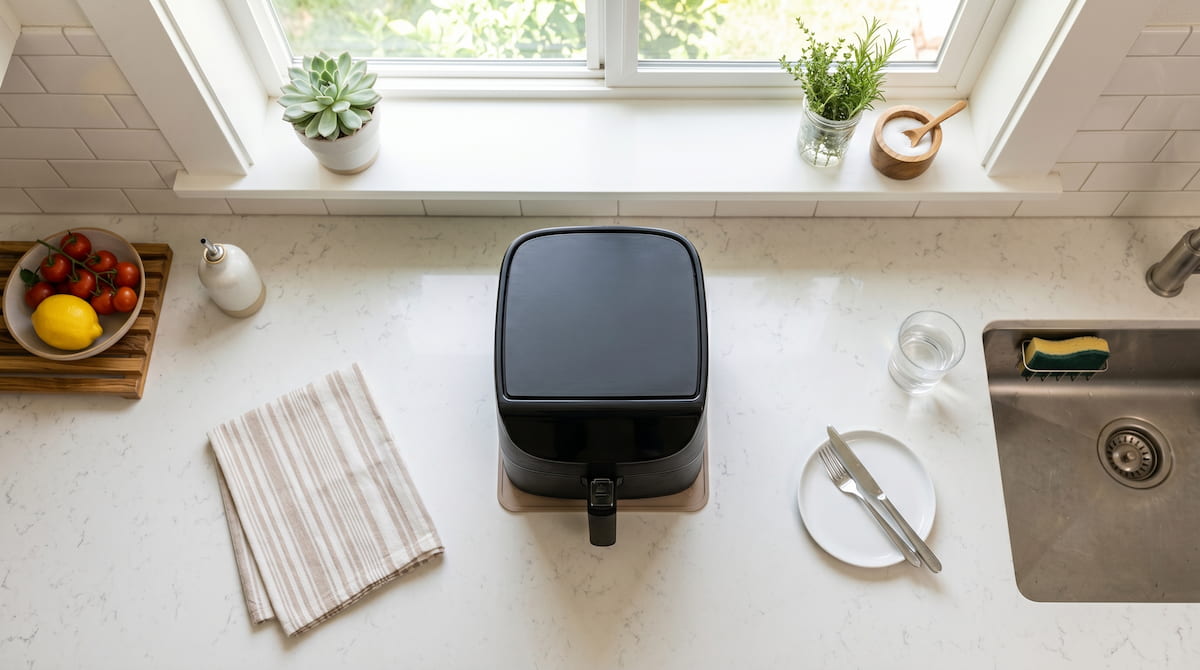
Proper air fryer placement — centered on the counter with clear space on all sides and a window nearby for ventilation.
Does a Non-Toxic Air Fryer Still Need Ventilation?
Yes — a ceramic or stainless basket eliminates the PTFE fume concern but doesn’t change the cooking physics. Hot air, grease vapor, and cooking steam still exit through the vent on every cooking cycle regardless of basket material. The ventilation requirement is the same for ceramic, glass, and stainless units as it is for nonstick models.
What changes with a non-toxic basket is what’s in that airflow — no PTFE degradation products, no PFAS-related compounds. The physical cooking output (steam, grease vapor, food particles) remains. Ventilation manages these; a PFAS-free basket manages the chemical component. Both together give you the cleanest possible air fryer cooking environment.
The Ninja AF150AMZ ceramic basket paired with an open window or range hood fan running is the most practical non-toxic daily cooking setup for most households. Full material details in our Ninja ceramic basket safety review.
Practical Ventilation Tips for Daily Air Fryer Use
- Open a window before you start cooking: Getting airflow established before the unit heats up is more effective than opening a window after smoke has already built up
- Run range hood on low during cooking: Even low-speed exhaust fan operation significantly reduces airborne cooking particles compared to no ventilation
- Keep the kitchen door open: Allows cooking air to move into a larger space rather than concentrating in the kitchen
- Continue ventilating 10 minutes after cooking ends: The heating element stays hot after the cycle ends and continues releasing heat and any residual cooking vapor
- Use a portable HEPA air purifier: For small apartments or closed kitchens, a HEPA filter purifier running during and after cooking captures fine particles that ventilation alone doesn’t address
- Avoid cooking high-fat foods without extra ventilation: Bacon, fatty meats, and heavily oiled foods produce significantly more smoke — plan for extra ventilation on these cooking sessions
Quick Safety Checklist: Air Fryer Ventilation
✅ Safe ventilation setup:
- Window open or range hood fan running during cooking
- Minimum 5–6 inches rear clearance from wall
- Minimum 8–10 inches top clearance from upper cabinets
- Kitchen door open for cross-ventilation
- Continue ventilating 10 minutes after cooking ends
- HEPA air purifier for studio apartments or closed kitchens
⚠️ Use with extra ventilation:
- High-fat foods — bacon, fatty meats, heavily oiled dishes
- Studio apartments with limited air volume
- Cooking sessions longer than 30 minutes
- Multiple back-to-back cooking cycles
❌ Never do:
- Push air fryer flush against the wall — blocks exhaust vent
- Place under low-hanging cabinet without top clearance
- Cook in a fully sealed room with no airflow
- Place on cloth, paper, or near flammable materials
FAQ
Do air fryers need ventilation?
Yes — for three reasons: the unit needs physical clearance for its exhaust vent to operate safely, cooking produces airborne particles that need to disperse, and smoke from high-fat foods needs somewhere to go. Opening a window or running a range hood fan during cooking addresses all three.
How much space does an air fryer need around it?
At least 5–6 inches of rear clearance, 3–4 inches of side clearance on vented sides, and 8–10 inches of top clearance from any upper cabinet or shelf. These aren’t suggestions — blocked vents cause overheating and reduce cooking performance.
Can I use an air fryer in a closed kitchen?
Yes — with a door open and a fan in the doorway to move air through. A HEPA air purifier running in the kitchen adds another layer of particle management for closed kitchens without windows. Our full guide on air fryer safety in closed kitchens covers this in detail.
Does a ceramic air fryer need less ventilation than a nonstick one?
The physical ventilation requirement is the same — cooking still produces steam, grease vapor, and heat regardless of basket material. What changes is the chemical content of that airflow — a ceramic basket doesn’t add PTFE degradation compounds. Ventilation manages the physical output; basket material manages the chemical component.
Will an air fryer set off a smoke detector?
With proper ventilation and a clean basket, a ceramic air fryer used correctly rarely triggers smoke detectors. High-fat foods without ventilation, a dirty heating element, or a degraded nonstick basket are the common causes of smoke detector triggers during air fryer use. Our guide on air fryers near smoke detectors covers how to avoid this. For our complete safe kitchen setup guide visit the PFAS-free air fryer guide.