Affiliate Disclosure: This post contains affiliate links. If you purchase through my links, I may earn a small commission at no extra cost to you. I only recommend products I’ve personally researched and trust for my own family.
Knowing how to cook frozen vegetables in air fryer the right way means getting crispy, evenly cooked results — not a soggy pile that tastes like the bag it came in. But it also means thinking about what’s happening to your basket coating when you run it through daily vegetable cooking at high heat.
Vegetables are the most frequent thing we air fry in our house. My wife uses the air fryer for broccoli, green beans, and mixed stir-fry blends multiple times a week. That frequency is exactly why I started paying attention to the basket, not just the food.
Here’s the full guide — temps, times by vegetable type, and the coating angle most how-to articles leave out entirely.
Why Air Fryer Works So Well for Frozen Vegetables
Frozen vegetables carry ice crystals that release water when they hit heat. In an oven, that moisture steams the vegetables from the inside, which leads to soft, limp results unless you’re running at very high temperatures with lots of space on the pan.
An air fryer solves this naturally. The high-speed circulating air pulls surface moisture away from the vegetables almost immediately, which means the exterior starts to caramelize and crisp while the interior cooks through. The result is much closer to roasted than steamed — and it happens in a fraction of the oven time.
No thawing, no oil-soaked sheet pan, no 25-minute preheat. For weeknight vegetable sides, it’s hard to beat.
How to Cook Frozen Vegetables in Air Fryer: The Basics
Step 1 — Don’t thaw first
Cook straight from frozen. Thawed vegetables release more water all at once, which creates steam in the basket and works against the crispiness you’re after. Frozen goes in dry and performs better.
Step 2 — Preheat for 3 minutes at your target temperature
A hot basket means the vegetables hit immediate high heat on contact. That surface contact is what starts the caramelization. A cold basket delays that process and adds steaming time.
Step 3 — Light coat of oil, tossed evenly
A very light spray or toss of avocado oil or olive oil helps the exterior brown. Too much oil and you get greasy vegetables. Too little and dense vegetables like broccoli stems stay dry in the center. A mist is enough.
Step 4 — Single layer with space between pieces
This is the most common mistake. Overcrowding kills airflow, which means the vegetables steam each other instead of roasting. If you have a large batch, cook in two rounds. It’s worth the extra few minutes.
Step 5 — Shake or toss halfway through
Most frozen vegetables benefit from a shake at the halfway mark to expose different surfaces to the basket and airflow. Flat pieces like green beans especially benefit from this.
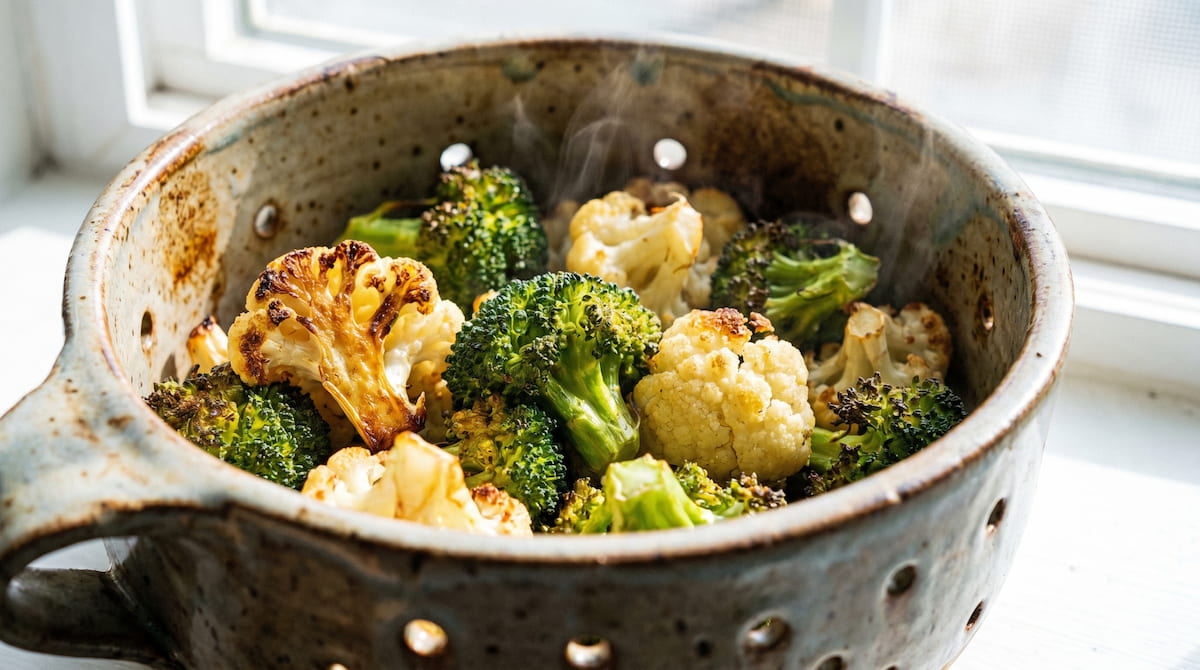
Broccoli and cauliflower from frozen — crispy edges, no sogginess, cooked in a ceramic basket at 400°F.
Temperature and Time by Vegetable Type
| Vegetable | Temp | Time | Notes |
|---|---|---|---|
| Broccoli florets | 400°F | 8–10 min | Shake at 5 min, edges will crisp nicely |
| Cauliflower florets | 400°F | 10–12 min | Denser than broccoli, needs extra time |
| Green beans | 375°F | 7–9 min | Shake halfway, watch for thin ends burning |
| Corn (kernels) | 380°F | 6–8 min | Light oil helps browning, stir halfway |
| Peas | 360°F | 5–7 min | Small size means quick cook, watch closely |
| Brussels sprouts | 380°F | 12–15 min | Halve if large, shake at 8 min |
| Mixed stir-fry blend | 390°F | 8–11 min | Shake twice, thin pieces cook faster |
| Edamame (shelled) | 375°F | 6–8 min | Lightly oil, shake at halfway mark |
These times assume a preheated basket and a single layer. Dense vegetables like cauliflower and Brussels sprouts need the full time range. Thinner pieces like green beans and peas cook faster — check early the first time you try a new brand or bag size.
Why Your Basket Coating Matters for Daily Vegetable Cooking
Vegetables seem like the safest, lowest-risk thing you can cook in an air fryer. And from a food safety standpoint, they are. But from a coating standpoint, daily high-heat vegetable cooking is actually one of the more demanding use cases for your basket.
Here’s why: frozen vegetables release water vapor as they cook. That steam, combined with high heat and repeated daily use, accelerates surface wear on PTFE-based nonstick coatings over time. Add dishwasher cleaning between uses and the degradation happens faster still.
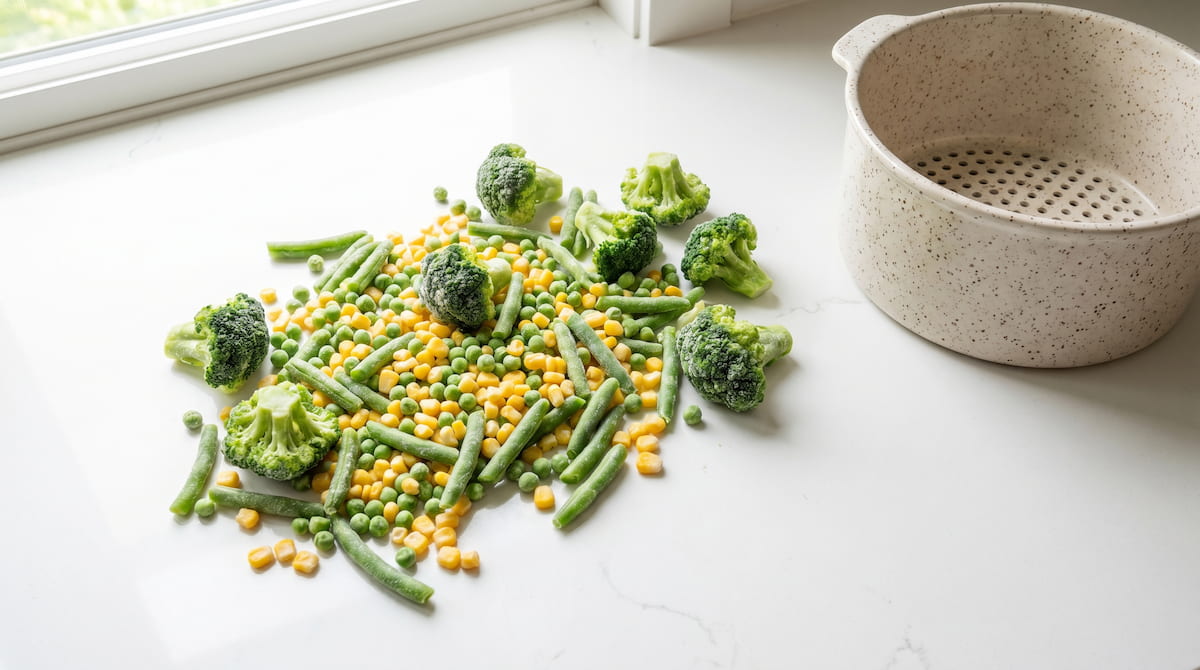
A ceramic basket handles the full range of frozen vegetables without the coating concerns that come with repeated high-heat use.
According to EPA guidance on PFAS compounds, minimizing repeated exposure to fluoropolymer coatings at elevated temperatures is a reasonable precautionary step for families — particularly those with young children. If vegetables are a daily air fryer staple in your house, the basket you’re using is worth a second look.
Ceramic-coated baskets are PTFE-free and PFAS-free. They handle the moisture and heat of frozen vegetable cooking without degradation concerns, and they’re easier to clean after starchy vegetables like corn and peas, which tend to leave residue.
Which Air Fryer Works Best for Frozen Vegetables
For everyday vegetable cooking, you want a basket that’s large enough to hold a full serving in a single layer without crowding, and a coating that holds up to daily use without concern.
The air fryer we use for vegetables is the Ninja AF150AMZ. The ceramic basket handles broccoli, green beans, and mixed blends without any coating issues, and the basket size fits a full side serving for four without needing to run two batches every time.
For larger families cooking vegetables in bigger batches — a full pound of broccoli, or multiple vegetable sides at once — the Instant Pot Omni Plus 18L gives you the tray space to do it all in one round.
Common Mistakes That Lead to Soggy Frozen Vegetables
Thawing before cooking. Thawed vegetables dump water into the basket all at once. That water has nowhere to go quickly, so the vegetables sit in steam for the first half of the cook. Go straight from freezer to basket.
Overcrowding. This is the single most common reason people get soggy results. The air fryer needs airflow around every piece. A packed basket blocks that circulation and turns a roasting environment into a steaming one.
Skipping the preheat. Cold basket, slow start. The first few minutes of cook time go to warming the appliance instead of cooking the food. Three minutes of preheat makes a measurable difference in final texture.
Too much oil. A light spray is enough. Heavy oil coating on frozen vegetables creates a greasy result and can cause smoke at higher temperatures, especially in a basket with any existing coating wear.
Not shaking halfway. Vegetables sitting on the basket floor get more direct heat than those on top. A shake at the halfway point exposes all surfaces evenly and prevents the bottom layer from overcooking while the top is still underdone.
Cooking Frozen Vegetables in Air Fryer: What Actually Works
Straight from frozen, preheated basket, single layer, light oil, shake halfway — that’s the formula. It works for broccoli, green beans, cauliflower, mixed blends, and most other frozen vegetables consistently.
The one thing worth getting right before you make this a daily habit is the basket material. A ceramic surface handles repeated high-heat vegetable cooking without the wear concerns that come with PTFE coatings over time.
For more on basket safety and when to consider replacing yours, see my guide on how long air fryer baskets last. And if you’re cooking frozen proteins alongside your vegetables, the guides on frozen chicken and frozen salmon cover the same approach for those cooks.
For a full breakdown of which air fryers use safe coatings for daily cooking, see the main guide on PFAS-free air fryers.