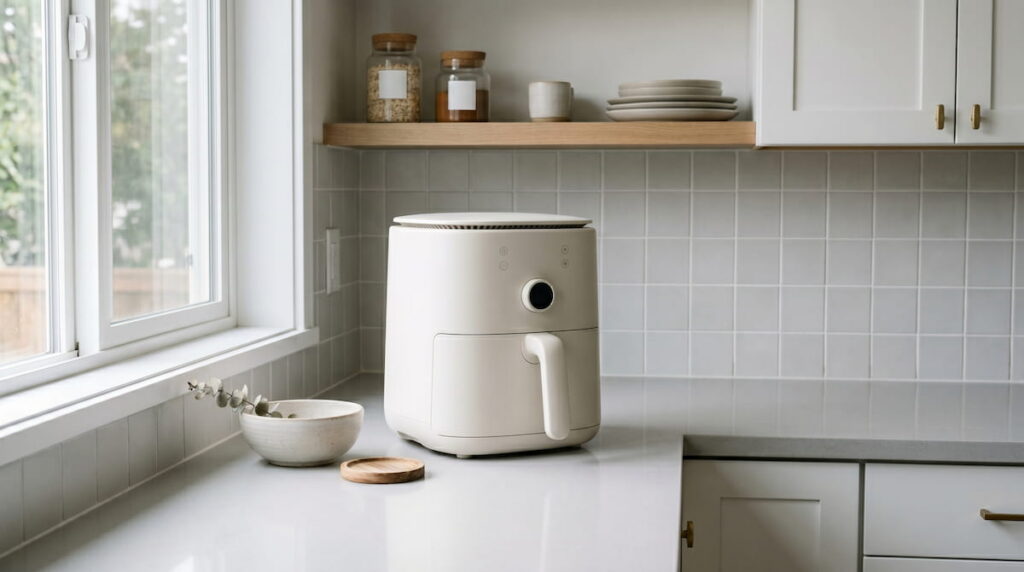
Is air fryer electromagnetic radiation safe? That question came up in a parenting group I follow online, and I realized I didn’t have a solid answer. I knew air fryers use electricity and heat, but I hadn’t thought carefully about what kind of electromagnetic fields they produce and whether daily use near a kitchen counter presents any real concern. Here’s what the research actually shows.
How Air Fryers Actually Work — No Microwaves Involved
The most important thing to understand about air fryer electromagnetic radiation is what type of radiation we’re actually talking about. Air fryers do not use microwave radiation. They use a resistive heating element — the same technology as a conventional oven or toaster — combined with a high-speed fan to circulate hot air around food. The heating element converts electrical energy into heat through resistance, not through electromagnetic wave emission into the food.
This is a meaningful distinction. Microwave ovens use non-ionizing radiation at specific frequencies to agitate water molecules inside food directly. Air fryers heat food the same way a conventional oven does — through convection of hot air. The electromagnetic fields an air fryer produces are incidental to its electrical operation, not central to its cooking mechanism.
What Kind of EMF Do Air Fryers Produce
Any appliance that runs on electricity produces extremely low frequency electromagnetic fields — commonly called ELF-EMF. This includes air fryers, conventional ovens, refrigerators, televisions, and virtually every other household appliance. The question is not whether air fryers produce EMF — they do — but whether the level of EMF they produce is meaningfully different from other household appliances, and whether that level presents a health concern at normal use distances.
Air fryers produce ELF-EMF at levels consistent with other kitchen appliances of similar wattage. At a distance of 12 inches or more from the unit — roughly the distance you’d stand while placing food in the basket — EMF exposure drops to levels comparable to background household EMF from wiring and other appliances. The World Health Organization has reviewed ELF-EMF extensively and concluded that everyday exposure from household appliances at normal use distances does not present a demonstrated health risk.
Is Air Fryer Electromagnetic Radiation Safe — The Direct Answer

Normal everyday use of an air fryer — setting the temperature and walking away — keeps you at a distance where EMF exposure is comparable to any other kitchen appliance.
Yes, air fryer electromagnetic radiation is safe at normal household use distances. The EMF produced by an air fryer is the same type — ELF-EMF — produced by every other electrical appliance in your kitchen. It is not ionizing radiation, it is not microwave radiation, and it is not at levels that have been associated with health effects in peer-reviewed research at typical household exposure distances.
The concern about air fryer EMF largely stems from confusion between air fryers and microwave ovens — two appliances that look somewhat similar but work through completely different mechanisms. A microwave oven emits microwave-frequency radiation specifically to heat food. An air fryer emits only the incidental ELF-EMF of its electrical components, which is functionally identical to what a toaster or convection oven produces.
Air Fryer EMF vs Other Kitchen Appliances
| Appliance | EMF Type | Radiation Used for Cooking? | Safety Concern at Normal Distance? |
|---|---|---|---|
| Air fryer | ELF-EMF | ❌ No — uses convection heat | ✅ No demonstrated risk |
| Microwave oven | Microwave radiation + ELF-EMF | ✅ Yes — microwave frequency | ✅ No at 12+ inches (shielded) |
| Conventional oven | ELF-EMF | ❌ No — uses radiant/convection heat | ✅ No demonstrated risk |
| Induction cooktop | ELF-EMF (higher during use) | ✅ Yes — electromagnetic induction | ⚠️ Minimal at normal distance |
| Toaster / toaster oven | ELF-EMF | ❌ No — uses radiant heat | ✅ No demonstrated risk |
Practical Distance Guidelines for Air Fryer Use
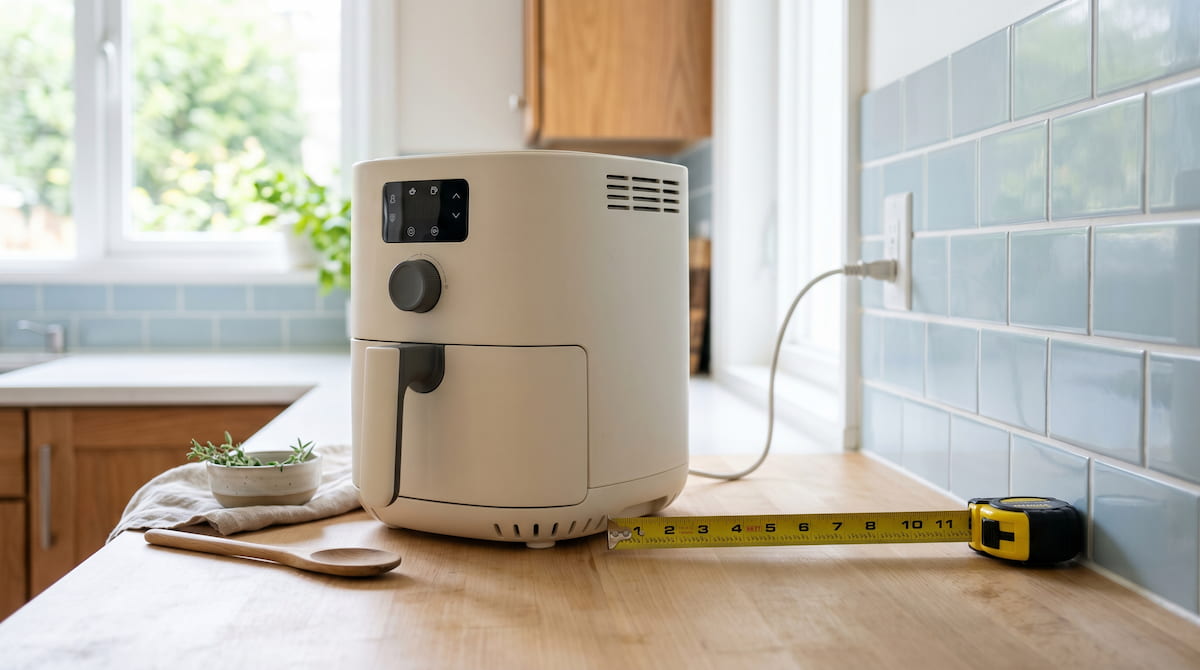
Maintaining 12 inches of clearance between an air fryer and nearby walls or surfaces is good practice for both EMF distance and heat ventilation.
EMF intensity decreases rapidly with distance — following what physicists call the inverse square law. At twice the distance, EMF exposure drops to one quarter of its close-range level. At three times the distance, it drops to one ninth. For household appliances, this means that a few feet of distance between you and the operating appliance reduces EMF exposure to essentially background levels.
For an air fryer specifically, the practical guideline is straightforward: set the temperature and timer, step back from the unit while it cooks, and return when the cycle ends. This is how most people use an air fryer anyway — it’s not an appliance you stand over while it runs. The combination of automatic cook cycles and auto shut-off timers means most air fryer use naturally keeps you at safe distances during operation.
The clearance rule that matters more for practical safety is heat ventilation rather than EMF: keep at least six inches on all sides of the unit to allow hot air to escape properly. This protects against heat buildup near cabinets — a more immediate concern than EMF at normal cooking distances.
What Actually Matters More Than EMF in Your Air Fryer
The real health variables in air fryer use are the basket coating and cooking temperature — not electromagnetic radiation. A PTFE-coated basket that’s scratched or overheated releases fluorinated compounds that are an established health concern. Acrylamide forms in starchy foods cooked at high temperatures. These are the factors worth monitoring and managing in daily air fryer use.
EMF from an air fryer at normal use distances is not in that category. It’s incidental electrical field emission at levels no different from your refrigerator, toaster, or kitchen lighting. Understanding this distinction helps focus your attention on the variables that actually affect your family’s health — coating material, cook temperature, and ventilation — rather than concerns that the evidence doesn’t support.
For a full breakdown of what air fryers actually release during cooking and what’s worth worrying about, our guide on air fryer fumes covers the real risk factors in detail. And if you want to start with the safest possible air fryer from a coating standpoint, our PFAS-free air fryer guide is the place to start.