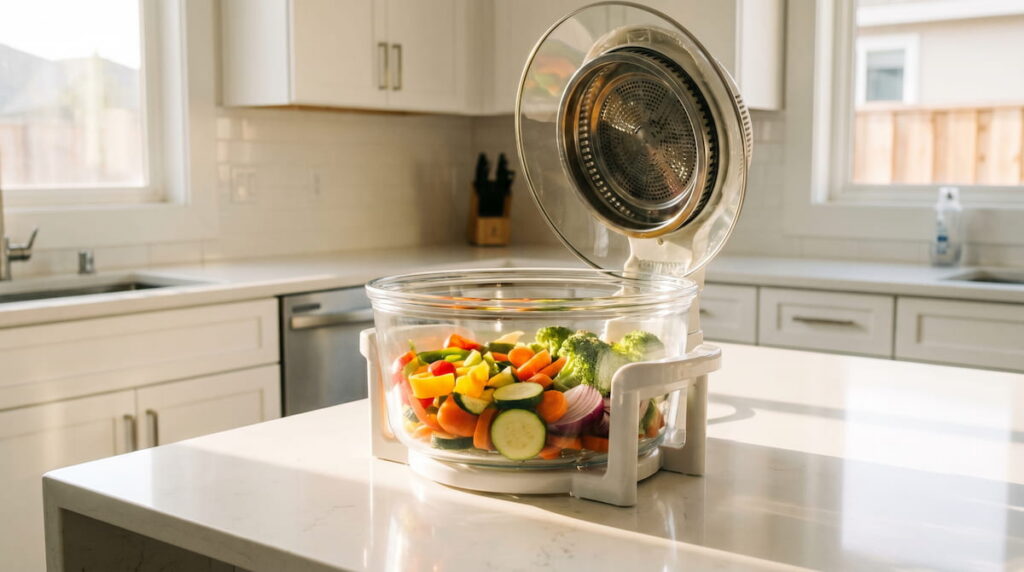
Is glass air fryer safer than nonstick and ceramic alternatives? In terms of cooking surface chemistry, yes — glass is the most inert material available in any air fryer format, with zero coating concerns under any cooking condition. But safety in the real world also means practical daily use, and the honest answer covers both dimensions.
I’m Wook, a bus driver and dad of two teenage boys. Our family researched and tested multiple air fryer surface types before settling on our current setup. Here’s the complete real-world picture of whether a glass air fryer is actually safer — not just on paper, but in the kitchen where it counts.
Is Glass Air Fryer Safer? The Surface Chemistry Answer
Glass is chemically inert at every temperature a home air fryer reaches. It contains no PTFE, no PFAS, no fluoropolymers, and no coating of any kind to scratch, peel, degrade, or release compounds into food or kitchen air. This makes it the most chemically neutral cooking surface available in the consumer air fryer market.
The safety advantage over nonstick (PTFE) baskets is clear and significant. The safety comparison against ceramic is more nuanced — ceramic coatings are PFAS-free and low-risk, but they are still a coating applied over metal, with a finite lifespan before wear affects surface integrity. Glass has no coating lifespan concern because there is no coating.
According to the EPA’s PFAS resource page, the health concerns around nonstick cookware are specifically tied to fluoropolymer chemistry — a category glass is completely outside of, permanently and unconditionally.
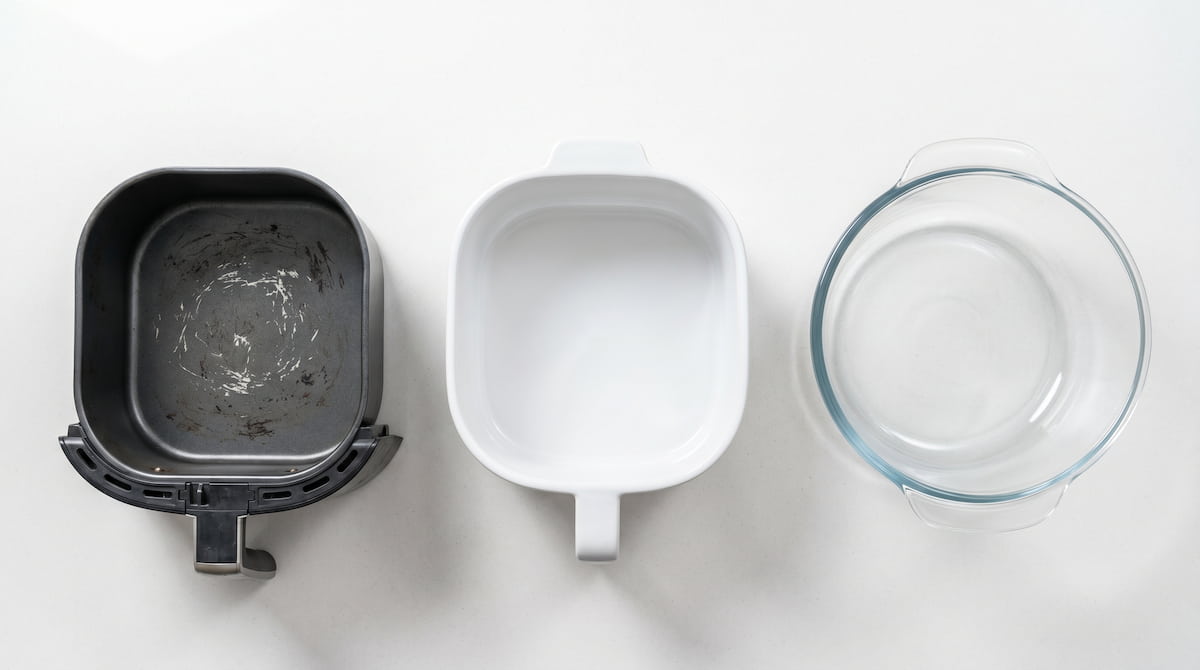
How Glass Compares to Every Other Surface Type
| Surface Type | PFAS-Free | Coating-Free | Safety Over Time | Fume Risk |
|---|---|---|---|---|
| Glass | ✅ Yes | ✅ Yes | ✅ Never changes | ✅ Zero |
| Stainless Steel | ✅ Yes | ✅ Yes | ✅ Never changes | ✅ Zero |
| Ceramic (PTFE-free) | ✅ Yes | 🟡 Has coating | ✅ Low risk as wears | ✅ Minimal |
| PTFE Nonstick | ❌ No | ❌ Has coating | ⚠️ Worsens with wear | ⚠️ Medium-High |
Is Glass Air Fryer Safer in Real-World Daily Use?
Chemistry tells one part of the story. Real-world daily use tells the rest. Here’s what families actually experience with glass air fryers compared to coated alternatives:
No Coating Monitoring Required
With PTFE baskets, families should inspect the surface monthly for scratching and peeling — and replace the basket when damage appears. With ceramic baskets, annual inspection for wear is recommended. With glass, there is no coating inspection required at any point in the unit’s lifespan. The bowl is either intact or it isn’t — and there’s no degradation spectrum in between.
No Utensil Restrictions
Glass bowls and stainless steel racks can be used with any utensil material without concern. Metal tongs, stainless spatulas, and skewers won’t damage a glass cooking surface. This eliminates the silicone-utensils-only habit that ceramic and PTFE baskets require for safe longevity.
Visible Cooking
The transparent glass bowl lets families monitor food during cooking without opening the lid — a practical safety advantage for families with children who are curious about what’s cooking, and a convenience advantage for anyone who wants to catch browning at the right moment.
No Chemical Smell — Ever
Our family’s experience with PTFE baskets included recurring chemical smells that we now understand were from coating degradation. Ceramic eliminated that smell. Glass eliminates even the theoretical possibility — there’s no coating chemistry present to produce any smell under any cooking condition.
When Glass Is the Right Choice for Your Family
- ✅ You have pet birds — glass is one of two safe options alongside stainless steel
- ✅ You have household members with chemical sensitivities or respiratory concerns
- ✅ You want a cooking surface you never need to inspect, replace, or worry about
- ✅ You primarily cook whole meats, roasts, and large vegetable batches
- ✅ You want the most complete non-toxic upgrade at a lower price than stainless oven models
When Ceramic or Stainless Makes More Sense
- 🟡 Small kitchen with limited counter space — ceramic basket models are significantly more compact
- 🟡 Household with young children who might handle the unit — stainless steel eliminates glass breakage risk
- 🟡 Frequent cooking of flat foods like fries and wings — stainless oven-style produces more even all-around crisping
- 🟡 Budget that doesn’t accommodate any large-format unit — the Ninja AF150AMZ ceramic basket is the most practical entry point
Our Family’s Recommendation
For households where glass is practical — enough counter space, no young children handling the unit, and cooking patterns that suit the bowl format — the Big Boss 16Qt Glass Air Fryer is the most complete non-toxic answer available. It eliminates coating concerns permanently and comprehensively.
For families where glass isn’t the right practical fit, the Ninja AF150AMZ ceramic basket delivers verified PTFE-free, PFAS-free cooking at a much smaller footprint. It’s the most accessible non-toxic upgrade for daily family cooking and what we use in our own kitchen for everyday meals.
See Big Boss 16Qt on Amazon → See Ninja AF150AMZ on Amazon →For the complete breakdown of every verified non-toxic option across all surface types, our PFAS-Free Air Fryer Guide covers the full 2026 landscape. And for detailed ceramic basket information, our Ninja ceramic basket guide goes deep on material certification and performance.
Quick Safety Checklist — Is Glass Right for Your Kitchen?
- ✅ Counter space available for larger format unit — glass models need more room than basket types
- ✅ Cooking patterns suit bowl format — whole meats, roasts, vegetables
- ✅ No young children likely to handle or drop the glass bowl
- ✅ Household includes birds, pets, or chemically sensitive members — glass is ideal
- ⚠️ Very small kitchen — consider ceramic basket as PFAS-free alternative
- ⚠️ Primary cooking is flat crispy foods — stainless oven-style may perform better
Frequently Asked Questions
Is a glass air fryer safer than ceramic?
From a pure chemistry standpoint, yes — glass has no coating of any kind, while ceramic is a silica-based coating applied over metal. Both are PFAS-free and safe for daily family cooking. The practical safety difference for most households is minimal — the bigger distinction is glass versus PTFE, not glass versus ceramic.
Does a glass air fryer last longer than a nonstick one?
The glass bowl itself has no wear-out mechanism from a safety standpoint — it doesn’t degrade the way coated baskets do. The halogen heating element is the component most likely to require replacement over time, typically after 1,000 to 2,000 cooking hours in quality models.
Is glass air frying healthier than regular air frying?
The cooking method is identical — hot air circulation. The health difference is in what your food doesn’t contact during cooking. Glass eliminates any coating-related chemical exposure, which is the specific health concern that drives families toward non-toxic air fryer options.
Can you use a glass air fryer every day?
Yes — borosilicate glass is designed for repeated thermal cycling and handles daily cooking use reliably. The bowl should be allowed to cool before washing to avoid thermal shock, but daily use presents no durability concern for quality glass models.
What is the safest air fryer for a family with birds?
Glass and stainless steel are the two safest options for households with pet birds. Both produce zero PTFE fumes under any cooking condition. PTFE fumes from nonstick baskets — even intact ones — are acutely toxic to birds at normal cooking temperatures. Ceramic is also considered safe for bird households, though glass and stainless are the most conservative choices.
Next up — the final article in Cluster 4: which specific glass air fryer models are worth buying for families in 2026, and how do they compare on capacity, performance, and value? We cover the complete buyer’s guide in our best glass air fryers for families guide.