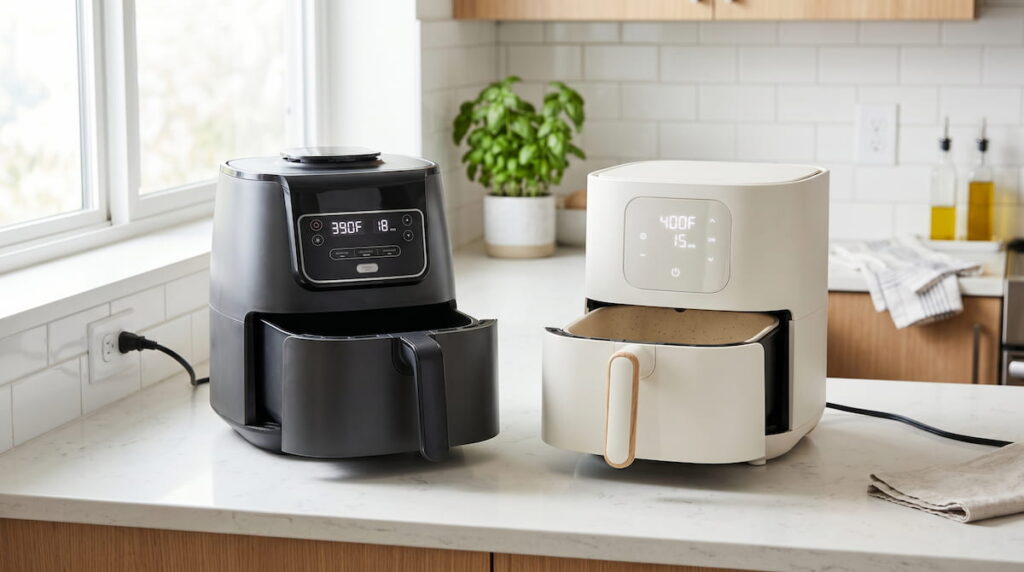
PFAS free vs regular air fryer — is the upgrade actually worth it, or is it mostly marketing? After switching our family from a standard nonstick model to a ceramic-coated one, I have a clear answer.
Here’s the straightforward comparison of what you actually get — and don’t get — when you upgrade from a regular PTFE-coated air fryer to a PFAS-free model.
What “Regular” vs “PFAS-Free” Actually Means
A regular air fryer uses a PTFE-based nonstick coating on the basket. PTFE — polytetrafluoroethylene — is the fluoropolymer compound in Teflon-style coatings. It’s part of the broader PFAS chemical family. When intact and used at normal temperatures, PTFE is largely stable. When scratched, degraded, or pushed above its stable temperature range, it releases fluorinated compounds into food and air.
The pfas free vs regular air fryer decision ultimately comes down to your household’s specific situation — not a one-size-fits-all answer.A PFAS-free air fryer uses a basket surface with no fluoropolymer chemistry — ceramic coating, stainless steel, or glass. The cooking performance is similar for most everyday meals. The chemical profile of what ends up in your food and kitchen air is meaningfully different over the lifespan of the appliance.
For a deeper explanation of how PTFE and PFAS relate, see our guide on PTFE vs PFAS in air fryers.
PFAS-Free vs Regular Air Fryer: Direct Comparison
| Factor | Regular (PTFE) Air Fryer | PFAS-Free Air Fryer |
|---|---|---|
| Coating chemistry | PTFE — fluoropolymer based | Ceramic, stainless, or glass — no fluoropolymer |
| Chemical release when scratched | ❌ Fluorinated particles + fumes | ✅ None (ceramic) / ✅ None (stainless/glass) |
| Safe for birds/pets | ❌ No — PTFE fumes toxic to birds | ✅ Yes |
| Safe during pregnancy | ⚠️ PFAS cross placental barrier | ✅ No fluoropolymer exposure |
| Cooking performance | ✅ Excellent nonstick | ✅ Excellent (ceramic) / ⚠️ Needs oil (stainless) |
| Basket lifespan | 1–2 years daily use | 2–4 years (ceramic) / 5+ years (stainless) |
| Price premium | Lower upfront cost | 10–30% higher — offset by longer basket life |
| Replacement cycle | More frequent basket replacement | Less frequent — especially stainless/glass |
What Most People Get Wrong About This Comparison
The most common mistake is assuming regular air fryers are dangerous under all conditions. They aren’t — a PTFE-coated basket that’s intact, used at normal temperatures, and maintained carefully presents low risk for most healthy adults cooking with good ventilation. The risk profile changes significantly when the coating ages, scratches, or is regularly pushed to high temperatures. For most families, that change happens within 12–18 months of daily use.
The second mistake is thinking PFAS-free means zero chemical exposure of any kind. PFAS-free air fryers still produce cooking-related compounds during normal use — VOCs from food, grease smoke, acrylamide from starchy foods. What they eliminate is the fluoropolymer-specific concern from coating degradation. That’s a meaningful improvement, not a guarantee of completely clean air.
The third mistake is comparing the upfront price without considering the full cost over time. A regular PTFE basket may cost less initially but needs replacing every 1–2 years. A ceramic basket at 10–30% more typically lasts 2–4 years. A stainless steel model never needs coating replacement at all. The total cost of ownership often favors PFAS-free models over a 3–5 year horizon. Our guide on how long air fryer coatings last covers this cost comparison in detail.
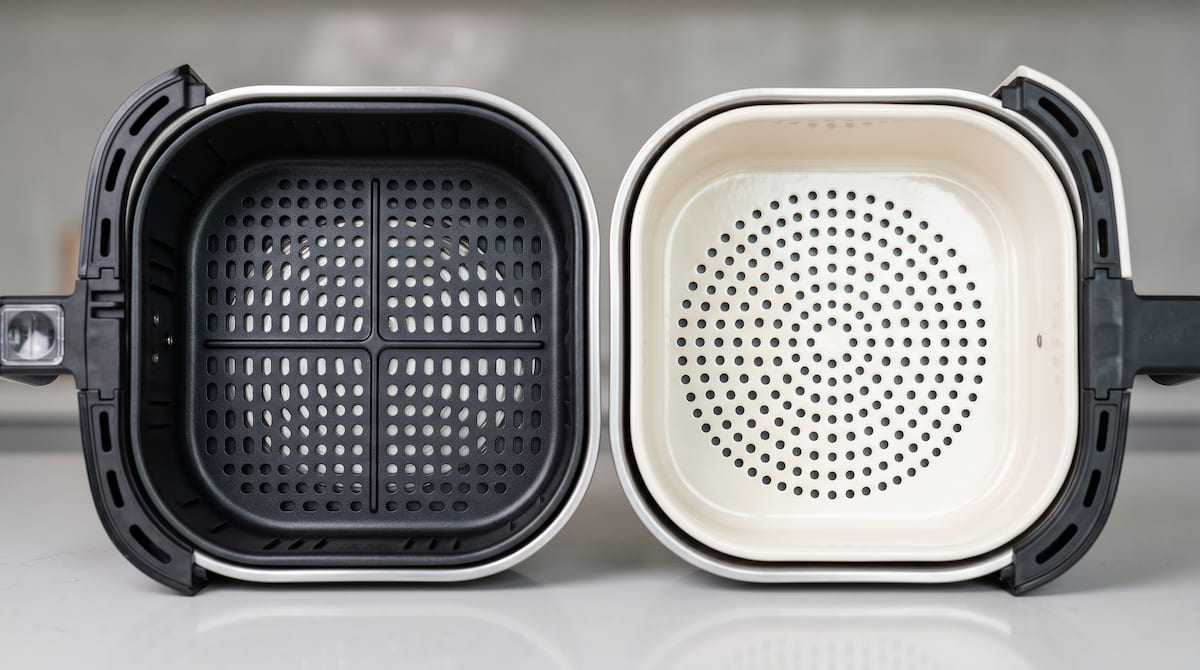
Standard PTFE nonstick basket (left) vs ceramic PFAS-free basket (right) — the surface chemistry difference is invisible but becomes significant as each coating ages.
When Is the Upgrade Clearly Worth It?
For these households, switching to PFAS-free is a straightforward yes:
- Households with pet birds — PTFE fumes are acutely toxic to birds. This isn’t a marginal concern; it’s a clear replacement signal for any bird-owning family currently using a nonstick model
- Pregnant women or families planning pregnancy — PFAS compounds cross the placental barrier. Eliminating daily fluoropolymer exposure during pregnancy is a meaningful risk reduction. Our guide on air fryer safety during pregnancy covers this in detail
- Households with infants or young children — children breathe faster relative to body weight and are more vulnerable to airborne compounds. See our guide on air fryer safety around babies
- Anyone with asthma, COPD, or respiratory sensitivity — PTFE fumes are airway irritants. A PFAS-free model meaningfully reduces daily inhalation exposure
- Families whose current basket is scratched or aging — if you’re already due for a replacement basket, replacing it with a PFAS-free model costs essentially the same as a like-for-like PTFE replacement
When Is the Upgrade Less Urgent?
For these situations, the upgrade is still beneficial but less immediately pressing:
- Healthy adults with no respiratory conditions, no pets, no pregnancy, cooking with good ventilation in a well-maintained intact-basket model
- Households who cook infrequently — less daily exposure means lower cumulative risk from the current model
- Families where the current PTFE basket is new and undamaged — the risk profile of an intact, well-maintained PTFE basket at normal temperatures is meaningfully lower than a scratched or aging one
Even in these situations, the next basket replacement is a natural opportunity to upgrade. The cost difference is modest, the performance is equivalent, and you eliminate the monitoring cycle entirely.
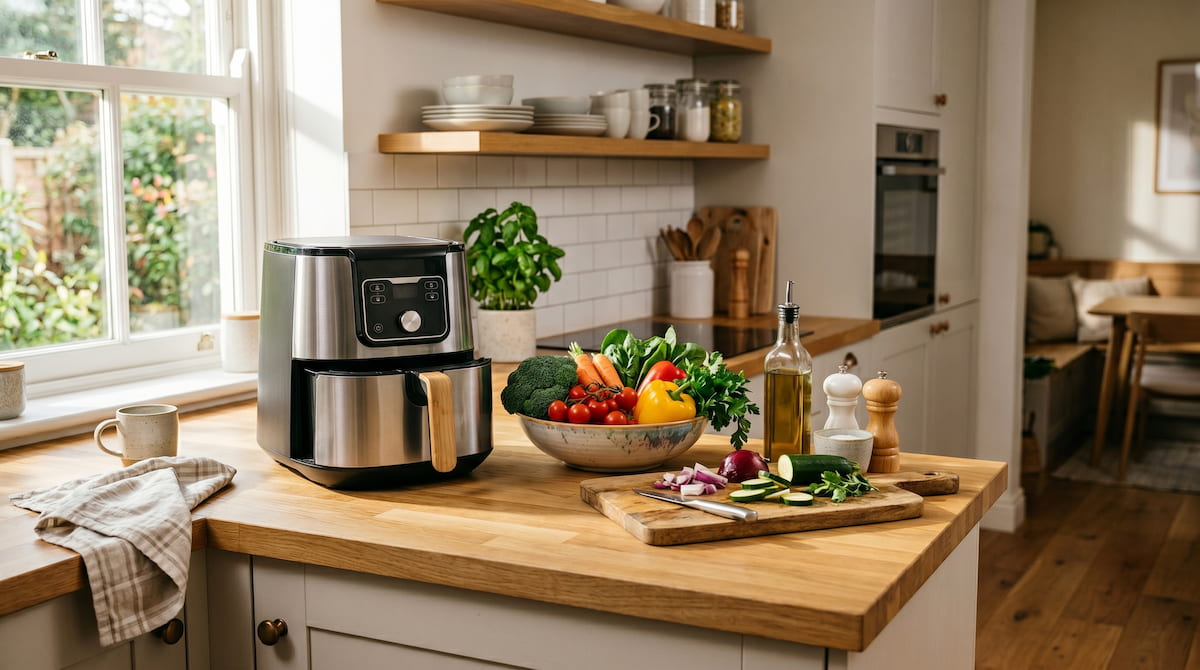
A PFAS-free air fryer in a family kitchen eliminates the coating degradation monitoring cycle — one less thing to track in a busy household.
Best PFAS-Free Air Fryers Worth Upgrading To
Best Everyday Upgrade — Ninja AF150AMZ
The most practical PFAS-free upgrade for most households. Verified PTFE-free and PFAS-free ceramic basket, compact 5.5Qt size, digital temperature control, and dishwasher-safe basket. Cooking performance matches PTFE nonstick models closely enough that the transition requires no adjustment for most families.
See Ninja AF150AMZ on Amazon →Best for Large Families — Instant Pot Omni Plus 18L
Stainless steel interior throughout — no coating chemistry of any kind. 18L capacity handles full family meals. For households where the larger footprint is practical, stainless eliminates the coating replacement cycle entirely.
See Instant Pot Omni Plus on Amazon →Most Complete Non-Toxic Option — Big Boss 16Qt Glass
Borosilicate glass cooking chamber with zero coating chemistry. The most chemically inert air fryer available — ideal for bird households, pregnancy, or any household where eliminating every coating variable is the priority.
See Big Boss Glass Air Fryer on Amazon →Frequently Asked Questions
Is a PFAS-free air fryer really better than a regular one?
For most families — yes, meaningfully so over the lifespan of the appliance. The performance difference is minimal. The chemical exposure difference becomes significant as the PTFE coating ages, scratches, and degrades during normal daily use. A PFAS-free model maintains its safety profile throughout its useful life without monitoring.
How much more does a PFAS-free air fryer cost?
Typically 10–30% more upfront for a ceramic model, and more for stainless or glass. However, PFAS-free baskets last 2–4x longer than PTFE baskets before needing replacement — meaning the total cost over 3–5 years is often comparable or lower than the regular model plus replacement baskets.
Does food taste different from a PFAS-free air fryer?
No — neither ceramic, stainless steel, nor glass imparts flavor to food. Any taste difference between models comes from cooking method and temperature control, not the basket material itself.
Can I tell if my current air fryer is PTFE-coated?
Check the manufacturer’s product page for “PTFE-free” and “PFAS-free” language. If it says “nonstick” without further specification, assume PTFE until confirmed otherwise. A dark grey or black smooth interior with no explicit non-toxic certification is almost always PTFE-based.
Is PFAS-free the same as non-toxic?
PFAS-free eliminates one specific category of chemical concern — fluoropolymer compounds from the coating. “Non-toxic” is unregulated marketing language that can mean anything or nothing. PFAS-free with explicit PTFE-free certification is more meaningful than “non-toxic” alone. Our guide on PTFE vs PFAS in air fryers explains the terminology in detail.
What if I can’t afford a PFAS-free air fryer right now?
Use your current model with parchment liners to reduce direct food contact with the coating, keep cooking temperatures at or below 380°F, ventilate the kitchen every session, and inspect the basket monthly. When the basket needs replacing anyway, that’s the natural upgrade opportunity. You don’t need to replace a functioning intact basket immediately — but the next replacement is worth making PFAS-free.
The Bottom Line: PFAS-Free vs Regular Air Fryer
PFAS-free vs regular air fryer — is the upgrade worth it? For households with birds, pregnant family members, infants, or anyone with respiratory sensitivity: yes, unequivocally. For healthy adults with intact baskets and good ventilation: still beneficial, but less urgent. For anyone already due for a basket replacement: absolutely — the cost difference is modest and the safety improvement is permanent.
For a full comparison of the best PFAS-free options across ceramic, stainless, and glass formats, our PFAS-free air fryer guide covers the complete 2026 landscape at every price point.