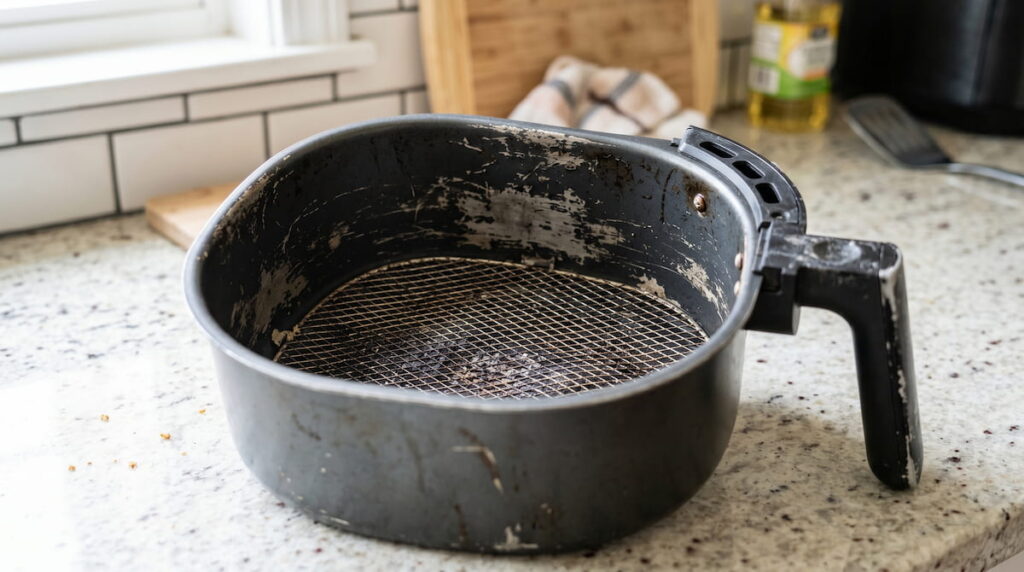
Air fryer coating damaged — what you do next depends on how damaged it is, what the coating is made of, and how quickly you need to act. Not every sign of wear requires stopping immediately, but some do. Getting this assessment right is what separates unnecessary worry from a genuine safety response.
I went through this exact situation with our old nonstick air fryer. The basket looked fine until it didn’t — and by the time I inspected it closely, the coating had been degrading for longer than I realized. Here’s the step-by-step process for assessing a damaged coating and deciding what to do next.
Step 1: Identify What Type of Coating You Have
Before anything else, knowing your coating type determines how urgently you need to respond. The same level of visible damage carries different implications depending on what the basket is made of.
| Coating Type | How to Identify | Urgency When Damaged |
|---|---|---|
| PTFE nonstick | Dark grey/black smooth surface — says “nonstick” without PTFE-free label | ❌ High — replace promptly |
| Ceramic | Lighter color, matte finish — says “ceramic,” “PTFE-free,” or “PFAS-free” | ⚠️ Lower — monitor and plan |
| Stainless steel | Silver metallic interior, no coating | ✅ None — no coating to damage |
| Glass | Transparent cooking chamber | ✅ None — no coating at all |
If you’re unsure what coating your basket has, check the manufacturer’s product page. Look for explicit “PTFE-free” and “PFAS-free” language. If it says “nonstick” without further specification, assume PTFE until confirmed otherwise. For more on why this distinction matters, see our guide on PTFE vs PFAS in air fryers.
Step 2: Assess the Damage Level
Once you know the coating type, assess how damaged the surface actually is. Inspect under bright light with a clean, dry basket:
Level 1 — Light Surface Marks (Monitor)
- Very fine surface scuffs with no depth
- Coating still smooth and intact when you run a finger across it
- No discoloration at the mark sites
- Nonstick performance unchanged
Action: Switch to silicone utensils immediately, start using parchment liners, and inspect monthly. No immediate replacement needed for ceramic. For PTFE, treat this as a warning to plan replacement soon.
Level 2 — Visible Scratches (Replace Soon)
- Scratches visible to the naked eye under normal lighting
- Possible slight roughness at scratch sites
- Minor discoloration in scratched areas
- Food starting to stick in spots where it didn’t before
Action: For PTFE — use parchment liners every cook, lower temperature to 350–375°F, order replacement within the week. For ceramic — continue with liners and plan replacement when performance drops further.
Level 3 — Significant Damage (Replace Immediately)
- Multiple deep scratches or large scratched areas
- Dull patches, discoloration, or color change across sections
- Consistent food sticking throughout the basket
- Occasional chemical smell at normal cooking temperatures
Action: Stop using for primary cooking. Use only with parchment liner as a very short-term bridge while replacement is ordered. Ventilate kitchen every session.
Level 4 — Critical Damage (Stop Using Now)
- Visible flaking or peeling anywhere on the basket
- Bare metal visible through coating gaps
- Persistent chemical or plastic smell every cooking session
- Dark bubbling or blistering on the surface
Action: Stop using immediately. No liner makes this safe to continue with. Replace before next meal.
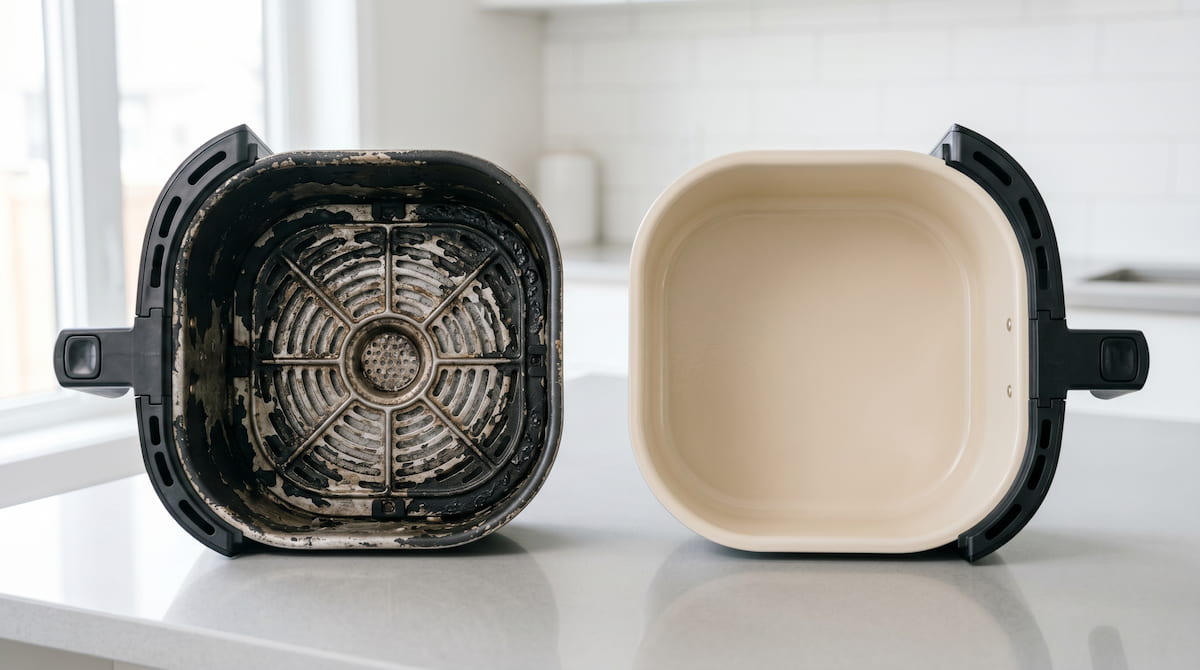
A basket showing Level 3–4 damage (left) vs an intact ceramic basket still in good condition (right) — the damage assessment determines whether you have days or weeks to act.
Step 3: Decide — Replace Basket or Replace the Unit
Once you’ve assessed the damage and determined replacement is needed, the decision is whether to replace just the basket or upgrade the entire unit:
Replace just the basket if:
- Your model sells replacement baskets separately
- This is your first replacement on this unit
- The replacement basket is ceramic-coated, not PTFE
- The unit itself is less than 2 years old and functioning well
Replace the entire unit if:
- This is your second PTFE basket replacement — you’re on a coating replacement cycle that will repeat
- Replacement baskets for your model are PTFE-coated — you’d be replacing like-for-like
- The unit is more than 3 years old — other components may also be approaching end of useful life
- You want to upgrade to a genuinely non-toxic surface and eliminate the issue going forward
For most families replacing a PTFE basket for the second time, upgrading to a ceramic, stainless, or glass model is the more sensible long-term decision. Our guide on how long air fryer coatings last by material type covers the full lifespan comparison to help with this decision.
Step 4: Interim Safety Measures While You Wait for Replacement
If you need to continue cooking while waiting for a replacement to arrive:
- Use parchment liners every single session — reduces direct food contact with the damaged surface. Our guide on whether air fryer liners are safe covers which types work best
- Lower cooking temperature to 350–375°F — reduces thermal stress on the damaged coating and slows further degradation
- Ventilate every session without exception — open a window and run the range hood. Our kitchen ventilation guide covers room-by-room strategies
- Don’t preheat empty at high heat — the greatest thermal stress on a coating happens when there’s no food buffer absorbing heat
- For Level 4 damage — use the oven or stovetop — no interim measures make a flaking basket safe enough to continue cooking with
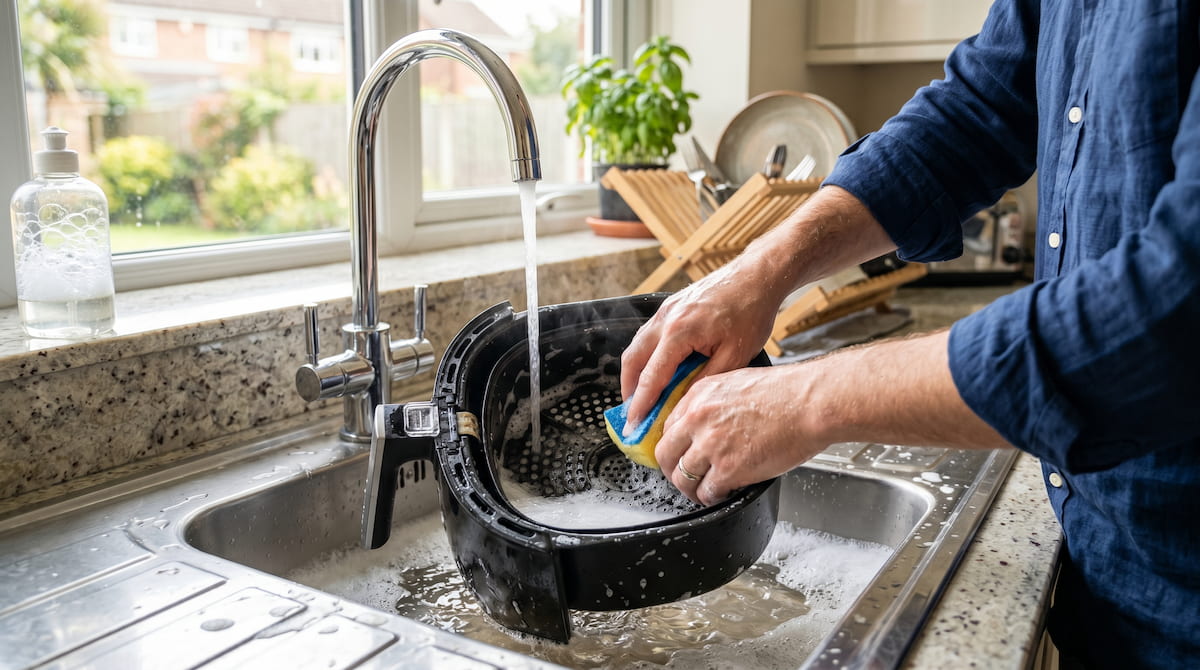
Hand washing with a soft sponge after every use is the most effective habit for preventing coating damage — and for catching early signs during the cleaning process.
Step 5: Choose the Right Replacement
If you’re upgrading rather than replacing like-for-like, these are the options worth considering:
For the most practical everyday upgrade: The Ninja AF150AMZ ceramic-coated basket is PTFE-free and PFAS-free — it addresses the coating damage concern at the source. When the ceramic surface eventually shows wear, the failure mode is reduced nonstick performance, not fluorinated compound release.
For families who want to eliminate the coating question entirely: The Big Boss 16Qt glass air fryer has no basket coating of any kind — borosilicate glass produces no coating-related chemicals at any temperature, and there’s nothing to scratch, nothing to degrade, and nothing to replace on a coating timeline.
For a full comparison of all safe options, see our PFAS-free air fryer guide.
See Ninja AF150AMZ on Amazon → See Big Boss Glass Air Fryer on Amazon →How to Prevent Air Fryer Coating Damage Going Forward
Whether you’re replacing the basket or the unit, these habits extend coating life significantly:
- Silicone or wooden utensils only — no metal ever contacts the basket surface
- Hand wash after every use — warm water, mild soap, soft sponge. Never abrasive scrubbers or steel wool
- Let it cool completely before washing — thermal shock from cold water on a hot basket accelerates coating bond stress
- Skip aerosol cooking sprays — brush oil directly onto food instead. Spray residue builds up and requires increasingly aggressive scrubbing
- Use parchment liners proactively — even on a new basket, liners reduce direct food and oil contact and extend coating life
- Inspect monthly — a quick visual check under bright light catches early wear before it becomes a safety issue
Frequently Asked Questions
Is it safe to use an air fryer with a damaged coating?
It depends on the damage level and coating type. Light surface marks on a ceramic basket — use with caution and liners. Visible scratches on a PTFE basket — plan immediate replacement and use liners as a bridge. Any flaking or peeling on any basket — stop using immediately regardless of coating type.
Can I repair a damaged air fryer coating?
No — there is no safe way to resurface or repair a damaged nonstick or ceramic coating at home. Any product marketed as a “coating repair” for cookware is not a reliable safety solution. Replacement is the only appropriate response to significant coating damage.
How long can I use a scratched air fryer basket before replacing it?
For PTFE baskets — as little time as possible. A scratched PTFE coating degrades faster with every subsequent heat cycle. For ceramic baskets — you have more time, but still plan replacement within weeks for significant scratching. See our full guide on what happens when air fryer coating gets scratched for the detailed timeline.
Do parchment liners make a damaged basket safe?
They reduce direct food contact with the damaged surface — a meaningful short-term mitigation for Levels 1–3 damage while waiting for replacement. They don’t stop a PTFE coating from off-gassing under heat at the damage sites, and they don’t make a Level 4 (flaking) basket safe to continue using. Liners buy time; they don’t solve the underlying problem.
What’s the fastest sign that my air fryer coating is damaged?
A chemical or plastic smell during cooking at normal temperatures is often the earliest detectable sign — before visible damage is apparent. Food sticking where it previously didn’t is the second earliest functional sign. Visual scratches visible under bright light typically become apparent around the same time as the sticking issue.
Should I throw away food cooked in a damaged basket?
For visibly flaking coating — yes, discard that batch and stop using the basket. For earlier-stage damage (scratches without flaking) — the risk is ongoing low-level exposure rather than an acute single-meal concern. The priority is replacing the basket promptly rather than discarding food from every meal until you do.
The Bottom Line on Damaged Air Fryer Coating
When your air fryer coating is damaged, the right response depends on three things: coating type, damage level, and whether you’re dealing with PTFE or ceramic. PTFE damage warrants faster action because the failure mode involves fluorinated compound release. Ceramic damage is less chemically urgent but still warrants replacement planning.
The interim steps — parchment liners, lower temperatures, consistent ventilation — buy time safely for most damage levels below flaking. And when replacement comes, switching to a PTFE-free ceramic, stainless, or glass cooking surface means this assessment process becomes significantly less urgent going forward. Our PFAS-free air fryer guide covers every safe option available in 2026.