Affiliate Disclosure: This post contains affiliate links. If you purchase through my links, I may earn a small commission at no extra cost to you. I only recommend products I’ve personally researched and trust for my own family.
If you want to know how to cook frozen chicken in air fryer without worrying about what’s coming off the coating, you’re asking the right question — and most guides skip it entirely.
I started asking it after I noticed a chemical smell coming from our air fryer during a high-heat cook. My sons were eating that chicken. That was enough for me to dig deeper.
Here’s what I found — and why the basket material matters just as much as the temperature.
Why Frozen Chicken and Air Fryers Are a Good Match
Air fryers handle frozen chicken better than almost any other appliance. The high-speed circulating air pulls moisture away from the surface while cooking the interior evenly — no thawing required, no soggy texture.
But here’s what most guides don’t mention: cooking frozen chicken means higher temperatures and longer cook times. That puts more thermal stress on your basket coating than a quick batch of vegetables does.
If your basket has a PTFE-based nonstick coating — even one marketed as “safe” — prolonged high-heat cooking is exactly the condition that accelerates coating breakdown. Scratches make it worse.
How to Cook Frozen Chicken in Air Fryer: Step-by-Step
These steps work for boneless chicken breasts, thighs, and tenders straight from the freezer.
Step 1 — Preheat your air fryer
Set to 360°F (182°C) and preheat for 3–5 minutes. Starting with a cold basket extends cook time and can lead to uneven cooking near the bone.
Step 2 — Place chicken in a single layer
Don’t stack. Airflow needs to circulate around each piece. Overlapping means the bottom pieces steam instead of crisp — and they take longer to reach a safe internal temperature.
Step 3 — Cook at 360°F for 20–25 minutes, flipping halfway
Flip at the 12-minute mark. Thicker breasts may need the full 25 minutes. Thin tenders are usually done closer to 18.
Step 4 — Check internal temperature before serving
The USDA recommends 165°F (74°C) as the safe internal temperature for all poultry. A meat thermometer inserted into the thickest part — not touching bone — is the only reliable way to confirm this.
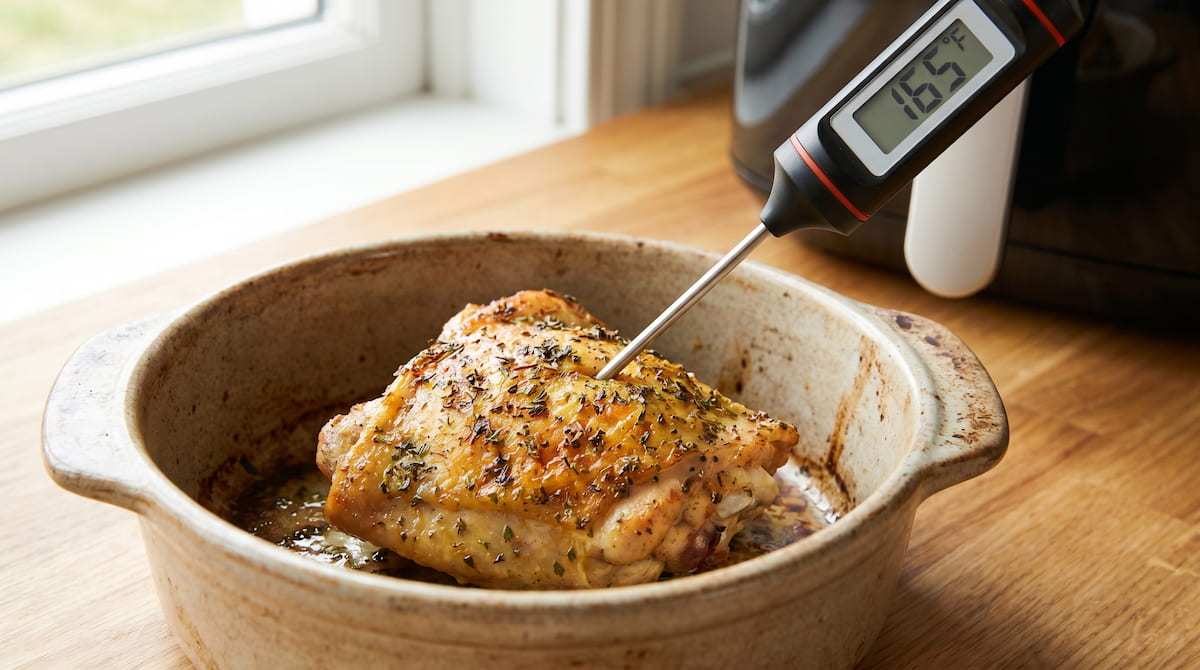
Always verify internal temperature reaches 165°F — the only safe measure for frozen chicken.
Step 5 — Rest for 3–5 minutes before cutting
Resting lets juices redistribute. Cut too early and you lose moisture — and you may also get a falsely low temperature reading if you check right after pulling from the basket.
The Coating Problem Most Guides Ignore
Frozen chicken cooks at 360–380°F. That’s well within the range where PTFE coatings — used in most standard nonstick air fryer baskets — begin to show signs of stress, especially if the coating is scratched or worn.
According to the EPA’s current PFAS guidance, certain fluoropolymer compounds in nonstick coatings have raised concerns around persistence and potential health effects. The science is still developing, but the precautionary case for avoiding PTFE-coated cookware — especially at high heat — is well documented.
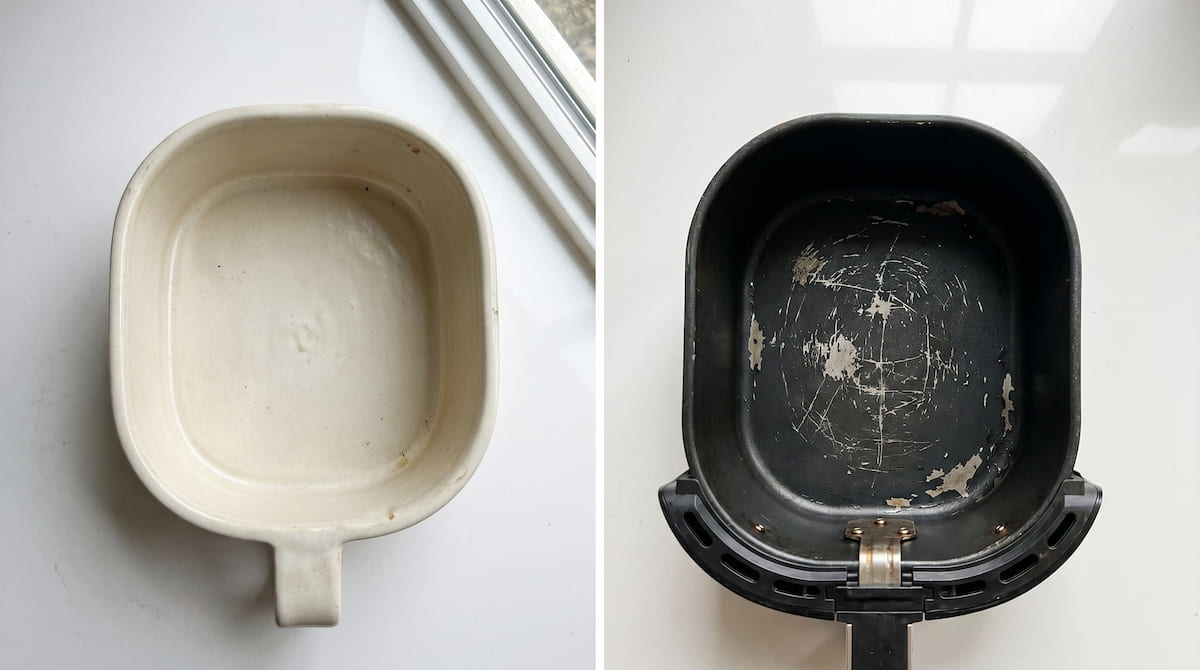
A scratched nonstick basket raises the stakes at high heat. Ceramic is a cleaner choice for frequent frozen food cooking.
When I switched to a ceramic-coated basket, the chemical smell stopped. That’s anecdotal — but it matched what the research suggested about coating integrity at sustained high temps.
What Basket Should You Use for Frozen Chicken?
Not all air fryer baskets handle repeated high-heat cooking the same way. Here’s a quick breakdown:
| Basket Type | High-Heat Safety | Notes |
|---|---|---|
| Ceramic-coated | ✅ Good | PTFE-free, PFAS-free, handles 400°F+ well when intact |
| Stainless steel | ✅ Best | No coating to degrade, most durable long-term |
| PTFE nonstick (unscratched) | ⚠️ Caution | Stable below 500°F if undamaged, but degrades over time |
| PTFE nonstick (scratched) | ❌ Avoid | Compromised coating at high heat is the biggest risk |
For regular frozen chicken cooking — which means high heat, multiple times a week — I’d strongly recommend moving away from PTFE-coated baskets, especially older or scratched ones.
The air fryer I use with my family for this is the Ninja AF150AMZ. It has a ceramic-coated basket, comes in at a reasonable price point, and handles frozen proteins without any of the smell issues I had with our old PTFE basket.
If you’re cooking for a larger family and need more capacity, the Instant Pot Omni Plus 18L is also PFAS-free and handles full frozen chicken breasts with room to spare.
Temperature Guide: Frozen Chicken in Air Fryer
| Cut | Temp | Time | Flip? |
|---|---|---|---|
| Boneless breast | 360°F | 20–25 min | Yes, at 12 min |
| Boneless thighs | 380°F | 18–22 min | Yes, at 10 min |
| Tenders / strips | 360°F | 15–18 min | Yes, at 8 min |
| Bone-in pieces | 360°F | 30–35 min | Yes, at 15 min |
These times assume a preheated basket and pieces laid in a single layer. Add 3–5 minutes if your air fryer runs cool, and always confirm with a thermometer.
Common Mistakes to Avoid
Skipping the preheat. A cold basket means the outside of the chicken sits in a warming environment for the first few minutes instead of hitting immediate high heat. That extends total cook time and affects texture.
Stacking pieces. Even two overlapping breasts will cook unevenly. The airflow can’t reach the contact point between them. Cook in batches if needed.
Not checking temperature. Color and texture can look done when the center is still at 150°F. A thermometer is non-negotiable for frozen protein.
Using a damaged basket. If your nonstick coating is visibly scratched or flaking, replace the basket before your next cook. This is especially true for frozen chicken, which requires higher sustained temps.
For more on basket safety and when to replace, see my guide on how long air fryer baskets last and how to clean an air fryer basket without ruining the coating.
Is Frozen Chicken Safe to Cook in Air Fryer?
Yes — with the right basket and a thermometer, frozen chicken cooked in an air fryer is both safe and practical. The risk isn’t the cooking method. The risk is using a compromised coating at sustained high heat and skipping the temperature check.
Switch to a ceramic or stainless basket, follow the time and temp guide above, and frozen chicken becomes one of the easiest proteins you can run through an air fryer.
For a full breakdown of which air fryers use safe coatings, see my guide on PFAS-free air fryers.