Disclosure: This post contains affiliate links. If you purchase through them, I earn a small commission at no extra cost to you. I only recommend products I personally trust for my family.
Can you use air fryer near a wall is a question that comes up in almost every kitchen because counter space is limited and walls are everywhere. I’m Wook, a bus driver and dad who cooks for my family almost every night. When we first got our air fryer, I pushed it into a corner against two walls because that’s where it fit. After noticing the wall behind it getting noticeably warm and the unit running hotter than usual, I measured the clearance and found we had less than an inch on one side. Here’s what the clearance rules actually are — and why they exist.
Can You Use an Air Fryer Near a Wall?
Yes — but only with adequate clearance. The question isn’t whether you can have a wall nearby, it’s how close is too close. Every air fryer manufacturer specifies minimum clearance distances in their user manuals for a reason: the hot air exhaust from an air fryer is hot enough to damage walls, cabinets, and nearby materials — and in some configurations, hot enough to ignite them.
Why Wall Clearance Matters
1. Hot Air Exhaust
Air fryers exhaust hot air — typically 300–400°F — through vents located on the back or sides of the unit depending on the model. This exhaust air needs somewhere to go. When the exhaust vent is positioned directly against a wall, hot air has nowhere to escape and recirculates back into the unit, causing internal temperature to rise and triggering thermal overload protection or sustained overheating.
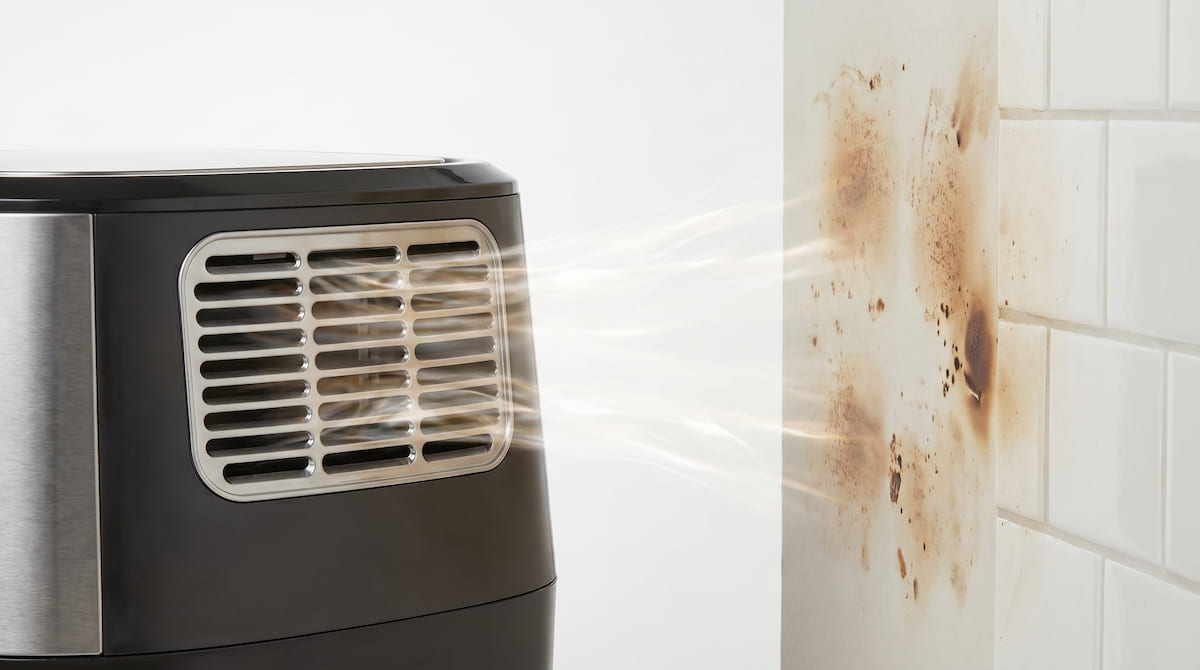
Hot air exhausted from an air fryer vent can damage walls and cause overheating when clearance is insufficient.
2. Wall Material Matters
Different wall materials respond differently to sustained heat exposure. Standard painted drywall can discolor and blister with repeated heat exposure. Wood-paneled walls can dry out and crack over time. Wallpaper can peel and in extreme cases ignite. Even tile grout can deteriorate with sustained heat directed at it. The wall material behind your air fryer determines how quickly damage accumulates at a given clearance distance.
3. Cabinet Overhead Risk
The clearance above an air fryer is often the most overlooked dimension. Hot exhaust rises — and if there’s a cabinet directly overhead, that hot air concentrates against the cabinet bottom with every cook cycle. Cabinet undersides can discolor, warp, and in extreme cases catch fire from sustained heat exposure. The clearance above is typically more important than the clearance behind.
4. Corner Placement Risk
Placing an air fryer in a corner — with walls on two sides — compounds the clearance problem by restricting airflow on multiple sides simultaneously. Corner placement is the single worst configuration for air fryer ventilation and the most likely to cause overheating, wall damage, and thermal shutoff events.
Minimum Clearance Rules by Direction
| Direction | Minimum Clearance | Why |
|---|---|---|
| Behind (exhaust side) | 5–6 inches minimum | Primary hot air exhaust direction |
| Above | 8 inches minimum | Rising hot air — cabinet fire risk |
| Sides | 5 inches minimum | Intake airflow on most models |
| Front | 12 inches minimum | Basket pull-out clearance and access |
How to Check Your Current Placement
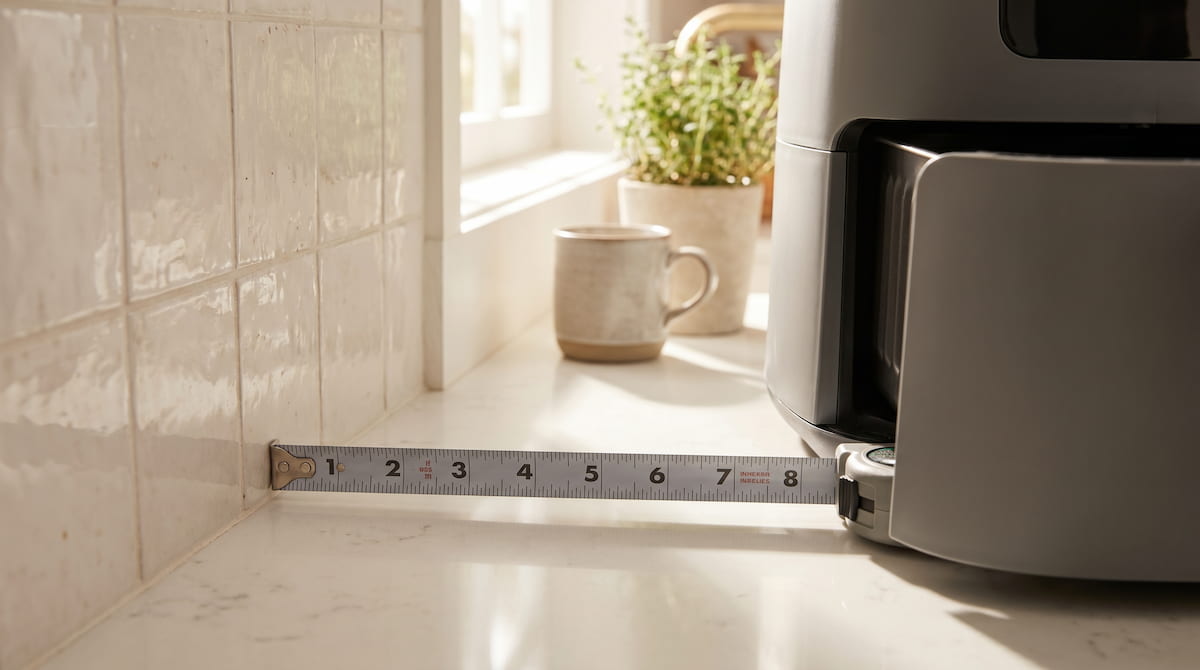
Measuring actual clearance distances takes under a minute and confirms whether your current placement is safe.
Grab a measuring tape and check all four directions from your air fryer to the nearest surface. Pay special attention to:
- The exhaust vent location on your specific model — check the manual to confirm which side exhausts hot air
- The clearance above to any cabinets, shelves, or mounted items
- Whether anything has been placed near the unit since you last checked — kitchen counters accumulate items over time
- The surface the unit sits on — never place on a towel, cutting board, or any surface that could restrict bottom airflow
Signs Your Air Fryer Is Too Close to the Wall
- Wall feels warm after cooking — heat is concentrating against the surface
- Unit shuts off mid-cook — thermal overload from restricted airflow
- Unit runs louder than usual — fan working harder due to recirculated hot air
- Discoloration on wall behind unit — heat damage accumulating over time
- Food cooking faster than expected — internal temperature running higher than set due to overheating
Wall Placement and Fire Risk
Inadequate clearance is one of the contributing factors in air fryer fire incidents — particularly when combined with grease buildup and unattended cooking. For the complete overview of what causes air fryer fires and how to prevent all of them simultaneously: Can an Air Fryer Catch Fire? Real Risk Explained
And if your air fryer has been overheating — which poor wall placement often causes: Air Fryer Overheating: Is It Dangerous and What Should You Do?
Bottom Line
Can you use air fryer near a wall? Yes — but with specific minimum clearances that most people don’t measure until something goes wrong. Five inches on the sides and behind, eight inches above, and never in a corner. The exhaust vent direction on your specific model determines which clearance is most critical — check the manual to confirm. Spending two minutes measuring your current placement is one of the simplest and most effective safety checks you can do for any air fryer setup.