Disclosure: This post contains affiliate links. If you purchase through them, I earn a small commission at no extra cost to you. I only recommend products I personally trust for my family.
Common air fryer mistakes dangerous enough to cause real problems are ones most families make without realizing it — because they’re not obvious mistakes. They’re small habits that seem harmless in the moment but compound into genuine safety issues over weeks and months of daily cooking. I’m Wook, a bus driver and dad who cooks for my family almost every night. I made most of these mistakes myself before understanding what they were actually doing to our air fryer and our food.
12 Common Air Fryer Mistakes That Create Real Risk
Mistake 1: Using Metal Utensils Inside the Basket
Metal tongs, forks, and spatulas scratch basket coatings with every use. A single scratch from a metal utensil creates a degradation point that expands with each subsequent heat cycle. Over weeks of daily use, metal utensil scratches compound into significant coating damage that releases particles into food. Switch entirely to silicone or wooden utensils — this single habit change extends basket lifespan significantly and eliminates the most common source of coating damage.
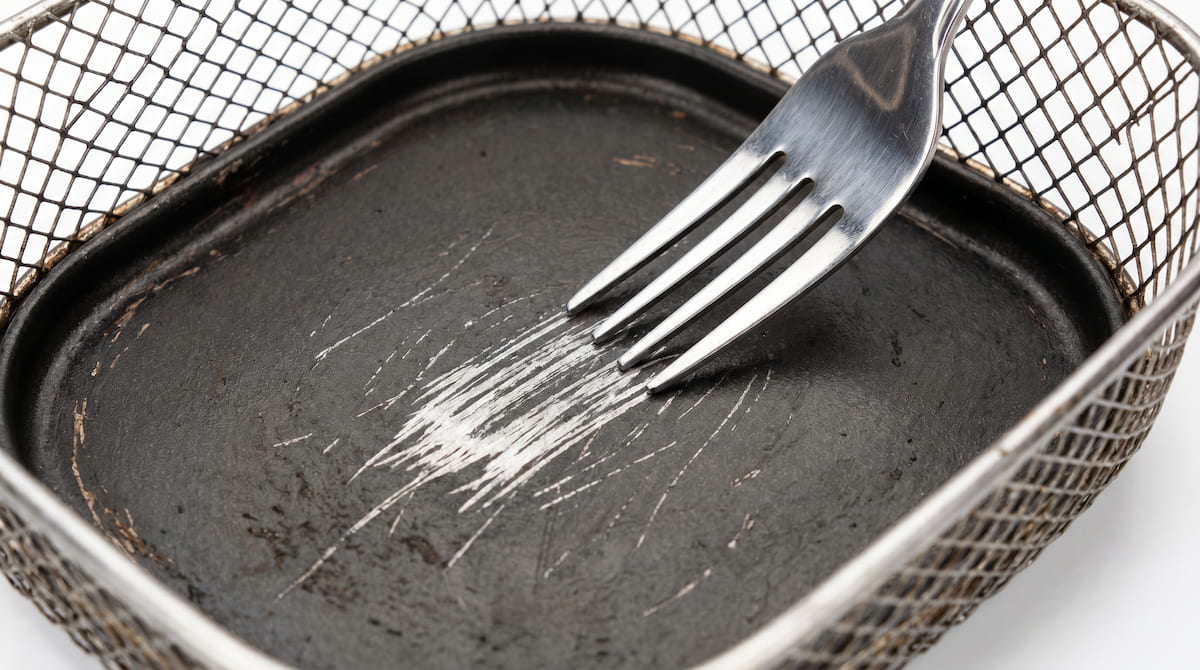
A single metal utensil scratch creates a coating degradation point that expands with every subsequent cook cycle.
Mistake 2: Using Aerosol Cooking Spray Directly on the Basket
Aerosol cooking sprays contain propellants and emulsifiers that leave a polymer film on basket surfaces. This film builds up with every use and bakes into an increasingly thick, sticky residue that smells, produces smoke, and damages the coating underneath. The fix is a pump mister filled with actual oil — no propellants, no residue buildup, and better oil distribution than aerosol spray.
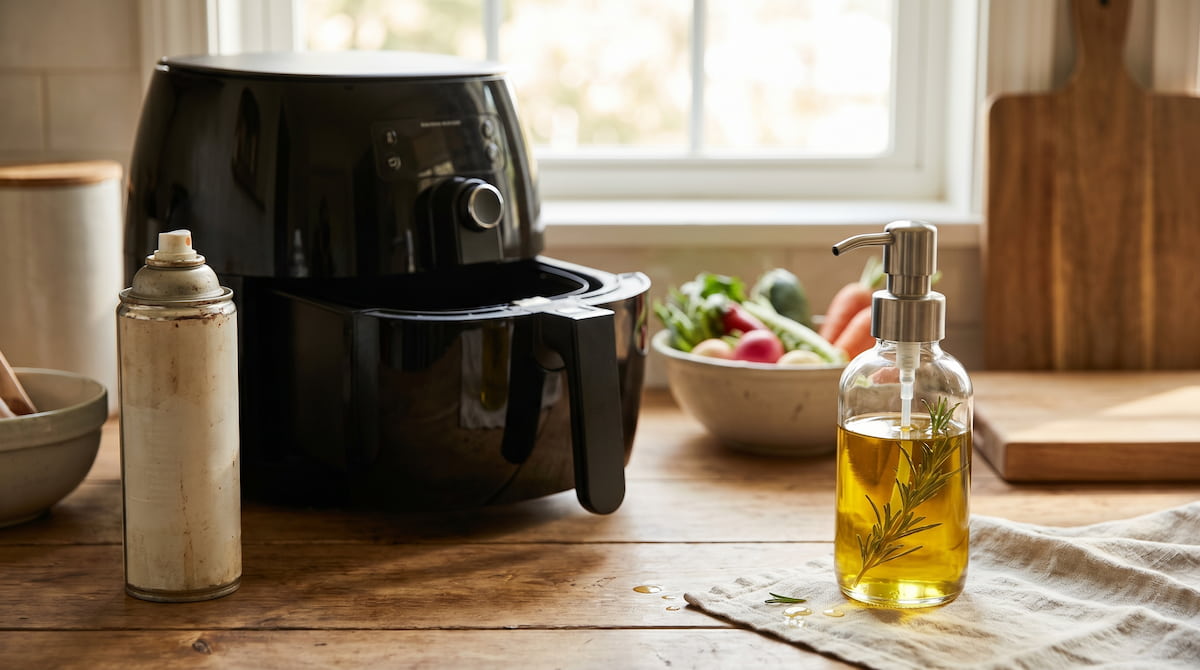
A pump mister with real oil eliminates the polymer residue buildup that aerosol sprays leave on basket coatings over time.
Mistake 3: Placing the Unit Too Close to Walls or Cabinets
Insufficient clearance is the setup mistake that causes the most serious consequences — overheating, thermal shutoffs, wall damage, and in worst cases fire. Most people push the air fryer into whatever corner space is available without measuring. The rule is 5 inches minimum on all sides, 8 inches above. Measure it once, mark the position, and don’t move it into a tighter spot when counter space gets crowded.
Mistake 4: Overfilling the Basket
Overfilling restricts airflow, causes uneven cooking, creates hot spots that burn food, and in fatty food scenarios, causes grease overflow into the drawer that creates fire risk. The correct fill level is a single layer with space between pieces — for every food type. Batch cooking in properly loaded rounds takes longer but produces better results and eliminates the most common source of air fryer smoke and fire incidents.
Mistake 5: Never Cleaning the Heating Element
Most people clean the basket and drawer regularly but never clean the heating element above the basket. Grease that reaches the element carbonizes with repeated heating, producing increasing amounts of smoke and odor with every cook. For daily users, this builds to problematic levels within 2–3 weeks. Cleaning the element monthly — or every 2 weeks for daily fatty food cooking — is not optional maintenance, it’s fire risk prevention.
Mistake 6: Using an Extension Cord or Power Strip
Air fryers draw 1,400–1,800 watts — more than most extension cords are safely rated for. Using a standard household extension cord or plugging into a power strip creates overheating risk at the cord itself, not just inside the air fryer. According to the U.S. Consumer Product Safety Commission, overloaded extension cords are a leading cause of home kitchen fires. Always plug directly into a wall outlet.
Mistake 7: Washing the Basket Before It Cools
Plunging a hot basket into cold water — or washing it immediately after cooking — causes thermal shock that cracks ceramic coatings and warps metal components. The correct sequence is: cook, cool completely (minimum 20 minutes), then wash. The time cost is minimal and the coating longevity benefit is significant.
Mistake 8: Leaving the Unit Plugged In When Not in Use
Leaving any high-wattage appliance plugged in when not in use creates a background electrical risk — particularly in units with aging components. Unplugging after every use eliminates standby electrical risk entirely and costs nothing. This matters more as the unit ages and internal component reliability decreases.
Mistake 9: Skipping Preheat for Proteins
Cooking raw chicken, pork, and fish without preheating means the food spends less total time at full cooking temperature than recipe times assume. This creates undercooked centers that appear done on the outside — a food safety issue, not just a quality one. Preheat empty for 3–5 minutes before adding any raw protein.
Mistake 10: Using the Dishwasher for Coated Baskets
High-heat dishwasher cycles combined with alkaline detergents degrade both ceramic and nonstick coatings significantly faster than hand washing. A basket that would last 3 years with hand washing may show coating failure within 1 year of dishwasher use. Hand washing with warm soapy water takes two minutes and extends coating lifespan measurably.
Mistake 11: Ignoring New Smells or Sounds
A chemical smell that didn’t exist three months ago, a grinding fan sound that’s new, or a burning smell from a clean unit are all signals that something has changed and needs attention. Daily familiarity with an appliance creates a tendency to normalize changes rather than investigate them. New smells and sounds from an air fryer are diagnostic information — treat them as such rather than assuming they’ll resolve on their own.
Mistake 12: Keeping a Unit Too Long Out of Habit
The most consequential mistake daily users make is keeping a unit well past its safe lifespan because replacing it feels unnecessary when it’s still technically working. A unit that’s working but producing chemical smells, showing coating flaking, or running irregularly is working and unsafe simultaneously. Function and safety are not the same metric — evaluate them separately.
Mistake Risk Level Summary
| Mistake | Primary Risk | Fix |
|---|---|---|
| Metal utensils | Coating damage, chemical exposure | Silicone or wooden only |
| Aerosol spray | Residue buildup, coating damage | Pump mister only |
| Poor clearance | Overheating, fire risk | 5 inch minimum all sides |
| Overfilling | Grease fire, uneven cooking | Single layer always |
| Extension cord | Electrical fire | Direct wall outlet only |
| Skipping preheat for proteins | Food safety — undercooked centers | Always preheat 3–5 minutes |
For a complete daily routine that incorporates all the right habits automatically: Air Fryer Safety Checklist for Everyday Use
And if any of these mistakes have been part of your routine and you’re now wondering about the condition of your basket: Is It Safe to Use a Scratched Air Fryer Basket Long-Term?
Bottom Line
The most common air fryer mistakes that create real danger are almost all habits rather than one-time errors — which means fixing them is a habit change rather than a one-time fix. Metal utensils, aerosol spray, poor clearance, overfilling, extension cords, and keeping aging units past their safe life are the six highest-impact mistakes to address first. Fix those six and the risk profile of daily air fryer cooking changes dramatically — from gradually accumulating danger to genuinely safe family cooking.