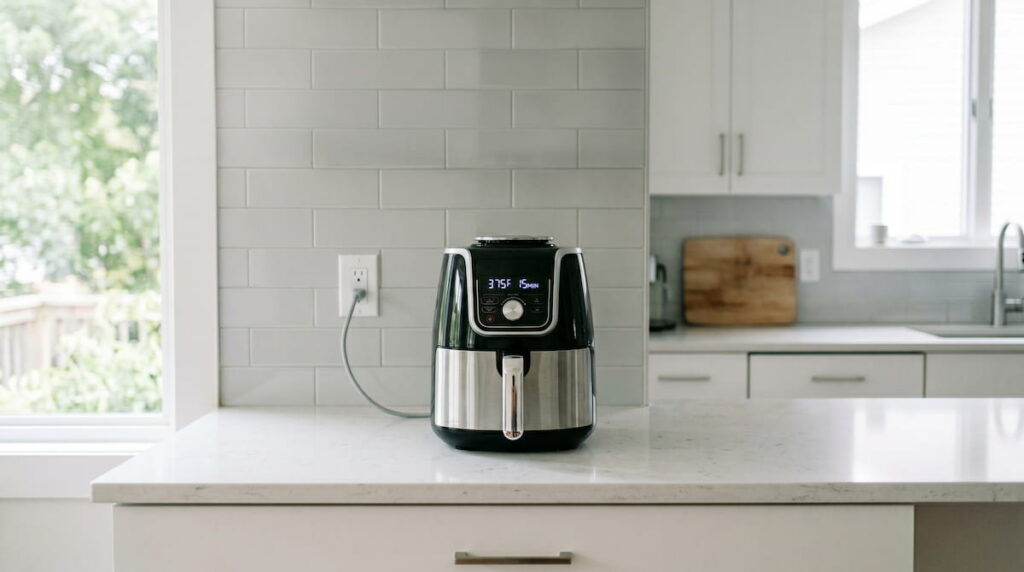
Knowing How much space around air fryer placement is safe depends on three clearance directions — and getting this wrong affects both cooking performance and kitchen safety. An air fryer pushed against a wall, tucked under a low cabinet, or crowded by other appliances can overheat, perform poorly, and in serious cases become a fire hazard. Here’s the complete clearance guide for every kitchen setup.
How Much Space Around Air Fryer Do You Actually Need?
The minimum safe clearance requirements for any air fryer are:
- Rear clearance: 5–6 inches minimum from any wall or surface behind the unit
- Side clearance: 3–4 inches on each side, more on the vented side if applicable
- Top clearance: 8–10 inches minimum from any upper cabinet, shelf, or surface above
- Front clearance: Enough space to fully pull out the basket without obstruction — typically 12–15 inches
- Surface clearance: The unit must sit on a flat, level, heat-resistant surface — no cloth, paper, or plastic underneath
These numbers come from manufacturer recommendations and basic heat management principles — not arbitrary guidelines. Each clearance direction corresponds to a specific safety concern that matters in daily use.
Why Each Clearance Direction Matters
Rear Clearance (5–6 inches minimum)
The exhaust vent on most basket-style air fryers is located at the rear of the unit. This vent releases hot air from the cooking chamber during and after cooking — it needs unobstructed space to do so effectively. When an air fryer is pushed flush against a wall, hot exhaust air has nowhere to go and gets recirculated back into the unit, raising internal temperatures and reducing cooking efficiency.
In severe cases, blocked rear ventilation causes the unit to overheat and trigger thermal protection shutoffs — or worse, builds heat in the gap between the unit and the wall, which is a fire risk if any flammable material is present. 5–6 inches of rear clearance prevents all of this.
Side Clearance (3–4 inches minimum)
Side clearance matters for units with side vents and for general heat dissipation from the unit housing. Even units without side vents get warm on the exterior during cooking — placing them directly against another appliance or cabinet wall traps that heat rather than allowing it to dissipate.
For units with side-mounted air intakes, side clearance is critical — a blocked intake reduces the airflow the unit needs to function and can cause overheating. Check your model’s manual to identify vent locations before finalizing placement.
Top Clearance (8–10 inches minimum)
Hot air rises — the air exiting your air fryer’s top or rear vent rises and needs space to dissipate above the unit. Placing an air fryer directly under an upper cabinet with less than 8 inches of clearance traps this heat against the cabinet bottom, which can damage cabinet finishes over time and in worse cases create heat buildup that poses a fire risk with wooden cabinets.
The 8–10 inch recommendation assumes normal use temperatures. For cooking sessions that produce significant steam or smoke — fatty meats, heavily oiled foods — more clearance above the unit is better.
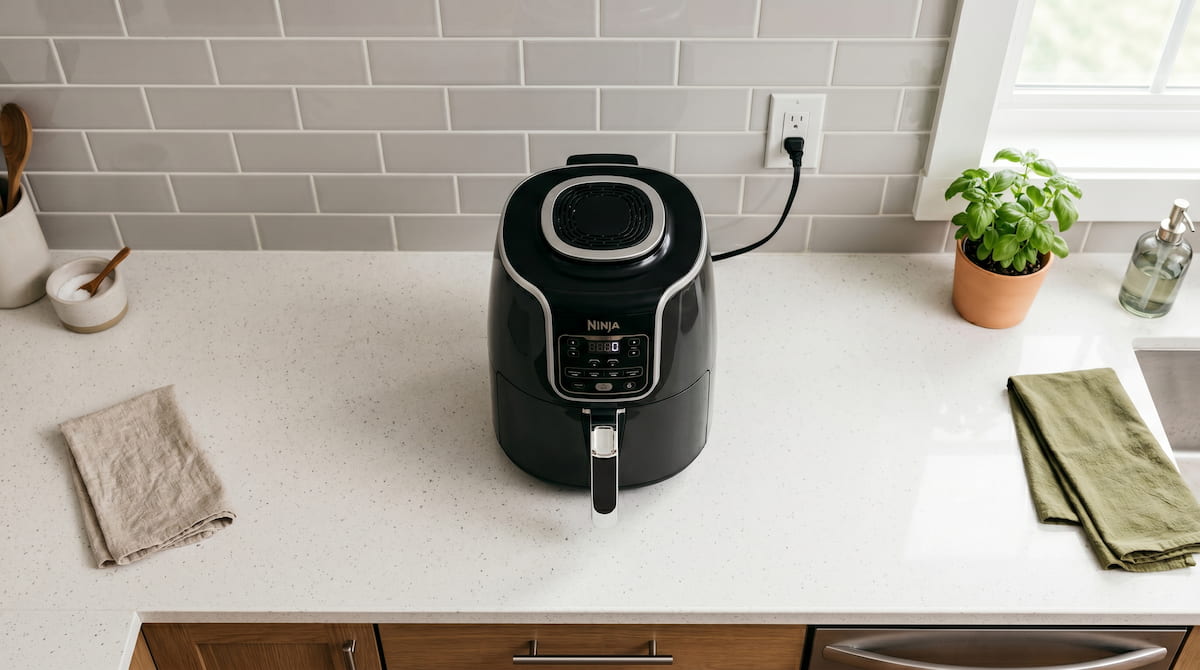
Proper air fryer placement — centered on the counter with clear space on all sides allows the exhaust system to work as designed.
Safe Air Fryer Placement by Kitchen Type
| Kitchen Type | Placement Challenge | Safe Solution |
|---|---|---|
| Standard home kitchen | Upper cabinets limit top clearance | Place on open counter section — measure top clearance first |
| Galley kitchen | Limited counter depth and width | Compact unit (Ninja AF150AMZ) — measure rear clearance carefully |
| Studio apartment | Limited total counter space | Dedicated spot away from walls — don’t crowd with other appliances |
| Open kitchen island | No upper cabinets — top clearance not an issue | Ideal placement — maintain side and rear clearance only |
| Office breakroom | Shared counter, limited dedicated space | Designated spot with posted clearance guidelines for shared users |
How to Measure Clearance Before Buying
The time to check clearance is before you buy, not after the unit arrives. Here’s the measurement process:
- Identify your intended placement spot on the counter
- Measure rear distance from the back of the placement spot to the wall — subtract the unit’s depth, then check remaining clearance
- Measure top clearance from the counter surface to the bottom of any upper cabinet or shelf above
- Compare to unit dimensions — unit height plus 8–10 inches must be less than your top clearance measurement
- Check side clearance — unit width plus 3–4 inches on each side must fit within available counter width
For the Ninja AF150AMZ specifically: the unit is approximately 11.1 inches wide, 13.9 inches deep, and 12.5 inches tall. Add 5–6 inches rear clearance (total 19–20 inches depth needed), 3–4 inches each side (total 17–19 inches width needed), and 8–10 inches top clearance (total 20–22 inches height needed from counter to cabinet). Measure these three dimensions at your intended placement spot before ordering.
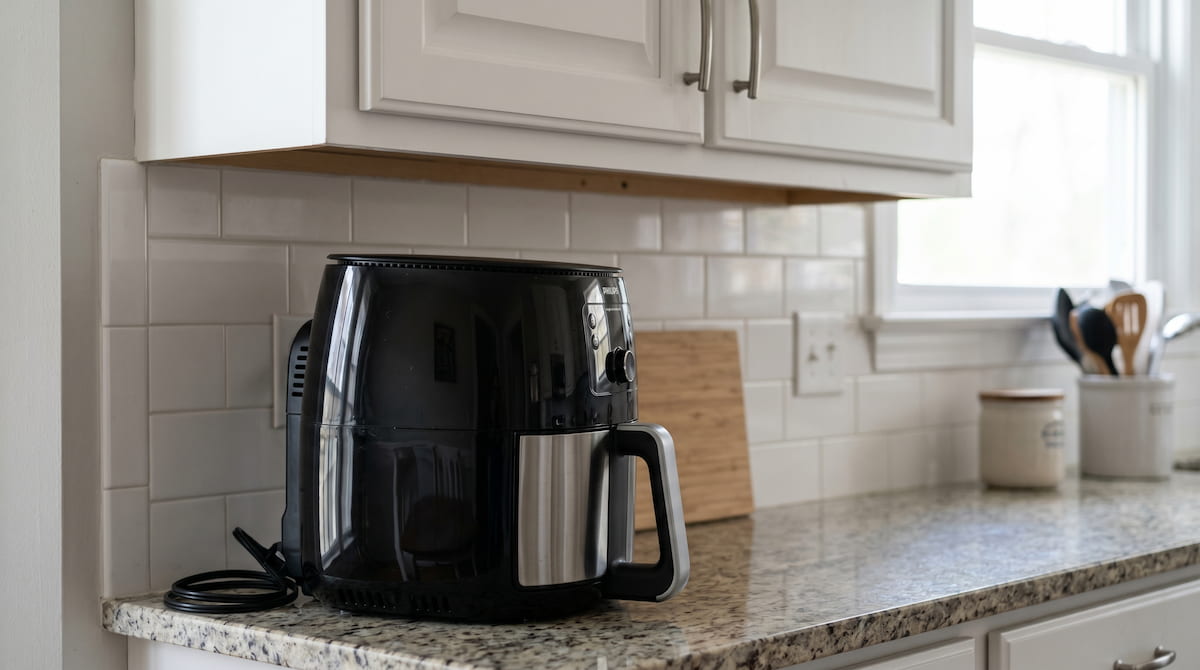
Top clearance between the air fryer and upper cabinet is one of the most commonly overlooked placement requirements.
What Happens If You Don’t Leave Enough Space?
Insufficient clearance creates a cascade of problems:
- Reduced cooking performance: Blocked vents mean the unit can’t circulate air efficiently — food takes longer and cooks less evenly
- Unit overheating: Thermal protection may trigger shutoffs mid-cooking — frustrating and a sign of a real problem
- Cabinet or surface damage: Heat buildup above the unit damages cabinet finishes, melts plastic shelf liners, and can warp wooden surfaces over time
- Increased smoke detector sensitivity: Trapped cooking air concentrates near the unit rather than dispersing — makes smoke detector triggers more likely
- Fire risk with extreme restriction: Completely blocked rear venting with flammable materials nearby is a genuine fire hazard — not theoretical
Safe Surface Materials for Air Fryer Placement
The surface under your air fryer matters too:
- Safe: Granite, quartz, marble, stainless steel, tile — all handle air fryer heat without damage
- Safe with caution: Laminate countertops — most handle normal air fryer heat, but extended use directly on laminate can cause discoloration over time. A silicone mat underneath protects the surface.
- Use a heat mat: Wooden countertops, butcher block — always use a heat-resistant silicone or trivet mat underneath
- Never use: Cloth placemats, paper, plastic cutting boards, or any flammable material under the unit
Quick Safety Checklist: Air Fryer Space Requirements
✅ Safe placement setup:
- 5–6 inches rear clearance from wall
- 3–4 inches side clearance on each side
- 8–10 inches top clearance from upper cabinet
- 12–15 inches front clearance for basket pull-out
- Flat, level, heat-resistant surface
- No flammable materials nearby
⚠️ Use with caution:
- Laminate countertops — use silicone mat underneath
- Wooden countertops — always use heat-resistant mat
- Tight galley kitchens — measure all clearances before permanent placement
❌ Never place:
- Flush against a wall — blocks exhaust vent
- Directly under a low upper cabinet with less than 8 inches clearance
- On cloth, paper, or plastic surfaces
- Next to open flame gas burners
- On an unstable or uneven surface
FAQ
How much space should you leave around an air fryer?
At minimum: 5–6 inches rear clearance, 3–4 inches side clearance on each side, and 8–10 inches top clearance from any upper cabinet or shelf. These clearances ensure proper ventilation, prevent overheating, and protect surrounding surfaces from heat damage.
Can I put an air fryer under a cabinet?
Only if there’s at least 8–10 inches of clearance between the top of the unit and the bottom of the cabinet. Less than 8 inches of top clearance risks heat damage to the cabinet and reduces cooking performance from blocked hot air dispersal.
Can I put an air fryer against a wall?
No — the exhaust vent at the rear of the unit needs at least 5–6 inches of clearance from any wall. Placing an air fryer flush against a wall blocks this vent, causes overheating, and can damage the wall surface from heat buildup.
What surface should I put my air fryer on?
Granite, quartz, marble, tile, or stainless steel countertops are ideal. For laminate, use a silicone mat underneath. For wooden or butcher block surfaces, always use a heat-resistant mat or trivet. Never place on cloth, paper, or plastic surfaces.
Can two air fryers be placed next to each other?
Yes — with adequate side clearance between them. Maintain at least 3–4 inches of separation between units, and ensure each unit also has its own rear and top clearance. Running two units simultaneously increases total heat output — additional ventilation is recommended. For our complete safe kitchen setup guide visit the PFAS-free air fryer guide.