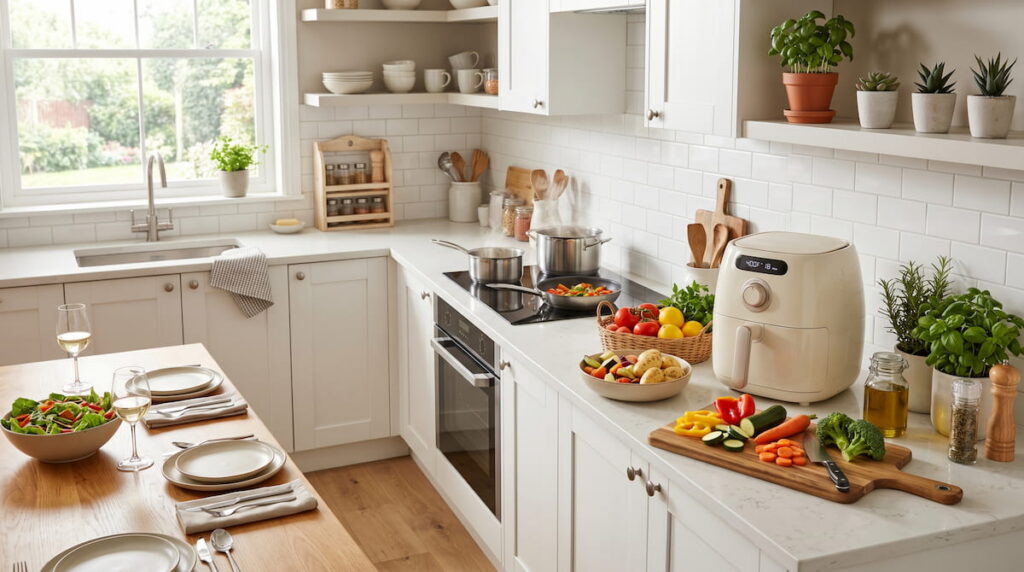
This complete non toxic air fryer guide families need covers everything in one place — safe basket materials, top product picks, accessories, ventilation, cleaning, and the red flags to avoid when buying. If you’re building a genuinely non-toxic kitchen setup for your family, this is the reference guide to bookmark.
Why Non-Toxic Air Fryer Cooking Matters for Families
Families cook daily — often multiple times a day. The cumulative exposure from repeated cooking sessions in a standard nonstick air fryer adds up in ways that occasional use doesn’t. PTFE coatings that degrade with heat, plastic components that off-gas in small kitchens, and unspecified “non-stick” coatings on budget models all contribute to indoor air quality concerns that ceramic, glass, and stainless steel eliminate entirely.
For households with young children, pet birds, or anyone with respiratory sensitivities, the material question isn’t academic — it’s a practical daily health decision. This guide gives you the information to make that decision clearly. For the science behind why coating material matters, the EPA’s PFAS overview is the most reliable starting point.
Part 1: The Three Safe Air Fryer Materials
Ceramic Coating
Ceramic-coated baskets contain no PTFE, PFOA, or PFAS-related compounds. The ceramic surface is chemically stable at cooking temperatures, doesn’t degrade in the same way nonstick does, and is the most practical non-toxic option for everyday basket-style air frying. Look for explicit PTFE-free, PFOA-free, and PFAS-free disclosure on the product listing — not just “ceramic non-stick” without further specification.
Stainless Steel
Stainless steel interiors — found in oven-style units like the Instant Pot Omni Plus — have no coating at all. Nothing to degrade, nothing to scratch, no chemical surface to wear over time. The most durable non-toxic option and the best choice for families cooking large volumes daily.
Glass
Glass cooking chambers — found in the Big Boss 16Qt — are the most chemically inert option available. No coating, no reaction with acidic foods, no degradation timeline. The purest material choice for households with chemical sensitivities or anyone who wants zero coating variables in their cooking environment.
| Material | PFAS-Free? | Coating Risk | Best For |
|---|---|---|---|
| Ceramic coating | ✅ Yes | Minimal — wears over 2–3 years | Daily basket-style cooking |
| Stainless steel | ✅ Yes | None — no coating | Large families, oven-style cooking |
| Glass | ✅ Yes | None — chemically inert | Maximum material safety |
| Standard nonstick (PTFE) | ❌ No | Degrades with heat and scratching | Avoid for daily family cooking |
Part 2: Our Top Non-Toxic Picks for Families in 2026
Best Compact: Ninja AF150AMZ
The most practical starting point for families switching from nonstick. Ceramic basket, PFAS-free, compact 5-quart size, simple controls, dishwasher-safe basket. Best for households of 2–4 people cooking daily. The most extensively reviewed ceramic basket fryer on the market with a strong real-world performance track record.
Best for Larger Families: Instant Pot Omni Plus 18L
Fully stainless steel interior — no coating anywhere in the cooking chamber. 18-liter capacity handles whole chickens, large batches, and multi-tier cooking. 11 cooking functions make it a complete kitchen appliance replacement. Best for families of 4+ cooking large volumes daily.
Best for Maximum Safety: Big Boss 16Qt Glass Air Fryer
Glass cooking bowl, stainless steel rack — no coating of any kind in the food contact zone. The most chemically inert option available. Best for households with chemical sensitivities, pet birds, or young children where eliminating every coating variable is the priority.
Best for Speed: Cosori TurboBlaze 6Qt
Ceramic basket, PFAS-free, faster preheat and cook times than most competitors. 6-quart capacity handles family portions in one batch. Best for busy households where cooking speed matters as much as material safety.
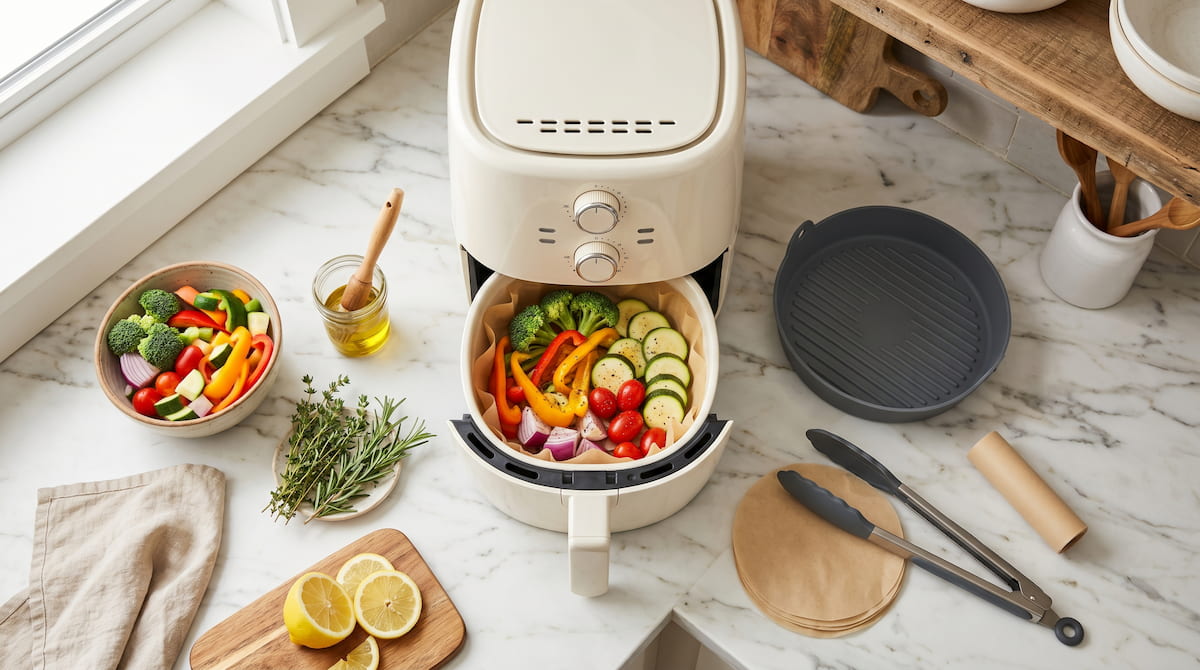
A complete non-toxic air fryer setup — ceramic unit, food-grade silicone liner, stainless tongs, and unbleached parchment for sticky foods.
Part 3: Safe Accessories for a Non-Toxic Setup
The basket isn’t the only thing that touches your food. A complete non-toxic kitchen setup extends to every accessory in the cooking chain:
- Liners: Food-grade perforated silicone liners for daily use (see silicone liners), unbleached perforated parchment for saucy foods (see parchment liners)
- Tongs: Stainless steel with silicone tips — protects ceramic basket surface from scratches
- Racks: Stainless steel only — avoid chrome-plated or nonstick-coated racks
- Skewers: Stainless steel — never bamboo above 350°F in an air fryer
- Baking dishes: Oven-safe ceramic ramekins, stainless steel mini pans, or food-grade silicone molds
- Oil mister: Refillable stainless steel mister — aerosol cooking sprays damage ceramic coatings
Part 4: Ventilation and Safe Kitchen Setup
Even a ceramic basket air fryer produces cooking steam, grease vapor, and heat that need proper management:
- Open a window or run range hood fan during every cooking session
- Rear clearance: 5–6 inches minimum from any wall
- Top clearance: 8–10 inches minimum from any upper cabinet
- Side clearance: 3–4 inches on each side
- Continue ventilating 10 minutes after cooking ends
- HEPA air purifier for small apartments or closed kitchens
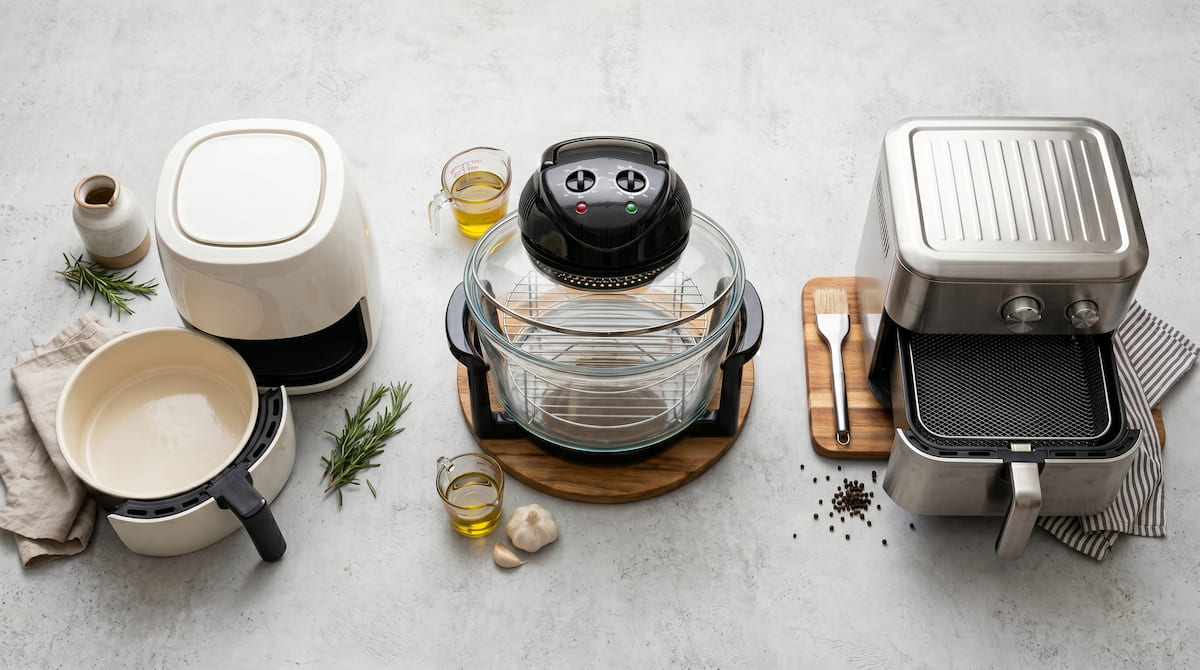
The three safe material categories for family air fryer cooking — ceramic basket, glass bowl, and stainless steel interior.
Part 5: Cleaning and Maintenance for Long-Term Safety
A well-maintained non-toxic air fryer stays safe longer. Here’s the maintenance schedule that matters:
- After every use: Wash ceramic basket with warm soapy water or dishwasher
- Every 2–4 weeks: Wipe exhaust vent and interior walls
- Monthly: Clean heating element with soft brush when fully cooled
- Every 3–6 months: Replace charcoal filter if your model has one
- When to replace basket: Any visible flaking, deep scratches, or persistent chemical smell — don’t wait
Part 6: Red Flags When Buying
These signals indicate a unit marketed as “non-toxic” may not meet that standard:
- “PFOA-free only” — doesn’t address PTFE or other PFAS compounds
- “Healthy coating” without specifying ceramic, stainless, or glass
- No material specification on the product listing
- Very low price for a claimed “ceramic” basket
- Brand doesn’t disclose coating composition when asked
Complete Non-Toxic Air Fryer Family Checklist
✅ Your complete non-toxic setup:
- Ceramic, stainless, or glass cooking surface — verified PTFE-free, PFOA-free, PFAS-free
- Right capacity for household size
- Food-grade silicone liner for daily use
- Unbleached parchment for saucy or acidic foods
- Stainless tongs with silicone tips
- Stainless steel rack if cooking large batches
- Refillable oil mister — no aerosol sprays
- Window open or range hood running during cooking
- 5–6 inches rear clearance, 8–10 inches top clearance
- Monthly heating element cleaning
FAQ
What is the safest air fryer for a family in 2026?
For most families, the Ninja AF150AMZ ceramic basket is the most practical starting point. For larger families or anyone wanting stainless steel, the Instant Pot Omni Plus is the top choice. For maximum material safety, the Big Boss 16Qt Glass Air Fryer eliminates every coating variable.
Is ceramic or stainless steel safer for family cooking?
Both are genuinely safe — stainless has a slight edge as it has no coating at all, while ceramic coating is PFAS-free but does wear over 2–3 years of daily use. The practical difference for most families is minimal; both are vastly safer than standard nonstick.
Do I need special accessories for a non-toxic air fryer?
The basket material is the most important factor, but accessories matter too. Food-grade silicone liners, stainless tongs with silicone tips, and stainless steel racks complete a non-toxic setup without introducing chemical concerns through the accessory chain.
How do I know if my current air fryer is non-toxic?
Check the basket material — does the product listing explicitly state ceramic, stainless steel, or glass? Does it say PTFE-free, PFOA-free, and PFAS-free? If the basket is described only as “non-stick” without further specification, assume it contains PTFE. See our guide to what makes an air fryer unsafe for the full checklist.
How long does a non-toxic air fryer last?
A ceramic basket with proper care — silicone utensils, hand washing, no aerosol sprays — lasts 2–3 years before showing significant coating wear. Stainless steel and glass have no coating to degrade and last as long as the unit’s mechanical components. The full lifespan breakdown is in our guide on how long air fryers last safely. For our full product comparison visit the PFAS-free air fryer guide.