
Air fryer breathing safety is something most families never think about — until they notice a chemical smell, a hazy kitchen, or a persistent headache after cooking. The air around an air fryer isn’t always as clean as it looks, and what you’re breathing during and after cooking depends significantly on what your basket is made of.
When my wife started keeping the kitchen window open every time she used our old air fryer, I figured it was just a preference. After looking into what air fryers actually release into the air, I realized she was onto something. This guide covers what’s actually in the air near an air fryer, who’s most at risk, and what practical steps make a real difference.
What Does an Air Fryer Release Into the Air?
Air fryers release several types of airborne compounds during normal operation. The concern level varies based on basket material, temperature, and cooking habits.
| Airborne Compound | Source | Risk Level |
|---|---|---|
| VOCs (volatile organic compounds) | Heated coatings, oil residue | ⚠️ Moderate with PTFE baskets |
| Ultrafine particles | High-heat cooking, burnt grease | ⚠️ Moderate — penetrate deep into lungs |
| Acrolein | Overheated cooking oil | ⚠️ Irritant to eyes and airways |
| PTFE decomposition byproducts | Damaged or overheated Teflon coating | ❌ High — linked to polymer fume fever |
| Steam and water vapor | Normal food moisture release | ✅ Safe — no health concern |
According to the EPA’s indoor air quality research, cooking is one of the leading contributors to elevated VOC and ultrafine particle levels inside homes. In a closed kitchen, these compounds can accumulate quickly — especially during high-heat air fryer sessions.
Who Is Most at Risk From Air Fryer Fumes?
Most healthy adults with a ventilated kitchen face a relatively low day-to-day risk from normal air fryer use. The concern rises significantly for specific groups:
- Children — breathe faster relative to body weight and spend more time at floor level where some particles settle
- People with asthma or respiratory conditions — airway inflammation makes them more sensitive to ultrafine particles and VOCs. Our guide on air fryer safety for asthma covers this in more detail
- Elderly family members — reduced lung capacity means less tolerance for airborne irritants
- Pet birds — birds have highly efficient respiratory systems that make them acutely sensitive to PTFE fumes specifically. Even low-level exposure can be fatal
- Pregnant women — developing fetuses may be more vulnerable to chemical exposure through maternal inhalation
If any of these apply to your household, choosing a PTFE-free basket material isn’t just a preference — it’s a meaningful safety decision.
Air Fryer Breathing Safety Checklist
✅ Your kitchen air is likely safe if:
- Your air fryer has a ceramic-coated, stainless steel, or glass interior
- The basket shows no scratches, peeling, or discoloration
- You cook with a window open or range hood running
- No chemical smell is present during or after cooking
- You clean the basket after every use to prevent grease buildup
⚠️ Pay attention if:
- You notice a faint chemical or plastic odor during cooking
- Your kitchen feels hazy or stuffy after a cooking session
- Family members mention headaches or eye irritation after meals
- Your air fryer basket coating is more than 2–3 years old with daily use
❌ Stop using and replace if:
- Coating is visibly flaking, peeling, or scratched through to bare metal
- Strong chemical smell occurs at normal cooking temperatures
- Anyone in the household experiences respiratory symptoms after cooking
- You cannot confirm the basket is PTFE-free from the manufacturer
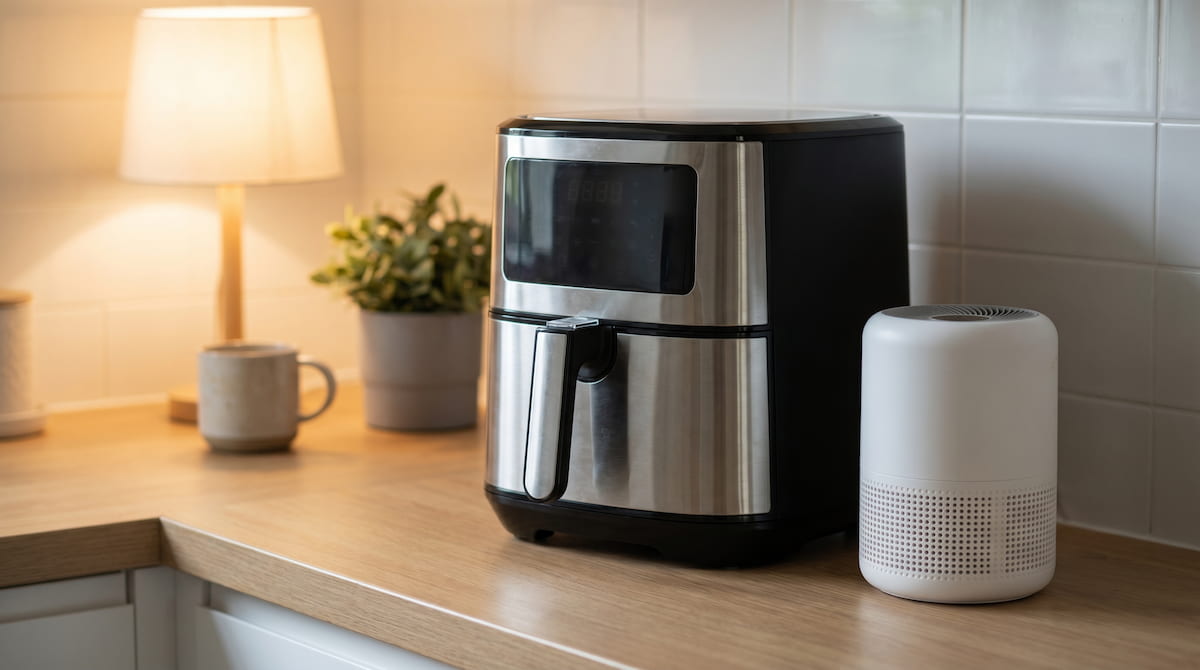
A HEPA air purifier near the cooking area can help capture ultrafine particles released during air fryer use.
Does Basket Material Affect Breathing Safety?
Significantly. This is the single most controllable factor in air fryer breathing safety, and it’s why material choice matters more than most buyers realize.
PTFE-based nonstick coatings — the most common type in budget and mid-range air fryers — begin to degrade and off-gas more readily when the coating is scratched or pushed above its stable temperature range. The compounds released at that point are what create genuine breathing risk, particularly in enclosed spaces.
Ceramic-coated baskets are PTFE-free and PFAS-free. Even under heat stress, they don’t release the same class of fluorinated compounds. Our detailed breakdown of air fryer VOC emissions by material covers exactly how these differ.
For families who want the lowest possible inhalation risk, stainless steel interiors and glass cooking chambers are the safest options — no coating means nothing to degrade or off-gas.
How to Improve Air Fryer Breathing Safety at Home
- Switch to a ceramic or glass-interior model — this addresses the root cause rather than just managing symptoms
- Always ventilate — open a window, run the range hood, or use a small fan directed toward an open vent. See our full kitchen ventilation guide for air fryer use
- Use a HEPA air purifier in the kitchen — captures ultrafine particles that ventilation alone may not fully clear
- Keep cooking temperatures moderate — 350–380°F handles most recipes with significantly less coating stress than 400°F+
- Clean the basket after every use — grease residue burning on a coating surface is the most avoidable source of airborne compounds
- Use parchment or silicone liners — reduces direct oil contact with the basket, cutting down on burn-off particles
- Inspect the basket monthly — catching coating damage early is the simplest way to prevent exposure from degrading surfaces

Running the range hood during air fryer use is one of the most effective ways to maintain safe air quality in your kitchen.
Which Air Fryer Is Safest for Breathing?
Our family uses the Ninja AF150AMZ — its ceramic-coated basket is verified PTFE-free and PFAS-free, which directly eliminates the main source of coating-related inhalation risk. For households with children or anyone with respiratory sensitivity, that material difference matters every single day.
For the absolute lowest inhalation risk, the Big Boss 16Qt glass air fryer is worth considering — a glass cooking chamber produces no coating off-gassing whatsoever, making it the safest option from a pure breathing safety standpoint.
For a full comparison of safe materials, see our PFAS-free air fryer guide.
See Ninja AF150AMZ on Amazon → See Big Boss Glass Air Fryer on Amazon →Frequently Asked Questions
Is it safe to stand next to an air fryer while it’s cooking?
For most people with a ventilated kitchen and a non-toxic basket, yes. The main risk comes from prolonged exposure in a sealed room with a degrading PTFE coating. Keep a window open and you significantly reduce any risk from standing nearby during cooking.
Can air fryer fumes cause lung damage?
Repeated long-term exposure to PTFE decomposition byproducts at high concentrations is associated with polymer fume fever — flu-like respiratory symptoms. This is rare under normal home cooking conditions but more plausible with a heavily used, scratched nonstick basket in a poorly ventilated space.
Are ceramic air fryers safer to breathe around?
Yes. Ceramic coatings don’t contain PTFE or PFAS, so they don’t release fluorinated compounds under heat. They still produce some food-related particles during cooking, but the coating itself is far less reactive than traditional nonstick.
Should I use an air purifier with my air fryer?
It’s a useful addition, especially for families with asthma, allergies, or young children. A HEPA purifier positioned near the cooking area captures ultrafine particles that ventilation alone may not fully address.
How long do air fryer fumes linger in a kitchen?
In a well-ventilated kitchen with an open window, most cooking-related particles and VOCs clear within 15–30 minutes after cooking ends. In a closed kitchen, they can persist for an hour or more — another reason ventilation during cooking matters.
The Bottom Line on Air Fryer Breathing Safety
Air fryer breathing safety comes down to two things: what your basket is made of, and how well your kitchen is ventilated. A ceramic or glass-interior model in a ventilated kitchen presents minimal inhalation risk for the vast majority of families. A degrading PTFE basket in a closed room is a different situation entirely.
If you’re ready to evaluate safer options, our PFAS-free air fryer guide covers the safest ceramic, stainless, and glass models available in 2026 — with honest comparisons at every price point.