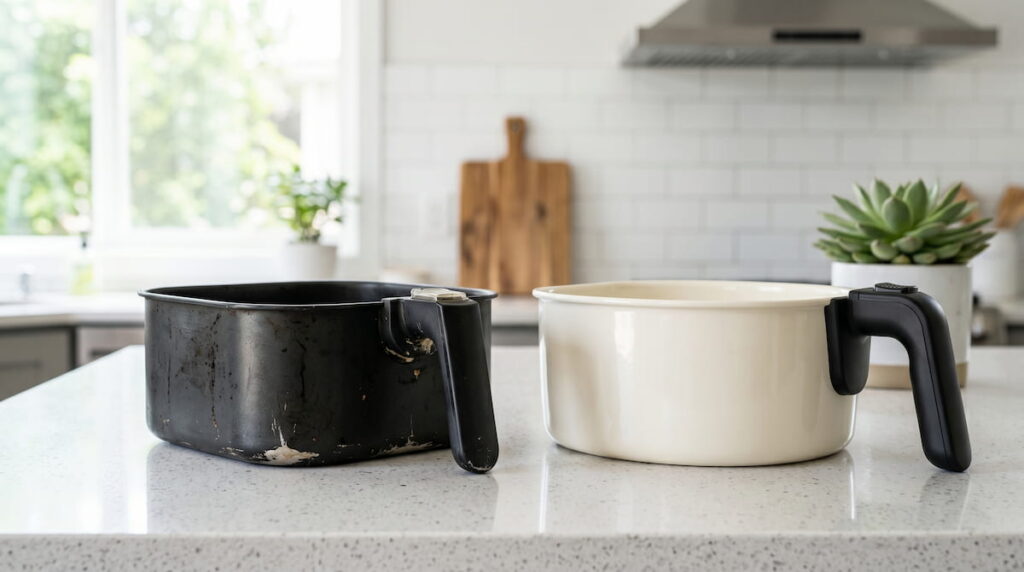
Air fryer coating last is a question most families don’t ask until the basket is already showing wear — and by that point, the coating has often been degrading for weeks without anyone realizing it. Understanding the realistic lifespan of each coating type, and recognizing the warning signs early, is what separates a safe kitchen from one that’s quietly exposing your family to compounds they don’t need to be around.
I replaced two nonstick baskets in three years before switching our household to ceramic. Here’s the honest timeline for every coating type, and exactly when replacement becomes a safety issue rather than just a convenience one.
How Long Does Air Fryer Coating Last by Material Type?
| Coating Type | Average Lifespan | Risk When Worn | Replacement Urgency |
|---|---|---|---|
| PTFE nonstick (standard) | 1–2 years daily use | ❌ Fluorinated particles in food | Immediate when scratched |
| Ceramic-coated | 2–4 years with care | ⚠️ Reduced nonstick only | When performance drops |
| Stainless steel | 5+ years | ✅ No coating to degrade | No coating-related replacement |
| Glass | 5+ years | ✅ No coating at all | No coating-related replacement |
The numbers above assume normal daily use — cooking once per day at temperatures between 350–400°F, hand washing, and using silicone utensils. Push those conditions harder and the timeline compresses. A PTFE basket used twice daily at high heat with metal tongs and dishwasher cleaning can show meaningful wear in under six months.
What Most People Get Wrong About Coating Lifespan
The most common mistake is measuring coating life in years rather than condition. A basket used gently every other day in a careful household might last four years. The same model used daily with metal utensils and regular dishwasher cycles might need replacing in eight months. Calendar time is less useful than a monthly visual inspection.
The second mistake is treating all coating wear as equivalent. When a ceramic coating wears, you lose nonstick performance — an inconvenience. When a PTFE coating wears, you get fluorinated particle release into food and air — a different category of concern entirely. Understanding which coating you have changes how urgently you need to respond to early signs of wear. Our guide on what happens when air fryer coating gets scratched covers this distinction in full detail.
The third mistake is assuming that because food still releases from the basket, the coating is still intact. PTFE coatings can be degrading and releasing compounds at the microscopic level before any visible change in nonstick performance appears. The smell test — a chemical or plastic odor during cooking — is often the first warning, not a visual one. Our guide on air fryer burnt plastic smell explains exactly what that odor indicates.
What Shortens Air Fryer Coating Life
These four habits are responsible for the majority of premature coating failures:
- Metal utensils — tongs, forks, and spatulas with metal tips create micro-scratches every single use. On PTFE, those scratches are the starting point of degradation. On ceramic, they accelerate surface wear. Silicone or wooden utensils only
- Dishwasher cycles — even “dishwasher-safe” baskets wear faster in the machine. Harsh detergents and high drying heat both stress the coating surface. Hand washing extends coating life noticeably on any material
- Aerosol cooking sprays — these leave a sticky polymer residue that builds up on the coating and requires increasingly aggressive scrubbing to remove, which then damages the surface further
- Thermal shock — washing a hot basket under cold water creates rapid temperature stress at the coating-metal bond. Always let the basket cool completely before washing
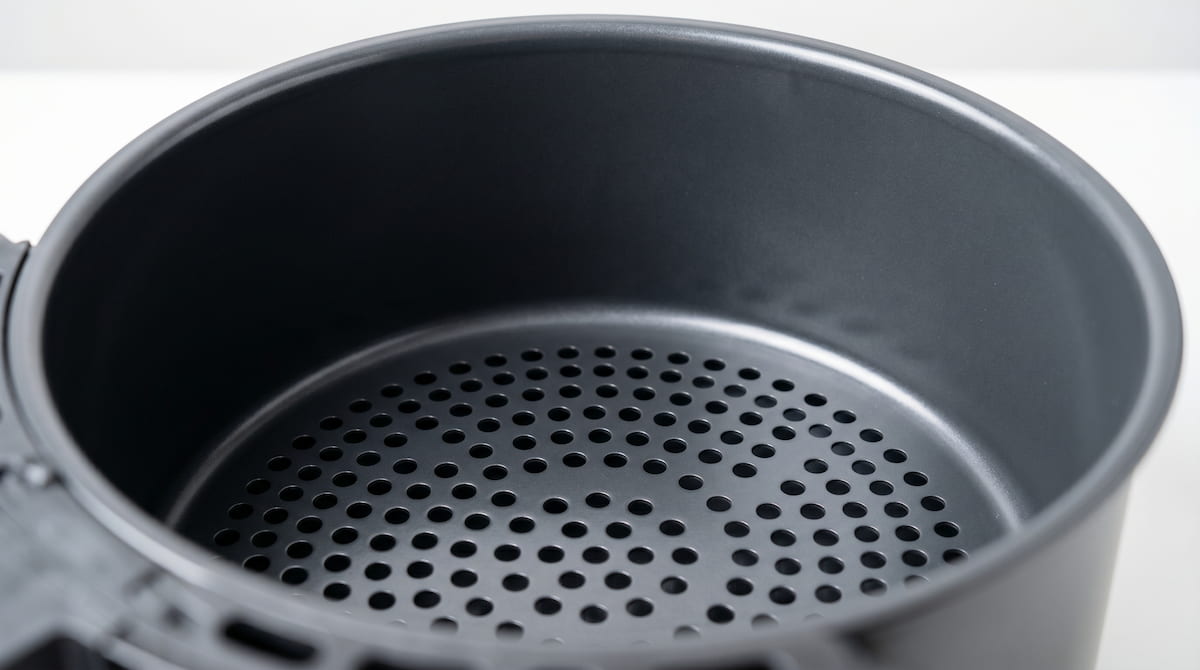
A well-maintained ceramic basket stays smooth and intact significantly longer than PTFE under the same daily cooking conditions.
Air Fryer Coating Safety Timeline
Here’s how the safety picture changes over time for a typical PTFE-coated basket under daily household use:
| Time Period | Typical Condition | Safety Status | Action |
|---|---|---|---|
| 0–6 months | Coating intact, nonstick performing well | ✅ Low concern | Maintain good habits |
| 6–12 months | Minor surface marks, still functional | ⚠️ Monitor closely | Inspect monthly, use liners |
| 12–18 months | Visible scratches, possible discoloration | ⚠️ Plan replacement | Replace within weeks |
| 18+ months | Coating degrading, possible flaking | ❌ Replace immediately | Stop using — upgrade now |
Warning Signs Your Coating Needs Replacing Now
✅ Still within safe use range:
- Surface smooth and intact with no visible scratches
- Food releases easily without extra oil
- No chemical smell during or after cooking
- Color consistent across the entire basket interior
⚠️ Warning signs — inspect and plan replacement:
- Visible surface scratches even without flaking
- Food beginning to stick in spots where it didn’t before
- Dull patches or color inconsistency on the coating surface
- Occasional faint chemical smell during high-heat cooking
❌ Replace immediately — no exceptions:
- Visible flaking or peeling anywhere on the basket interior
- Bare metal visible through coating damage
- Persistent chemical or plastic smell at normal cooking temperatures
- Dark bubbling or blistering on the coating surface
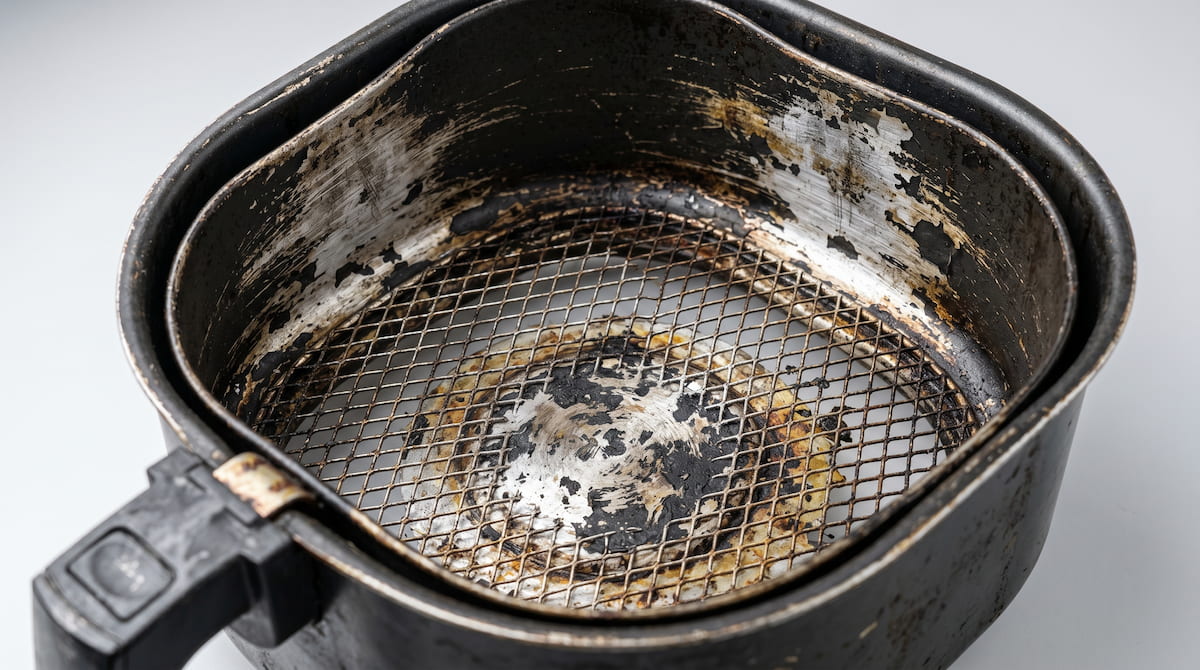
Discoloration, scratching, and visible wear like this are signs the coating has passed its safe useful life — replacement is the right call, not continued use with liners.
How to Make Any Air Fryer Coating Last Longer
- Hand wash after every use — warm water, mild soap, soft sponge. Never abrasive scrubbers
- Let the basket cool completely before washing — thermal shock accelerates coating bond stress
- Use silicone or wooden utensils exclusively — no metal ever touches the coating surface
- Use parchment or silicone liners — reduces direct food and oil contact with the basket, cutting down on residue buildup and the scrubbing required to remove it
- Skip aerosol sprays — brush a small amount of oil directly onto food instead
- Store the basket separately — don’t nest it inside metal pots or pans
- Inspect monthly — a quick visual check under bright light catches early wear before it becomes a safety issue
When to Upgrade Instead of Just Replace
If you’re replacing a PTFE nonstick basket for the second time, that’s the signal to evaluate whether a coating-free option makes more sense going forward. Ceramic baskets last 2–4 years with proper care and don’t carry the fluorinated particle release concern when they eventually wear. Stainless steel and glass interiors eliminate the coating lifespan question entirely — there is nothing to degrade, scratch, or replace on a coating timeline.
Our family switched to the Ninja AF150AMZ after the second PTFE replacement. Its ceramic-coated basket is PTFE-free and PFAS-free — and after well over a year of daily use, the surface is still visibly intact. For families who want to eliminate the coating variable entirely, the Big Boss 16Qt glass air fryer has a borosilicate glass cooking chamber with no coating of any kind.
See Ninja AF150AMZ on Amazon → See Big Boss Glass Air Fryer on Amazon →Frequently Asked Questions
How long does air fryer coating last with daily use?
PTFE nonstick coatings typically last 1–2 years with daily use before degradation becomes a safety concern. Ceramic coatings last 2–4 years with proper care. Stainless steel and glass have no coating to degrade and can last 5+ years under normal use without any coating-related replacement concern.
How do I know when my air fryer coating needs replacing?
The clearest signals are visible scratches exposing the basket material beneath the coating, persistent food sticking where it didn’t before, dark discoloration that won’t wash off, any flaking or peeling, or a chemical smell during normal cooking. Any one of these means replacement is the right call.
Does coating type affect how long it lasts?
Significantly. Ceramic coatings are harder than PTFE and more resistant to heat degradation — they typically last twice as long under equivalent conditions. More importantly, their failure mode is different: worn ceramic loses nonstick performance, while worn PTFE releases fluorinated particles. The urgency of replacement is higher for PTFE on both durability and safety grounds.
Can I extend my air fryer coating life with liners?
Yes — parchment and silicone liners reduce direct oil and food contact with the basket surface, cutting down on residue buildup and the scrubbing cycles that cause micro-scratches. They won’t reverse existing damage, but they meaningfully extend the life of an intact coating by reducing the stress it experiences each cook.
Is it worth replacing the basket or buying a new air fryer?
If your model sells replacement baskets and you’re otherwise happy with it, a basket replacement is cost-effective for the first replacement. If you’re replacing a PTFE basket for the second time, use it as an opportunity to upgrade to a ceramic or stainless model — you’ll avoid the same replacement cycle in another year or two.
How often should I inspect my air fryer basket?
Once a month under bright light is enough for most households. Look for surface scratches, dull patches, discoloration, and any area where the coating looks thinner or different from the surrounding surface. Catching early wear before it becomes visible flaking is the goal — not waiting until the damage is obvious.
The Bottom Line on Air Fryer Coating Lifespan
Air fryer coating last depends on material type and maintenance habits more than calendar time. PTFE baskets need monitoring from the start and replacement at the first sign of meaningful wear — the failure mode carries chemical risk. Ceramic baskets offer a longer and safer lifespan with the same care habits. Stainless and glass eliminate the coating lifespan question entirely.
For a full comparison of the longest-lasting and safest basket materials in 2026, our PFAS-free air fryer guide covers ceramic, stainless, and glass options side by side. And for more on the specific safety timeline for scratched coatings, our guide on Ninja ceramic basket safety covers real-world durability and maintenance in detail.