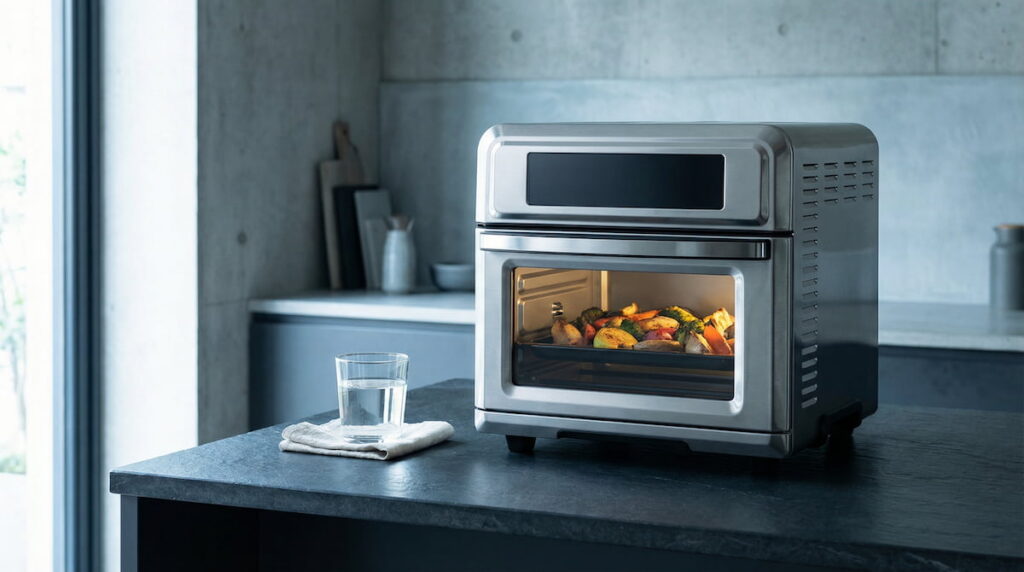
When I first started looking into safer air fryer options, stainless steel kept coming up. People in forums, in YouTube comments, in product reviews — a lot of them pointed to stainless steel as the safest choice because it has no coating at all. No coating means nothing to flake, nothing to off-gas, nothing to wonder about.
But I wanted to actually understand whether that was true, or just marketing language. So I spent a few weeks digging into the materials, the manufacturing differences, and what stainless steel actually means in the context of an air fryer. Here’s what I found — including where stainless steel wins, and where it has real limitations.
If you want to jump straight to options: Best PFAS-Free Air Fryers for 2026
Why Stainless Steel Gets Recommended So Often
Most standard air fryer baskets are coated with PTFE-based nonstick surfaces — the same family of materials as Teflon. Some of these were historically manufactured using PFAS chemicals. Even modern “PFOA-free” versions leave some consumers uneasy, especially when cooking at high heat every day.
Stainless steel sidesteps the whole coating question. It’s an alloy of iron and chromium — sometimes with small amounts of nickel — and it doesn’t need a chemical coating to function. The surface is naturally resistant to corrosion, doesn’t leach into food under normal cooking conditions, and doesn’t degrade the same way a nonstick layer does over time.
That’s the core appeal: no coating means no coating-related concerns.
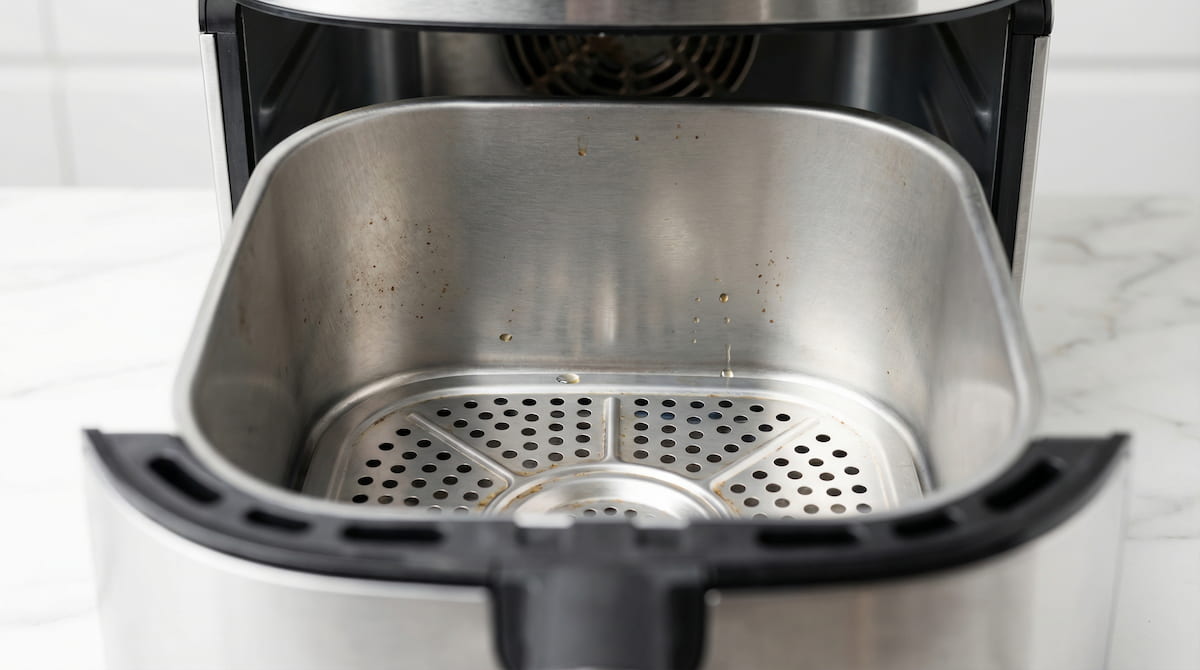
Are Stainless Steel Air Fryers Actually Safer?
For most families, yes — with some caveats worth knowing upfront.
Where stainless steel genuinely wins:
- No PTFE, no PFAS, no coating of any kind on the interior
- Doesn’t degrade with heavy use the way nonstick coatings do
- Safe at higher temperatures without off-gassing concerns
- Easier to inspect — you can see exactly what you’re cooking on
- Long lifespan with basic care
Honest limitations:
- Food sticks more without a nonstick surface — you’ll need parchment liners or a light oil spray
- True stainless steel interior models tend to be larger oven-style units, not compact basket models
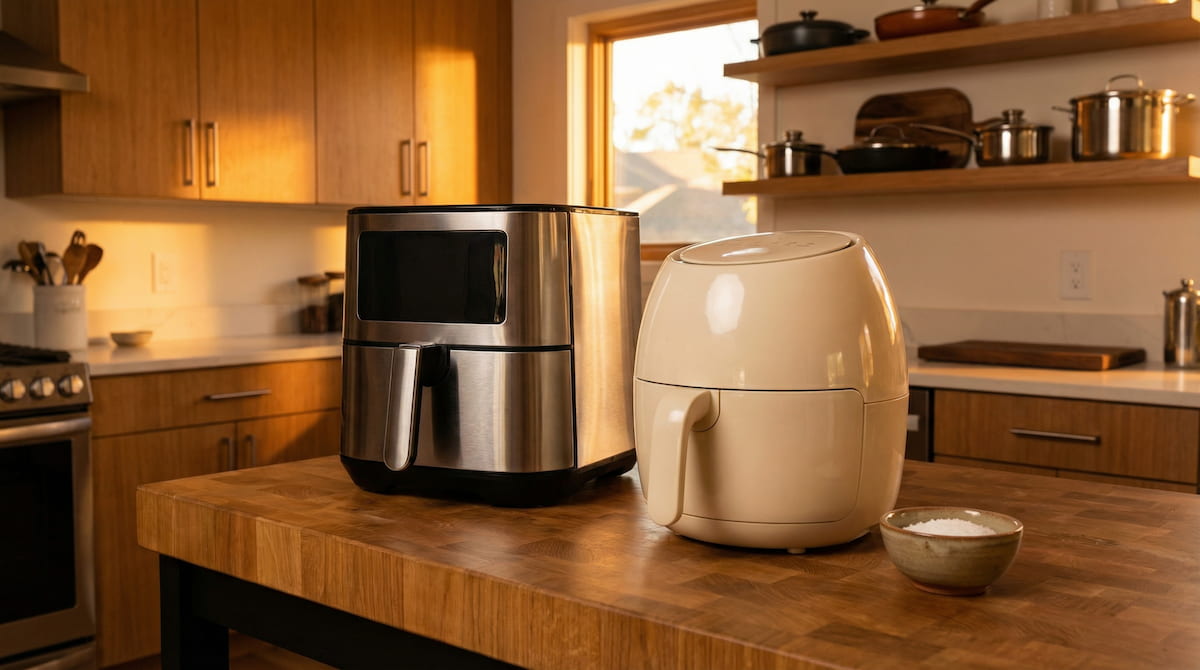
- Some air fryers marketed as “stainless steel” only have a stainless exterior — the basket inside may still be coated
- Heavier and usually more expensive than ceramic basket models
That last point tripped me up early on. I almost bought an air fryer because the outside looked like stainless steel, but the basket inside was still a nonstick-coated drawer. Always check the interior material specifically.
For a full material comparison: Ceramic vs Stainless Steel Air Fryer
PFAS-Free Options Worth Considering
After going through the research, here are the three models I’d actually point someone toward depending on what they’re looking for.
| Model | Material | Capacity | Best For |
|---|---|---|---|
| Instant Pot Omni Plus | Stainless steel interior | 26 QT | Family-sized coating-free cooking |
| Ninja AF150AMZ | Ceramic-coated basket | 5.5 QT | Compact everyday PFAS-free cooking |
| Big Boss 16Qt | Glass bowl | 16 QT | Fully coating-free cooking |
Instant Pot Omni Plus — Best Stainless Steel Pick
This is the model I point people toward when they specifically want to avoid coatings entirely. The interior is stainless steel — no nonstick layer, no PFAS, nothing to chip or degrade over time. It’s an oven-style unit with 26 quarts of capacity, so it’s built for families doing serious cooking. My wife uses ours for batch prep — multiple trays, multiple dishes at once.
Honest downside: it’s bigger than most people expect, and food does stick without parchment liners. Factor that into your workflow.
Ninja AF150AMZ — Best Ceramic Alternative
If you want something more compact and easier to use daily, the Ninja AF150AMZ is what we use for quick everyday cooking. The ceramic-coated basket is PFAS-free and holds up well without the food-sticking issue you get with raw stainless steel. At 5.5 quarts it fits easily on the counter.
Honest downside: it’s still a coating, just a safer one. Treat it carefully and replace the basket if it chips.
Big Boss 16Qt — Best Fully Coating-Free Pick
The glass bowl option is worth knowing about if you want zero coatings of any kind. No ceramic, no stainless, no nonstick — just heat-resistant glass. You can watch the food cook through the sides, which my kids actually love. It’s a halogen-style design, so it cooks a bit differently than basket models.
Honest downside: bulkier than it looks and the glass bowl needs careful handling.
What to Check Before Buying a “Stainless Steel” Air Fryer
This is something I wish I’d known earlier. Not all stainless steel air fryers are built the same way:
- Stainless exterior only — The outside shell is stainless, but the basket inside is still PTFE-coated nonstick. Very common in mid-range models.
- Stainless interior + coated basket — The oven chamber is stainless, but a removable basket or tray inside has a coating. Check what accessories come with it.
- Fully stainless interior — The entire cooking surface is stainless steel with no coating anywhere. This is what you actually want if coating-free is the goal.
Always read the product description carefully and look for explicit “stainless steel interior” language — not just “stainless steel design.”
More on materials: Safest Air Fryer Materials Guide
Frequently Asked Questions
Are stainless steel air fryers completely free of chemicals?
The cooking surface itself contains no PTFE or PFAS. Stainless steel is a metal alloy — iron, chromium, and sometimes nickel — that doesn’t require chemical coatings. Other parts like handles or exterior panels may use different materials, but the cooking interior is coating-free.
Is ceramic coating safer than stainless steel?
Both are significantly safer than traditional PTFE nonstick. Ceramic is mineral-based and PFAS-free, while stainless steel has no coating at all. Stainless steel has a slight edge in long-term durability since there’s no surface layer to chip or degrade. Ceramic is more convenient day-to-day because food doesn’t stick as easily.
Do stainless steel air fryers cook differently?
The cooking method is the same — hot air circulation. The difference is that food sticks more to raw stainless steel, so you’ll want to use parchment liners, silicone mats, or a light coating of oil. For most families, this is a minor adjustment rather than a dealbreaker.
Can I use a stainless steel air fryer every day?
Yes. Stainless steel is more durable for heavy daily use than ceramic-coated surfaces, since there’s no coating to wear down over time. Regular cleaning keeps it performing well long-term.
What’s the safest air fryer overall?
From a materials standpoint, stainless steel interior and glass bowl air fryers have the fewest coating-related concerns. For a full breakdown: Are Air Fryers Safe? Full Guide
Looking for all the best PFAS-free options in one place?
→ See the Complete PFAS-Free Air Fryer Guide for 2026
Affiliate Disclosure: This post contains affiliate links. If you purchase through our links, we may earn a small commission at no extra cost to you. We only recommend products we’ve genuinely researched and believe are worth considering.