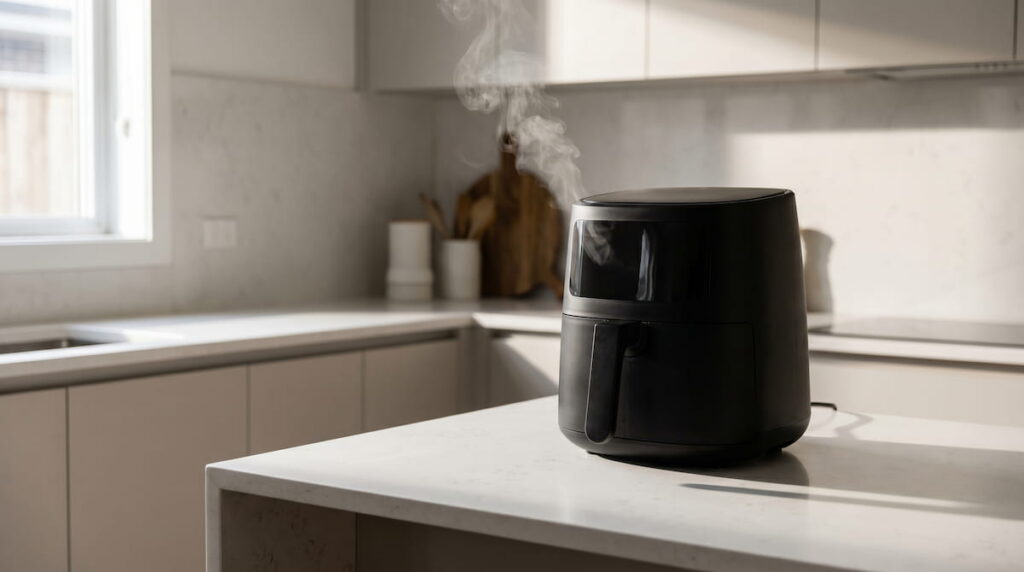
If your air fryer smells like burning plastic, you’re right to be concerned — and you’re not alone. I’m Wook, a bus driver and dad who cooks for my family almost every night. When our air fryer started producing a faint burning plastic smell around the six-month mark, I went down a research rabbit hole trying to figure out whether it was normal, fixable, or a sign we needed to replace the unit immediately.
Here’s everything I found — including the one cause that made me replace ours without hesitation.
Is a Burning Plastic Smell From an Air Fryer Normal?
A mild smell during the first 1–3 uses of a brand new air fryer is normal — manufacturing residues burning off during initial heating. But if your air fryer smells like burning plastic after months of regular use, that is not normal. That’s a different problem entirely, and it needs to be identified quickly.
Why Does My Air Fryer Smell Like Burning Plastic? 6 Causes
1. Degrading Nonstick Coating (Most Serious)
This is the cause that matters most. Traditional nonstick coatings — particularly PTFE-based coatings — begin to break down with heat and wear over time. As the coating degrades, it produces a distinct burning plastic or chemical smell during cooking. This isn’t just unpleasant — it’s a sign the coating is off-gassing directly into your food and kitchen air.
According to the U.S. EPA, PFAS chemicals found in traditional nonstick coatings are persistent in the body and environment, with ongoing research into long-term health effects. A coating that’s visibly worn and producing smells should be treated as a replacement trigger, not a cleaning problem.
2. Grease Buildup on the Heating Element
Grease that accumulates on the heating element burns at high temperature and produces a smell that can closely mimic burning plastic. This is more fixable — a thorough cleaning of the heating element with a soft brush often resolves it. If the smell disappears after cleaning, grease was the culprit. If it returns within a few uses, look at the coating.
3. Food Residue Trapped in the Unit
Small food particles that work their way into gaps between the basket and the unit can carbonize over time and produce a persistent burning smell. Deep cleaning all components — including the interior walls and the gap around the heating element — can resolve this.
4. External Plastic Components Overheating
If the air fryer is placed too close to a wall, cabinet, or another heat source, the external plastic housing can overheat and produce a burning smell. Check that you have at least 5 inches of clearance on all sides. If the smell is coming from the outside of the unit rather than the basket area, this is likely the cause.
5. Aerosol Spray Residue
Aerosol cooking sprays leave a sticky film on basket surfaces that builds up over months and burns at air fryer temperatures. This residue can smell distinctly chemical or plastic-like. Switching to a pump mister — or no oil at all with a ceramic basket — and doing a thorough degreasing often eliminates this smell.
6. Electrical Component Issue
A burning smell that seems to come from inside the unit rather than the basket — especially if accompanied by discoloration of the exterior or any flickering of the display — may indicate an electrical component issue. This is the most serious cause and requires immediately unplugging the unit. Do not continue using an air fryer with suspected electrical burning.
How to Tell Which Cause Is Yours
| Smell Characteristic | Likely Cause | Action |
|---|---|---|
| Smell gets worse over months | Coating degradation | Replace basket or unit |
| Smell disappears after cleaning | Grease or food residue | Deep clean regularly |
| Smell from outside the unit | Overheating plastic housing | Improve clearance |
| Chemical smell, food tastes off | Coating off-gassing | Replace immediately |
| Sharp electrical smell | Electrical component issue | Unplug, do not use |
| Sticky residue smell | Aerosol spray buildup | Degrease, switch to pump mister |
Quick Safety Checklist: When to Stop Using Your Air Fryer
✅ Safe to continue using:
- Mild smell only on first 1–3 uses of a new unit
- Smell disappears completely after deep cleaning
- No taste change in food
⚠️ Clean and monitor:
- Occasional smell that improves after cleaning
- Smell linked to specific greasy foods
- Mild smell that started after aerosol spray use
❌ Stop using immediately:
- Burning plastic smell that worsens over months
- Food tastes chemical or metallic
- Visible coating flaking or peeling
- Electrical burning smell from inside the unit
- Exterior discoloration or display flickering
What the Smell Means for Your Family’s Safety
If your air fryer food has started tasting slightly off alongside the burning plastic smell, the coating is almost certainly the source. When a nonstick coating degrades enough to produce a smell, it’s also degrading enough to release particles into food. This is the point at which continuing to use the unit becomes a genuine health concern — not just a comfort issue.
If you have pets — especially birds — in your home, a degrading coating is an even more urgent issue. PTFE fumes that are merely unpleasant to humans can be rapidly fatal to birds. For more on this, see our full guide: Ninja Air Fryer Ceramic Basket: Is It Actually PFAS-Free?
For more on what food taste changes from a degrading coating actually signal, see: Why Does My Air Fryer Food Taste Like Chemicals?
And if you’ve been noticing the plastic smell for a while and wondering whether the fumes are actually harmful, this covers it in detail: Why Does My Air Fryer Smell Like Plastic? (And Is It Dangerous?)
The Fix: What We Switched To
When our air fryer started producing that persistent burning smell around month six, we replaced the unit rather than just the basket. We switched to the Ninja AF150AMZ with its ceramic coating — no PTFE, no PFAS concerns, and after months of daily use it still doesn’t produce any chemical or plastic smell during cooking.
Ceramic coatings don’t contain the same chemical compounds as traditional nonstick surfaces, which means they don’t produce the same off-gassing smell as they wear. For a family cooking daily, that peace of mind is worth more than the cost difference. You can read the full breakdown of why the ceramic basket matters in our PFAS-free air fryer guide.
Frequently Asked Questions
Is it normal for a new air fryer to smell like burning plastic?
Yes, a mild smell during the first 1–3 uses is normal as manufacturing residues burn off. Run the unit empty at 400°F for 10–15 minutes with the kitchen ventilated. If the smell persists beyond the third use, contact the manufacturer.
Can the burning plastic smell from an air fryer make you sick?
Occasional mild smells from grease or residue are unlikely to cause illness. However, fumes from a degrading PTFE coating — particularly at temperatures above 500°F — can cause flu-like symptoms sometimes called “polymer fume fever.” If you feel unwell after using your air fryer, ventilate the space immediately and stop using the unit until you’ve identified the cause.
How do I get rid of the burning plastic smell in my air fryer?
Start with a deep clean of the basket, interior walls, and heating element. Run the unit empty once after cleaning. If the smell is gone, grease or residue was the cause. If it returns, the coating is degrading and the unit needs to be replaced.
Is a burning plastic smell dangerous for pets?
Yes — particularly for birds. PTFE fumes from degrading nonstick coatings are toxic to birds even at low concentrations and can cause rapid death. If you have birds in your home and your air fryer is producing a burning smell, move the birds to a separate well-ventilated room immediately and stop using the unit until the cause is identified.
Which air fryers don’t produce a burning plastic smell?
Ceramic-coated and stainless steel air fryers are significantly less likely to produce a burning plastic smell because they don’t contain PTFE compounds that off-gas as they degrade. Our PFAS-free air fryer guide covers the safest options currently available.
Bottom Line
An air fryer that smells like burning plastic after months of use is telling you something specific — and in most cases, it’s telling you the coating is breaking down. Grease and food residue are fixable with cleaning. Overheating housing is fixable with better clearance. But a coating that’s degrading and producing chemical smells during cooking is not a cleaning problem. It’s a replacement trigger. Act on it early and upgrade to a PFAS-free ceramic option that won’t put your family through this again.