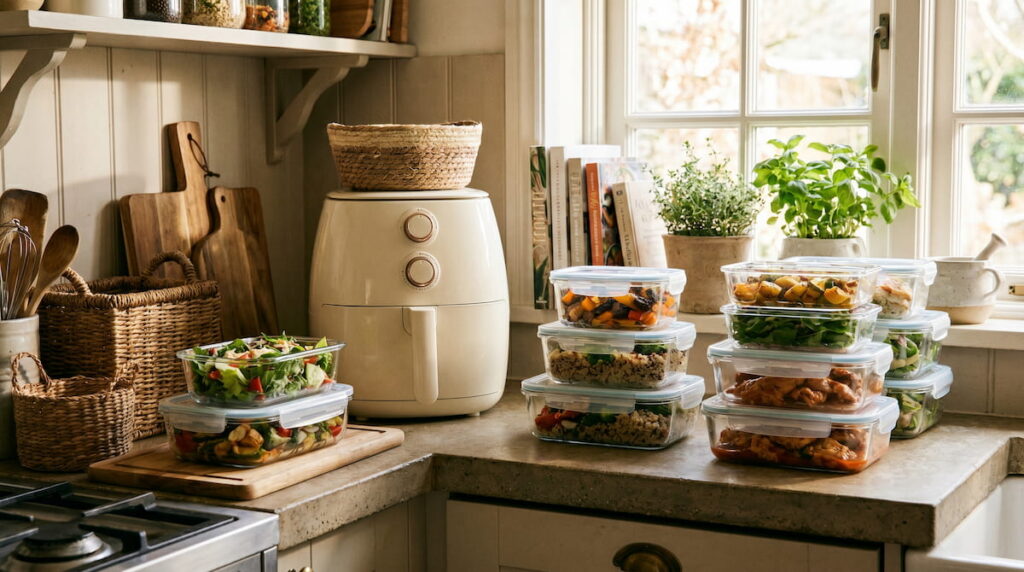
How to build non toxic kitchen on a budget is a question that stops a lot of families before they start. The assumption is that non-toxic means expensive — ceramic pans that cost $80, glass containers that cost $60 a set, appliances that run twice the price of standard models. The reality is more manageable than that. Here’s how to prioritize the swaps that give you the most safety improvement per dollar spent.
Why You Don’t Need to Replace Everything at Once
The biggest mistake families make when trying to build a non-toxic kitchen is treating it as an all-or-nothing project. It isn’t. PFAS exposure in a standard family kitchen is concentrated in a small number of high-contact, high-heat items — the air fryer basket, the everyday frying pan, and the plastic containers used for hot food storage. Replace those three things and you’ve eliminated the majority of daily PFAS exposure at a fraction of the cost of a full kitchen overhaul.
Everything else — wooden utensils, stainless steel pots, glass bakeware, cast iron — can be added gradually as budget allows and as existing items wear out. The goal isn’t a perfect kitchen on day one. It’s a meaningfully safer kitchen built progressively over months without financial strain.
How to Build Non Toxic Kitchen on a Budget: Highest Impact Swaps First
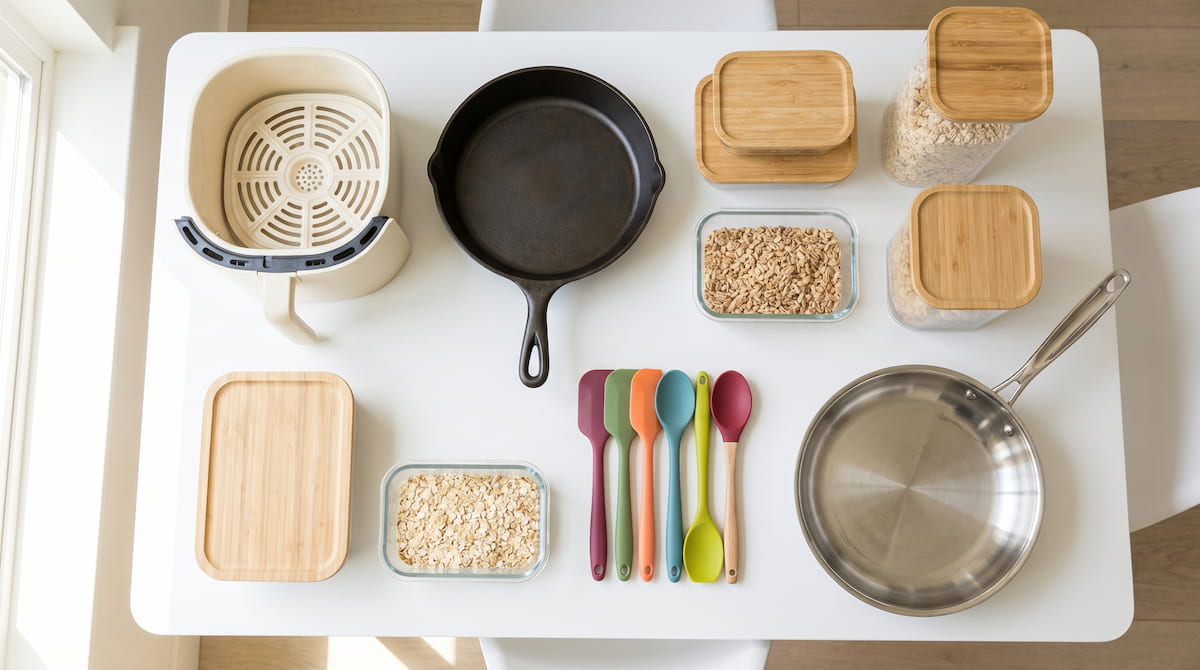
The core non-toxic kitchen essentials don’t require buying everything at once — start with the highest-impact items and build from there.
Swap 1: Air Fryer Basket — Highest Impact, One-Time Cost
If you use an air fryer regularly, the basket coating is the single highest-impact swap in your kitchen. A PTFE-coated basket running at 400°F with food in direct contact is the most concentrated daily PFAS exposure point in most family kitchens. The EPA has flagged PFAS-related compounds as an ongoing health concern — and eliminating this exposure source is worth prioritizing above everything else on this list.
The Ninja AF150AMZ has a ceramic-coated basket with no PTFE and no PFAS. It’s compact, dishwasher safe, and priced reasonably enough that it’s the most cost-effective safety upgrade available in this category. One purchase, used daily for years, covering the highest-risk cooking surface in the kitchen. This is where the budget goes first.
Swap 2: Everyday Frying Pan — High Impact, Moderate Cost
The nonstick frying pan is the second-highest priority. Used daily for eggs, proteins, and vegetables, a scratched PTFE pan is a consistent PFAS exposure source that most families don’t think about because the pan looks fine from above. The coating degradation happens on the cooking surface — the side you can’t see while the pan is on the stove.
The most budget-friendly replacement is a cast iron skillet. A quality cast iron pan costs less than most ceramic-coated alternatives, lasts indefinitely with basic care, and has no coating at all — nothing to degrade, nothing to replace, nothing to monitor. The learning curve is minimal: use slightly lower heat than a nonstick pan, add a small amount of fat to prevent sticking, and dry thoroughly after washing. Within a week of daily use, most families find the transition unremarkable.
If the texture adjustment of cast iron feels like too much, a ceramic-coated pan is the next option — same nonstick convenience, no PTFE, at a price point comparable to mid-range conventional nonstick pans.
Swap 3: Hot Food Storage Containers — High Impact, Low Cost
Plastic food containers used for storing warm food, purees, or reheating in a microwave are a consistent PFAS and plasticizer exposure source that most families replace last — and should replace much earlier. The cost of a basic glass container set is lower than most people assume, and the safety benefit is immediate: nothing migrates from glass into food regardless of temperature.
Replace the plastic containers you use most often for hot food first — the ones for soup, leftovers, and baby purees. Add glass containers incrementally as budget allows rather than replacing the entire collection at once. A set of four to six glass containers covers most daily family food storage needs and costs a fraction of a full glass container collection.
Budget Impact Table: Non-Toxic Swaps Ranked by Value
| Swap | PFAS Impact | Relative Cost | Longevity |
|---|---|---|---|
| Ceramic air fryer | 🔴 Highest reduction | Medium (one-time) | 5–7+ years |
| Cast iron skillet | 🔴 High reduction | Low–Medium | Lifetime |
| Glass food containers (6-piece) | 🟠 High reduction | Low | 10+ years |
| Silicone utensil set | 🟡 Medium (extends pan life) | Very Low | 3–5 years |
| Stainless steel saucepan | 🟡 Medium reduction | Low–Medium | Lifetime |
| Stainless baking sheet | 🟡 Medium reduction | Very Low | 10+ years |
| Wooden cutting board | 🟢 Lower priority | Very Low | 5–10 years |
The Free Swaps: Habits That Cost Nothing
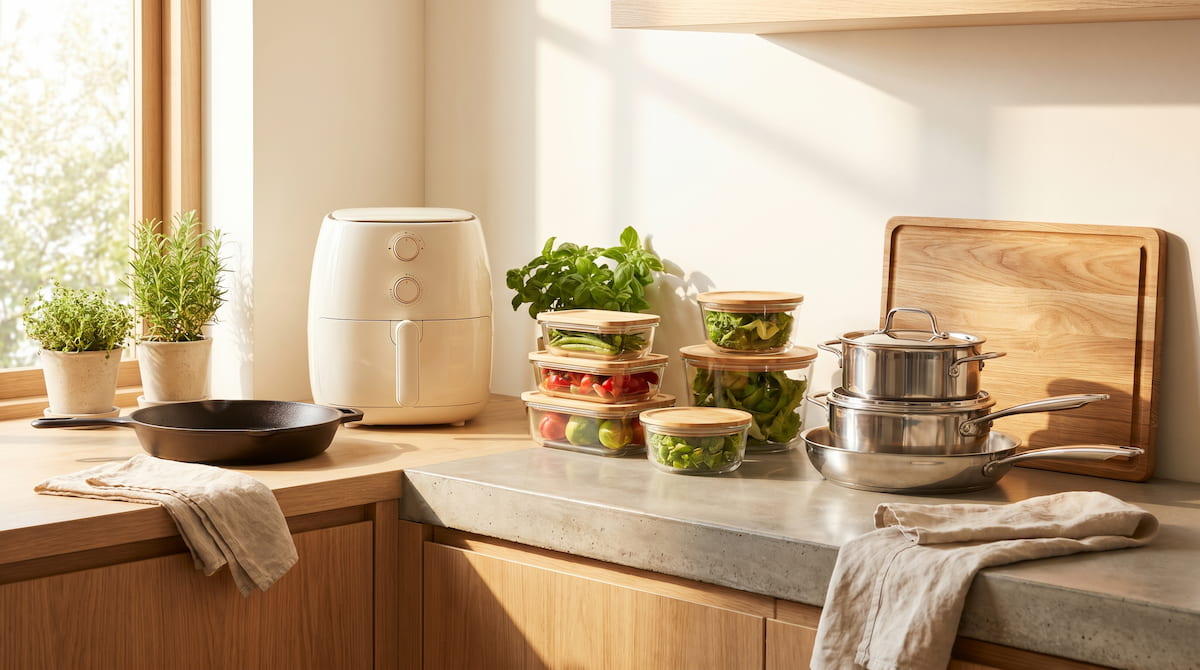
A ceramic air fryer and glass storage containers cover the two highest-impact swaps — and neither requires replacing your entire kitchen at once.
Some of the most effective non-toxic kitchen changes cost nothing and can start today. Stop using metal utensils in any coated cookware — switch to the wooden spoons and silicone spatulas already in your drawer. This single habit extends the life of your current pans and reduces the coating scratch rate that accelerates PFAS release.
Run a new air fryer through an empty burn-off cycle before the first food use — this costs nothing and removes factory residues before they transfer to meals. Open a window during every air fry session — again, free, and it clears any cooking vapor before it concentrates in the kitchen. Let cookware cool before washing — prevents thermal shock that accelerates coating degradation on any pan you haven’t replaced yet.
A Realistic Budget Build Order
For a family working with a limited budget, here’s the order that gives the most safety improvement for the least immediate spending. Start with the ceramic air fryer if you use an air fryer regularly — it covers the highest daily exposure point. Add a cast iron skillet next, which costs less than most ceramic-coated pan alternatives and lasts a lifetime. Replace hot-food plastic containers with a basic glass set — this is often the cheapest item on the list and covers an exposure point that affects every meal stored in the refrigerator.
After those three, the remaining swaps — stainless saucepan, stainless baking sheets, wooden cutting board, silicone utensils — can be added one at a time as budget allows and as existing items wear out. Within six to twelve months of this approach, most families find themselves with a kitchen that’s functionally non-toxic at the highest-exposure points without having spent more than a gradual series of modest purchases.
For the full priority breakdown with more detail on each category, our non-toxic kitchen checklist for families covers every item worth replacing. And for the air fryer specifically, our PFAS-free air fryer guide is the place to start.