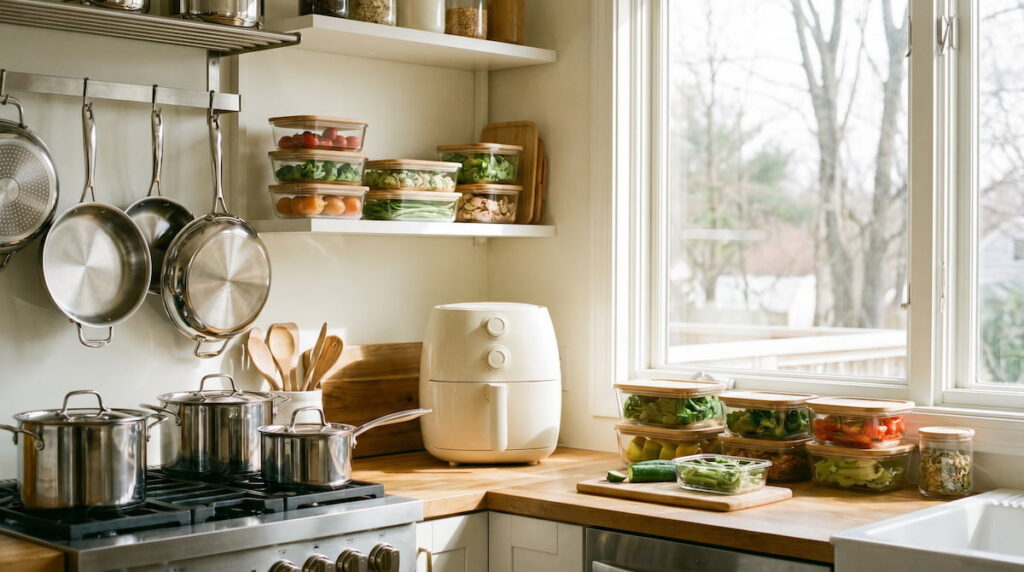
A pfas free kitchen where to start guide — that’s what I needed a couple of years ago when I was overwhelmed by the scope of the problem and unsure whether to begin with the pans, the air fryer, or the storage containers.
What PFAS Are and Why the Kitchen Is the Starting Point
PFAS — per- and polyfluoroalkyl substances — are a family of synthetic chemicals used in nonstick coatings, water-resistant packaging, and a range of consumer products. They don’t break down in the environment or in the body, which is why they’re sometimes called “forever chemicals.” The EPA has identified PFAS compounds as a serious ongoing health concern, linking chronic exposure to immune system effects, hormone disruption, and increased cancer risk in long-term research.
The kitchen is the primary PFAS exposure point for most households because it’s where PFAS-coated surfaces meet high heat — the combination that causes these compounds to off-gas and transfer to food. Reducing PFAS exposure at home starts in the kitchen, and within the kitchen it starts with the items that run hottest and touch food most directly.
PFAS Free Kitchen: Where to Start — The Priority Framework
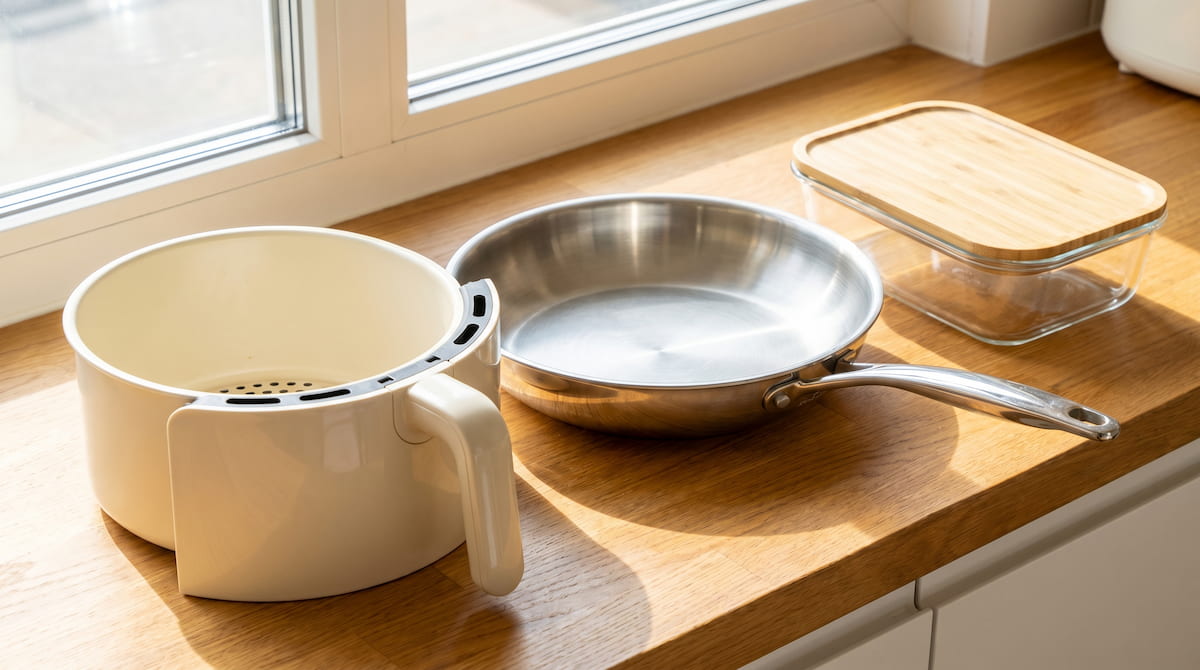
A ceramic air fryer basket, stainless steel pan, and glass storage container cover the three highest-exposure PFAS sources in most family kitchens.
The framework for building a PFAS-free kitchen is straightforward: rank items by two factors — how frequently they contact food, and how hot they get during that contact. The intersection of high frequency and high heat is where PFAS exposure concentrates, and that’s where replacement effort should concentrate too.
Priority 1: The Air Fryer Basket
If you use an air fryer — which most families do, because it’s the fastest weeknight cooking appliance available — the basket coating is the single highest-priority PFAS item in your kitchen. An air fryer basket runs at 350°F to 400°F with food in direct contact for 15 to 20 minutes per cook cycle. A PTFE-coated basket that’s scratched or worn releases fluorinated compounds directly into that contact zone.
The replacement is a ceramic-coated air fryer with no PTFE anywhere on the basket surface. The Ninja AF150AMZ is the model I use and recommend — ceramic basket, compact size for everyday family cooking, dishwasher safe, and priced as a practical household purchase rather than a premium upgrade. This is the first item I’d replace in any household trying to build a PFAS-free kitchen.
Priority 2: The Everyday Frying Pan
The nonstick frying pan is the second item to replace. Used daily at medium-high to high heat for eggs, proteins, and vegetables, a PTFE-coated frying pan accumulates thermal stress and surface scratches that accelerate coating degradation over time. The degradation isn’t always visible from above — it happens on the cooking surface where food contacts the pan directly.
Cast iron is the most cost-effective long-term replacement — no coating at all, lasts indefinitely, and adds a small amount of dietary iron to food cooked in it. Ceramic-coated pans offer a closer transition for households that find cast iron’s learning curve inconvenient. Either eliminates PTFE entirely from the highest-use cooking surface in the kitchen.
For families who also need a larger-format cooking appliance, the Instant Pot Omni Plus covers oven baking, roasting, and air frying in a stainless steel interior with no PTFE coating anywhere on the cooking surfaces — a meaningful upgrade for households that cook at volume.
Priority 3: Hot Food Storage
Plastic food containers used for storing warm food or reheating in a microwave are the third-highest PFAS exposure source in most kitchens. Heat accelerates chemical migration from plastic into food — warm soup stored in a plastic container, a puree reheated in a plastic bowl, leftovers microwaved in a plastic dish. Glass containers eliminate this entirely. Nothing migrates from glass regardless of temperature or how many times you use it.
Replace hot-food plastic containers first — specifically the ones used for soup, leftovers, purees, and microwave reheating. A basic glass container set covers the highest-exposure storage scenario at a low one-time cost.
PFAS Free Kitchen Replacement Roadmap
| Stage | What to Replace | Replace With | PFAS Reduction |
|---|---|---|---|
| Stage 1 | PTFE air fryer basket | Ceramic air fryer (Ninja AF150AMZ) | 🔴 Highest |
| Stage 2 | Nonstick frying pan | Cast iron or ceramic-coated pan | 🔴 High |
| Stage 3 | Plastic hot-food containers | Glass storage containers | 🟠 High |
| Stage 4 | Nonstick saucepan | Stainless steel saucepan | 🟠 Medium-High |
| Stage 5 | Nonstick baking sheets | Uncoated stainless steel | 🟡 Medium |
| Stage 6 | Microwave popcorn bags | Stovetop or silicone popper | 🟡 Medium |
What a PFAS-Free Kitchen Actually Looks Like
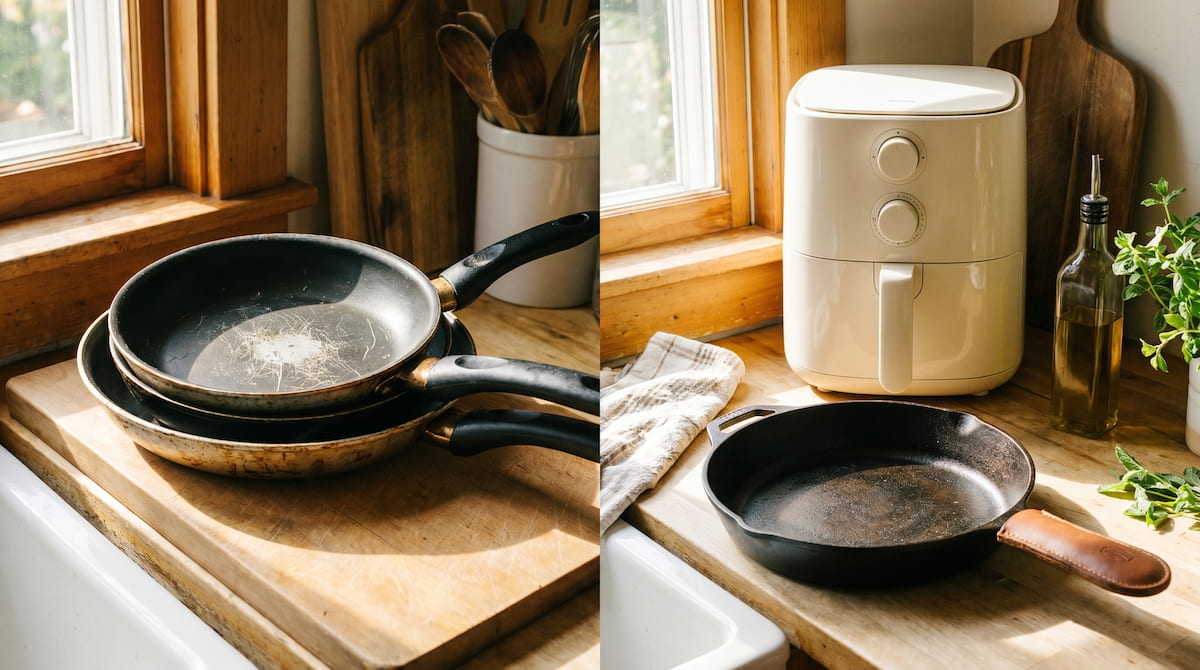
Replacing nonstick cookware with a ceramic air fryer and cast iron skillet is the most impactful two-item swap available for building a PFAS-free kitchen.
A PFAS-free kitchen doesn’t look dramatically different from a standard kitchen. The air fryer on the counter is ceramic instead of PTFE-coated. The frying pan is cast iron or ceramic-coated. The food storage containers are glass instead of plastic. The baking sheets are bare stainless steel. The utensils are silicone or wood. That’s the whole picture — no exotic materials, no specialty stores, nothing that requires a significant lifestyle adjustment.
The cooking results are functionally identical. Cast iron sears proteins better than nonstick. A ceramic air fryer produces the same crispy results as a PTFE-coated one. Glass containers store food identically to plastic ones. The PFAS-free kitchen is not a compromise kitchen — it’s a kitchen where the materials that touch your food at high heat have been chosen with more intention than the defaults.
Where to Start Today
If you cook with an air fryer, start there. Our PFAS-free air fryer guide covers every safe material option and the models worth buying in 2026. If you want to understand the full kitchen picture before making any purchases, our non-toxic kitchen checklist for families covers every swap in priority order. And if budget is the constraint, our guide on how to build a non-toxic kitchen on a budget maps the most cost-effective path through the full replacement list.
The first step is always the same: replace the air fryer basket. Everything else builds from there.