Disclosure: This post contains affiliate links. If you purchase through them, I earn a small commission at no extra cost to you. I only recommend products I personally trust for my family.
Do air fryers release more toxins when old is a question that gets to the heart of why basket material matters so much for families cooking daily. I’m Wook, a bus driver and dad who cooks for my family almost every night. After noticing our old air fryer producing a chemical smell that wasn’t there when it was new, I researched exactly what was happening inside that coating — and what it meant for the food we were eating. Here’s the honest answer.
Do Air Fryers Release More Toxins as They Age?
Yes — but specifically in units with traditional nonstick coatings. The relationship between age and toxin release is not linear and automatic — it depends almost entirely on the coating material and its condition. An air fryer with a degrading PTFE-based nonstick coating releases more chemical compounds as it ages. An air fryer with a ceramic coating or stainless steel interior does not have the same progressive toxin release problem.
What Happens to Nonstick Coatings Over Time
1. PTFE Coating Breakdown
PTFE (polytetrafluoroethylene) — the base material in most traditional nonstick coatings — is stable at normal cooking temperatures when intact. The problem is that PTFE coatings don’t stay intact indefinitely. Heat cycling, cleaning, physical abrasion, and general wear all progressively damage the coating’s molecular structure. As the coating degrades, it begins releasing PTFE particles and decomposition byproducts at increasingly lower temperatures.
According to the U.S. EPA, PFAS compounds — which include PTFE decomposition products — are persistent in both the environment and the human body, with ongoing research into their long-term health effects. An old, degraded nonstick coating produces more of these compounds per cook cycle than a new, intact one.
2. The Scratch-Release Relationship
Every scratch in a nonstick coating creates a new exposure point where the underlying metal meets food and cooking air directly — and where degraded coating material can flake into food. A coating with ten scratches releases more particles than a coating with one scratch. Since scratches accumulate over time with normal use, older nonstick baskets have proportionally more release points than newer ones.
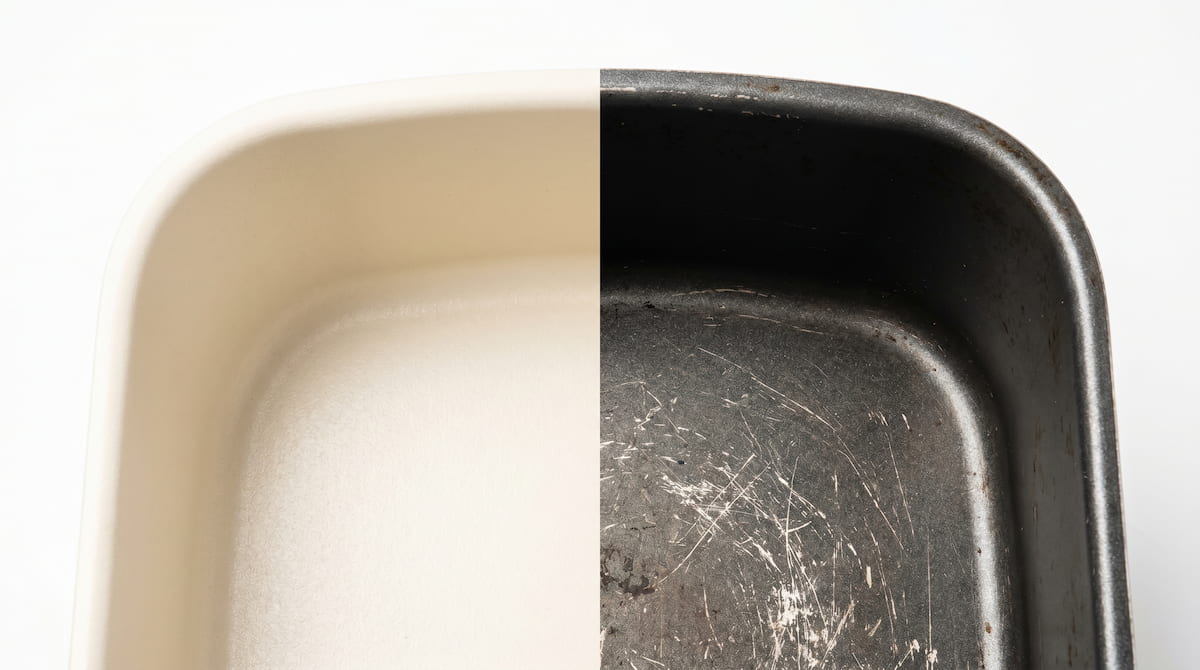
An intact new coating vs a scratched worn coating — the difference in particle and compound release between these two states is significant.
3. Temperature Threshold Reduction
New, intact PTFE coatings begin to break down at temperatures above 500°F — well above normal air fryer operating range. But degraded coatings have a lower breakdown threshold. An old, scratched PTFE coating can begin producing decomposition byproducts at temperatures within normal air fryer operating range — particularly at the 400°F+ settings used for crisping. Age lowers the safety margin that distance from breakdown temperatures provides.
What About Ceramic Coatings and Stainless Steel?
Ceramic coatings present a different aging profile. They don’t contain PTFE or PFAS compounds, so their degradation doesn’t involve the same chemical release pathway. An aging ceramic coating primarily loses its nonstick properties — food sticks more easily — rather than releasing chemical compounds. The safety concern with an aged ceramic coating is more about performance loss than toxin release.
Stainless steel interiors have essentially no coating degradation concern. Stainless steel is chemically inert at air fryer temperatures regardless of age, making it the material that maintains its safety profile longest over time.
Toxin Release Risk by Coating Type and Age
| Coating Type | New Unit Risk | Old/Worn Unit Risk | Primary Concern |
|---|---|---|---|
| Traditional nonstick (PTFE) | Low | High | PTFE particles, PFAS compounds |
| Ceramic coated | Very Low | Low-Medium | Performance loss, not toxin release |
| Stainless steel | Very Low | Very Low | No coating to degrade |
| Budget nonstick models | Medium | Very High | Thin coating degrades rapidly |
How to Tell If Your Air Fryer Is Releasing More Toxins
You can’t directly measure toxin release at home — but these signs indicate a coating is in a state where release is likely:
- Visible scratches exposing metal beneath the coating
- Flaking or peeling coating pieces — stop using immediately
- Chemical or plastic smell during cooking that wasn’t present when new
- Food that tastes off — slightly chemical or metallic
- Discoloration that won’t wash off — indicates coating structure damage

Switching to a PFAS-free ceramic basket eliminates the progressive toxin release risk that comes with aging nonstick coatings.
The Solution: Materials That Don’t Get Worse With Age
The most effective way to eliminate the age-related toxin release problem is to cook with a basket material that doesn’t have a PFAS-containing coating to degrade. Our family made this switch when we replaced our old nonstick unit with the Ninja AF150AMZ ceramic basket — no PTFE, no PFAS concerns, and the aging profile is about performance rather than chemical release.
For the full breakdown of which coating materials are actually PFAS-free: What Is PFAS and Why Does It Matter in Your Air Fryer?
And if your current air fryer is showing the signs of a coating that’s been degrading, this covers whether it’s still safe to use: Is It Safe to Use an Old Air Fryer? (When to Replace)
Bottom Line
Do air fryers release more toxins when old? For traditional nonstick coatings, yes — progressively and measurably as the coating degrades. For ceramic coatings, the aging concern is performance loss rather than toxin release. For stainless steel, age doesn’t change the safety profile at all. The practical implication is straightforward: if you’re cooking daily for a family in a unit with a traditional nonstick coating, age is working against you with every cook cycle. Switching to a ceramic or stainless steel option removes that progressive risk entirely.